|
Industry |
Repeat Purchase Rate Benchmark |
|
Grocery and consumables |
40%+ |
|
Pet supplies |
35–45% |
|
Health and wellness |
30–40% |
|
Beauty and personal care |
25–35% |
|
Fashion and apparel |
20–30% |
|
Electronics and tech |
10–20% |
|
Furniture and home decor |
Below 15% |
How KwikAds helped Shop Unrush boost ROAS by 37% in 3 months
How KwikAds helped Shop Unrush boost ROAS by 37% in 3 months
How KwikAds helped Shop Unrush boost ROAS by 37% in 3 months
How KwikAds helped Shop Unrush boost ROAS by 37% in 3 months
Kwik Engage
What is Repeat Purchase Rate? Formula, Benchmarks and How to Improve This Metric
 06 Jun 2026
 11 Min Read
Parousia leads product marketing strategies at GoKwik, and she is an expert in driving e-commerce optimisation, conversion growth, and innovative GTM strategies. She crafts compelling messaging and creates content pertaining to D2C commerce.
Read this blog on your favourite platform
Customer acquisition cost across Indian ecommerce is rising steadily, making profitability on new customer acquisition increasingly difficult. Repeat purchases change that equation in the brand's favor. Returning customers cost significantly less to convert and spend more per order on average.
Most D2C brands spend more on acquiring new customers than on keeping the ones they already have. This creates a situation where traffic grows while profitability stagnates. Measuring how often customers return to your ecommerce store is the first step toward fixing it.
The repeat purchase rate tracks the share of buyers who return within a specific time period. This metric signals brand loyalty and product-market fit more clearly than acquisition data. A strong repeat purchase rate means your product delivers and your brand stays relevant beyond the first purchase.

What is Repeat Purchase Rate?
Before getting started, it is crucial for you to understand what the repeat purchase rate is in practical terms. It measures the percentage of customers who return to make additional purchases in a set period. It signals customer loyalty and product-market fit for any ecommerce business.
Here is what this metric actually tracks and why it matters for D2C growth.
- Tracks the number of repeat customers returning after their initial purchase, differing from the customer retention rate which measures overall relationship longevity.
- Reflects the combined impact of product quality, post-purchase communication and positive experiences on customer behavior over time.
- Acts as a more actionable ecommerce metric than churn rate for short-term customer retention efforts and strategy decisions.
- Differs from purchase frequency in that it measures whether a customer comes back at all to make additional purchases, not how often they do so.
The Repeat Purchase Rate Formula
The repeat purchase rate formula gives you a measurable ecommerce metric baseline to track and improve customer retention. It needs only two data points pulled from your store analytics dashboard.
What is the Formula for Repeat Purchase Rate?
Most D2C brands use the following RPR formula to quickly determine the repeat purchase rates:
RPR = (Number of customers who made more than one purchase / Total number of customers) x 100
Here,
- Numerator: Count of unique customers who placed two or more orders in the measurement period
- Denominator: Total unique customers who placed at least one order in the same period
Let’s use an example to understand this crucial metric better.
If your store recorded 5,000 unique customers in a quarter and 1,400 of them placed more than one order, your ecommerce repeat purchase rate is 28%. These are your repeat purchase examples in aggregate, the buyers who came back without a paid incentive.
The remaining 72% are one-time buyers, each representing a direct retention growth opportunity. A repeat purchase rate formula result of 28% tells you that 3,600 buyers have not yet returned, and that a modest improvement in that figure has an outsized impact on revenue without additional acquisition spend.
What Time Period Should You Use to Calculate RPR?
Most D2C brands measure the repeat purchase rate formula monthly or quarterly to track retention strategy performance. Monthly windows suit fast-moving consumables because purchase frequency is high and repeat intent surfaces quickly.
Quarterly windows suit fashion and electronics because their purchase cycles are naturally longer than consumable categories. Matching the window to your category's purchase behavior makes the RPR formula result meaningful and actionable.
What is a Good Repeat Purchase Rate by Industry?
Your repeat purchase rate benchmark carries real meaning only when measured against your specific product category rather than broad ecommerce averages.
The average repeat customer rate in ecommerce globally sits between 25% and 30%, but this average masks enormous variation across categories. The repeat purchase rate by industry data above reflects this.
For Indian D2C brands, the repeat customer rate ecommerce benchmark tends to run lower, between 10% and 20%, because loyalty infrastructure and post-purchase communication remain underdeveloped relative to the market's scale.
Why Repeat Purchase Rate Matters More Than Acquisition Metrics
Paid acquisition grabs the attention, but the customer repeat purchase rate determines whether that spend builds a profitable business.
- Most D2C brands over-optimize for first-order conversion while largely ignoring post-purchase behavior and the customer lifetime value those decisions drive.
- Returning customers spend up to 67% more per order on average than first-time buyers, according to Bain and Company customer loyalty research.
- Repeat customers cost significantly less to convert than cold traffic generated through paid digital advertising campaigns and search channels.
- A 5% increase in customer retention can increase overall profits by 25% to 95% over time according to industry research.
- High ecommerce repeat purchase rate reduces dependence on paid acquisition and strengthens overall average order value and margin health for D2C brands.
_1779878176.jpg)
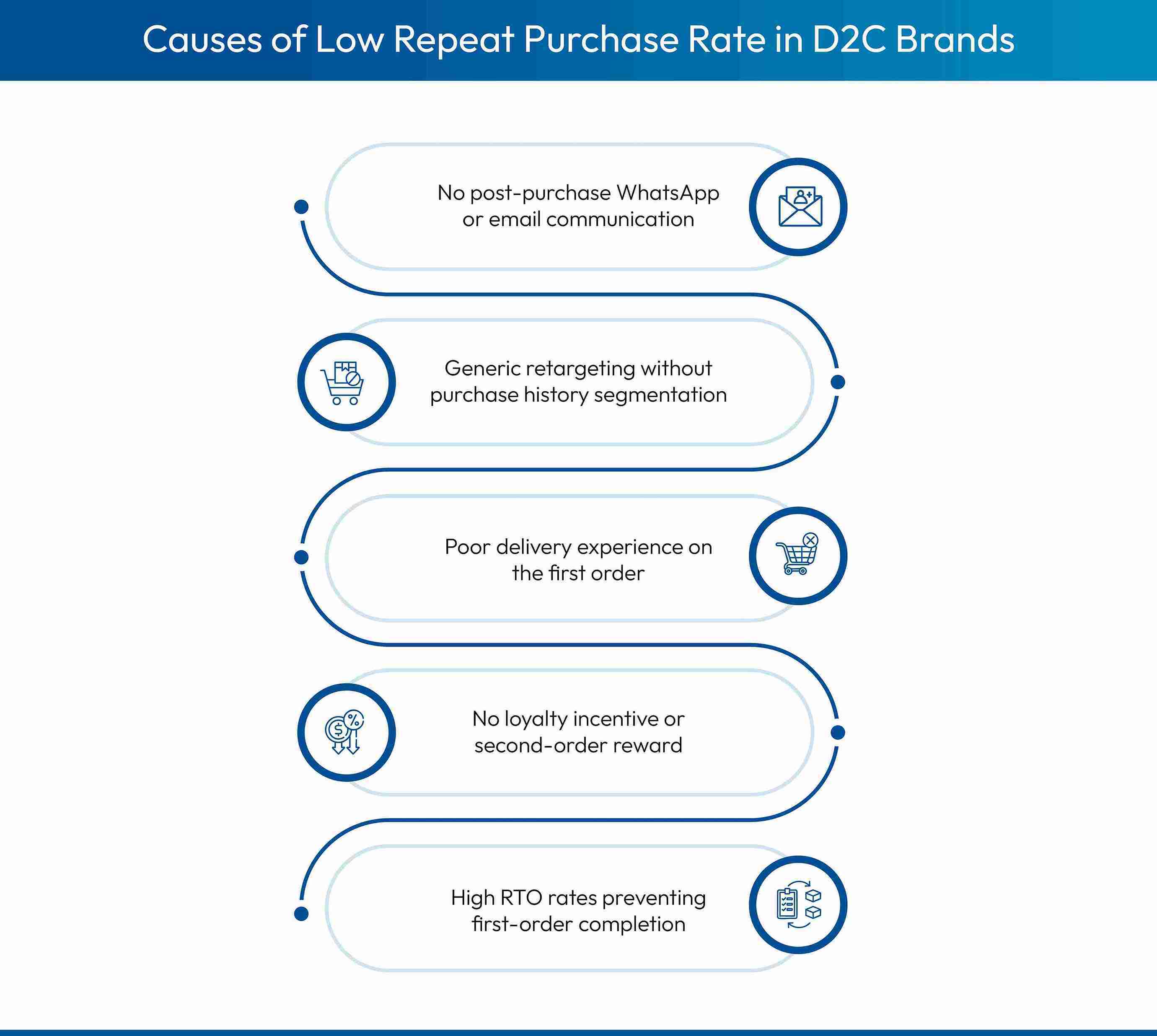
What Drives Low Repeat Purchase Rate for Indian D2C Brands?
Low repeat purchase rate in ecommerce rarely stems from product failure alone. These are the root causes most Indian D2C brands miss during their retention analysis.
- No Post-Purchase Communication: Brands that go silent after shipment lose the peak window for repeat purchase intent. One personalized WhatsApp message post-delivery keeps the brand present when customer engagement matters most.
- Generic Retargeting: Blanket messages sent without purchase history segmentation consistently fail to re-engage lapsed buyers in any category. Customers respond to relevant offers tied to what they already bought, not to mass campaigns with no personalization.
- Poor Delivery Experience: A damaged or delayed first order removes repeat intent regardless of how strong the marketing remains afterward. The physical experience of receiving the product shapes the entire post-purchase relationship and customer satisfaction baseline.
- No Loyalty Incentive: Without a loyalty program or reward structure, first-time buyers have no clear reason to return over a competing brand. A second-order incentive sent post-delivery converts one-time buyers more reliably than later retargeting campaigns do.
- High RTO Rates: Undelivered COD orders erode repeat purchase intent before the customer experiences the product at all. Reducing RTO is the foundation of building a customer retention base that grows and compounds over time.
Proven Strategies to Increase Repeat Purchase Rate
These repeat purchase rate strategies are particularly relevant for Indian D2C brands working with COD-heavy buyer segments and competitive categories.
WhatsApp-Led Post-Purchase Engagement
WhatsApp post-purchase messages deliver the highest customer retention return of any channel for Indian D2C brands. Sending delivery updates and product tips via WhatsApp produces higher second-order rates than email alone. Repeat intent peaks immediately after delivery, which is exactly when WhatsApp reaches buyers most effectively.
Replenishment Reminders Timed to Purchase Cycle
Using purchase data to time replenishment reminders turns the natural purchase-frequency cycle into a consistent retention strategy. A WhatsApp reminder at day 25 of a 30-day consumable converts reorders well above standard broadcast campaigns. Timing each reminder to the buyer's purchase behavior removes all friction from the repeat decision.

First-Order Discount to Second-Order Conversion
A second-order WhatsApp discount sent within 48 hours of first delivery converts one-time buyers at minimal customer acquisition cost. It costs far less than re-acquiring the same shopper through paid advertising channels. Timing this offer to peak customer satisfaction is what makes it convert reliably.
Exclusive Subscriber Access and Early Drops
Giving WhatsApp subscribers early collection access before the general audience builds repeat purchase habit through exclusivity. This shifts the relationship from transactional to aspirational, sustaining customer engagement without requiring discounts. Subscribers tied to early-access opt-ins return more frequently and generate higher average order value per session.
Win-Back Campaigns for Lapsed Buyers
Customers inactive for 60 to 90 days respond well to personalized WhatsApp messages referencing their last purchase. A time-sensitive incentive with product context recovers lapsed buyers well below cold acquisition cost. Targeting buyers by customer retention cohort before 90 days maximizes the recovery rate.

How GoKwik's Product Suite Helps D2C Brands Increase Repeat Purchase Rate?
GoKwik's product suite addresses every touchpoint that shapes customer loyalty and repeat purchasing behavior for Indian D2C brands. Each solution targets a specific post-purchase gap that standard ecommerce tools leave unresolved.
Kwik Engage - Automate Post-Purchase Re-engagement on WhatsApp
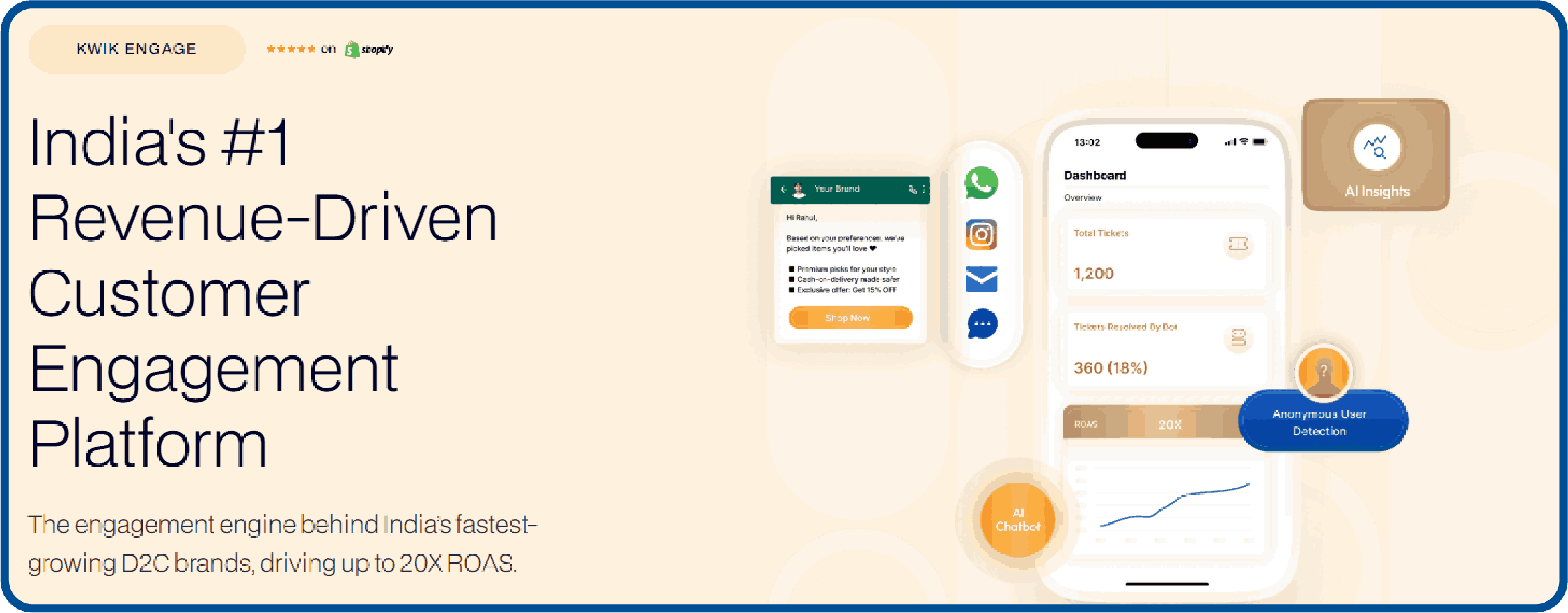
Kwik Engage triggers personalized WhatsApp flows at delivery, covering review requests, cross-sells and replenishment reminders automatically. These flows run without manual effort, keeping the brand present when repeat intent is highest.
Brands using Kwik Engage report a 134% improvement in abandoned cart recovery and measurable gains in repeat purchase rates through post-delivery re-engagement flows. The platform integrates with Kwik Checkout and Return Prime to deliver a unified post-purchase experience across the GoKwik ecosystem.
Kwik Checkout - Remove Friction at the Second Visit
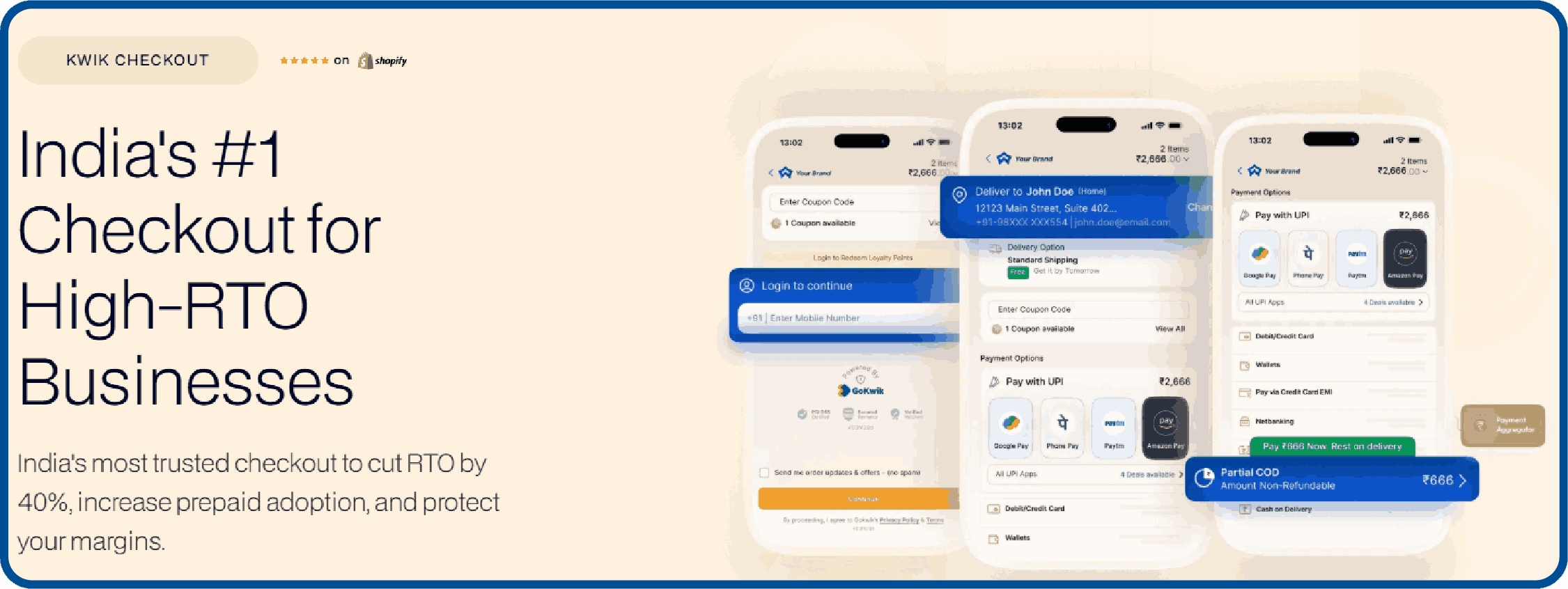
Kwik Checkout pre-fills address and payment details for returning shoppers, compressing second-order checkout to under 10 seconds. A buyer who completes checkout in seconds is far more likely to develop a consistent purchase habit going forward.
Network-level address recognition auto-fills data for over 90% of returning GoKwik shoppers, eliminating form friction that causes second-visit drop-off. This improvement directly improves the results from the repeat-purchase-rate formula by removing the most common obstacle at the checkout step.
GoKwik Cart - Recover Repeat Buyers Who Abandon Mid-Session
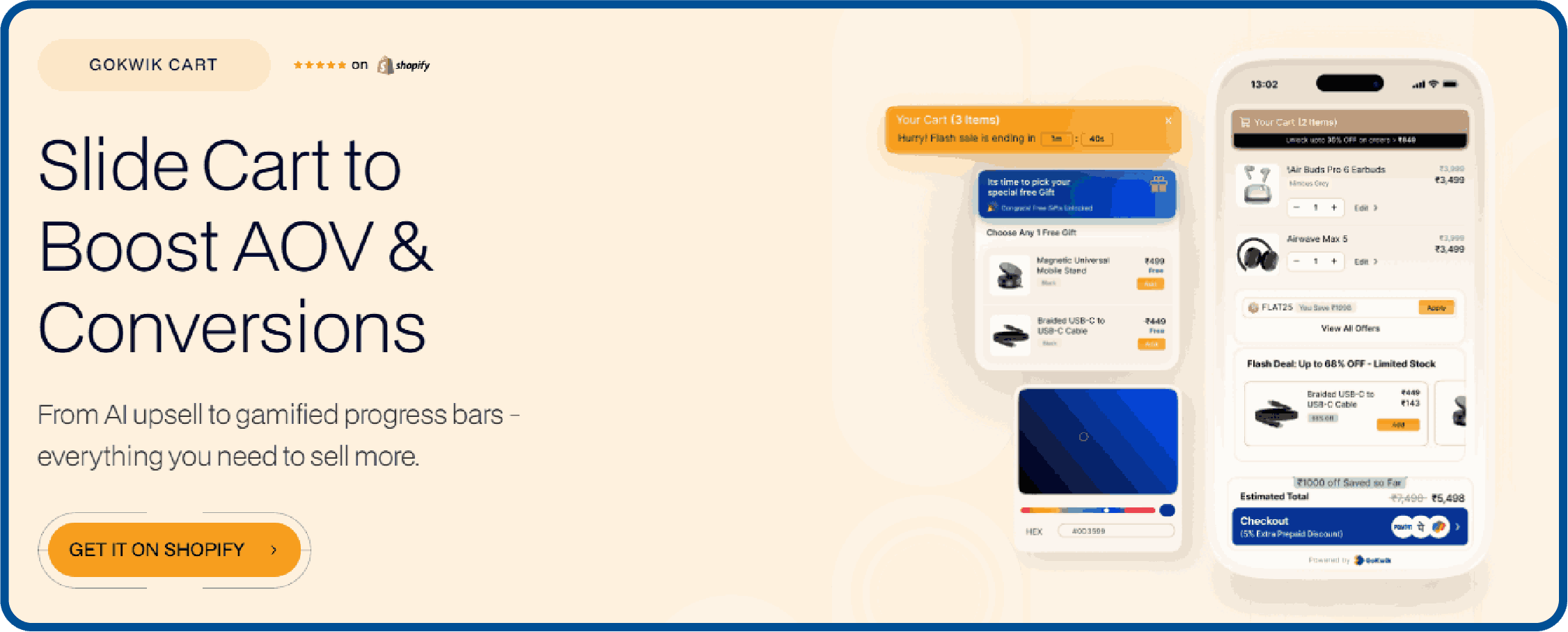
GoKwik Cart surfaces prepaid incentives and upsell nudges within the cart view to convert hesitant returning shoppers before they exit. Prepaid incentives convert COD-intent repeat buyers to prepaid orders, protecting cash flow and reducing RTO simultaneously.
Kwik Engage recovers repeat buyers who exit anyway through automated WhatsApp messages sent within minutes of abandonment. Multi-step recovery flows with optional discount triggers convert these sessions into completed orders without any manual effort from the brand team.
Kwik Pass - Recognize Returning Customers Instantly
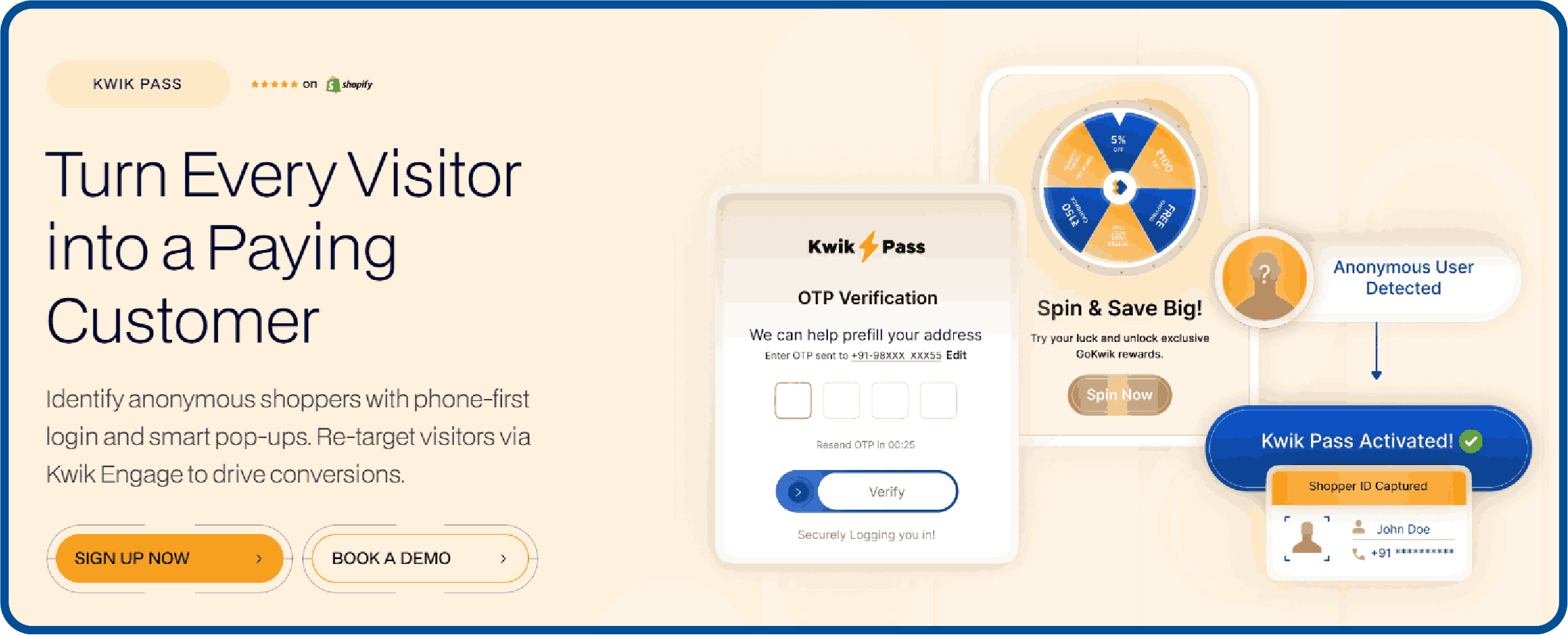
Kwik Pass gives returning shoppers a one-tap SSO login using their mobile number or Truecaller, eliminating the friction of account creation that disrupts repeat purchases. Shoppers across the 200M+ GoKwik network skip login friction and reach the payment screen in seconds.
Removing password and OTP friction on the second visit makes the customer's repeat-purchase experience as smooth as a saved-app checkout. This frictionless recognition measurably increases repeat checkout completion rates across the GoKwik network.
Return Prime - Turn Returns Into Retention Opportunities
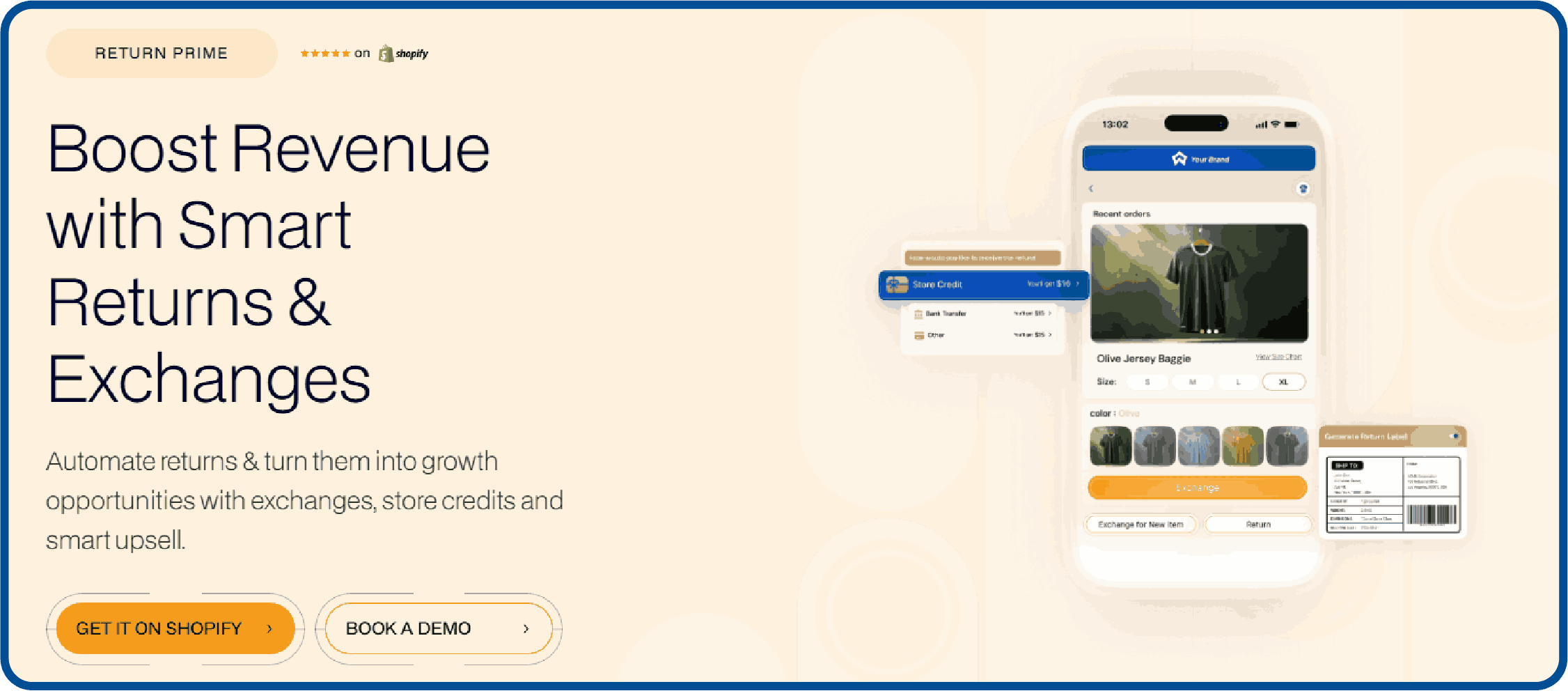
Return Prime converts returns into reasons to shop again through self-service portals and exchange incentives, keeping customers within the brand ecosystem. A buyer who leaves the return experience with store credit has committed to a future purchase rather than a permanent churn event.
Customers who receive store credit instead of refunds stay in the brand ecosystem rather than churn permanently after a negative experience. This single intervention lifts the repeat purchase rate from what would otherwise be permanent churn caused by a poor first-order outcome.
Book a demo with GoKwik today and see how the full suite helps your D2C brand increase repeat purchase rate at scale.
Frequently Asked Questions

AUTHOR
Parousia Khan
Senior Product Marketing Manager @GoKwik