|
Channel |
Traffic Volume |
Conversion Rate |
Best For |
|
Google Organic (SEO) |
Very high, ~40% of all web traffic |
~1.76% (Seer Interactive) |
Discovery, top-of-funnel volume, branded search |
|
Google AI Overviews (AEO) |
Moderate, 35% CTR boost when cited; 61% drop when not |
Comparable to organic |
High-intent informational queries, category authority |
|
ChatGPT / Perplexity / Claude (GEO) |
Low, 0.21% of web traffic today |
10.5–15.9% (Seer Interactive) |
High-intent buyers, mid-funnel research, brand consideration |
How KwikAds helped Shop Unrush boost ROAS by 37% in 3 months
How KwikAds helped Shop Unrush boost ROAS by 37% in 3 months
How KwikAds helped Shop Unrush boost ROAS by 37% in 3 months
How KwikAds helped Shop Unrush boost ROAS by 37% in 3 months
Kwik GEO
GEO vs SEO vs AEO: What Actually Drives Traffic in the AI Search Era?
 10 Jun 2026
 13 Min Read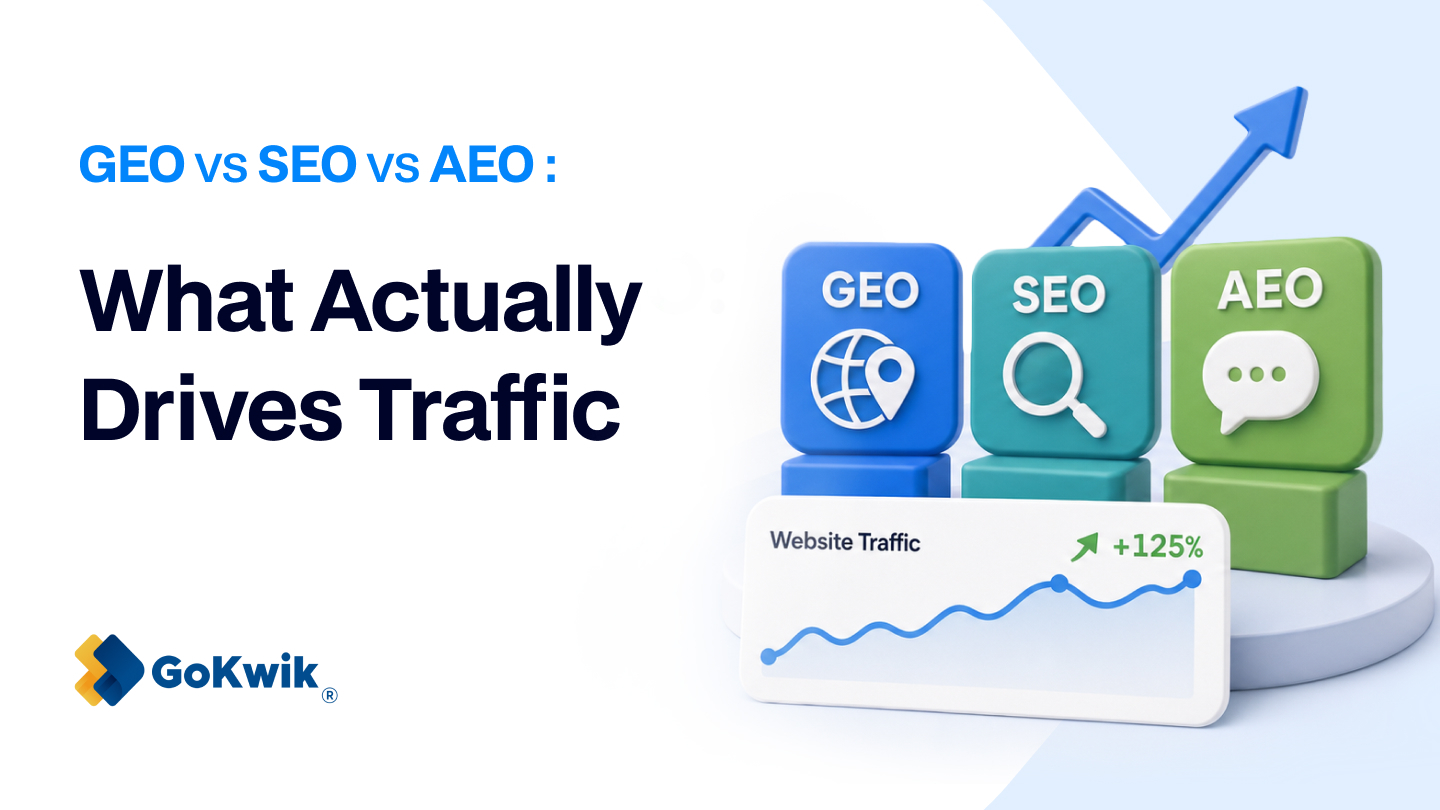
Parousia leads product marketing strategies at GoKwik, and she is an expert in driving e-commerce optimisation, conversion growth, and innovative GTM strategies. She crafts compelling messaging and creates content pertaining to D2C commerce.
Read this blog on your favourite platform
Kwik Summary
Here's the most disorienting thing happening in digital marketing right now: you can be ranking higher than ever on Google, getting the most impressions in Search Console, and still watching your traffic decline.
Here's the most disorienting thing happening in digital marketing right now: you can be ranking higher than ever on Google, getting the most impressions in Search Console, and still watching your traffic decline.
It's a structural shift, and it's playing out across thousands of ecommerce brands right now. A consistent pattern is emerging: more rankings, but less traffic. Impressions trend up. Click-through rates fall sharply. The organic traffic paradox of 2026, where visibility and visits decouple, is the clearest signal that the rules of search have changed.
Three disciplines now govern how brands get discovered online: SEO, AEO, and GEO. Most marketers are operating with only one of them. The brands winning in 2026 are deploying all three as a unified strategy, and they understand exactly what each one does, and doesn't do.
What is the Difference Between SEO, AEO and GEO?
Before defining the three disciplines, it helps to understand the specific shifts forcing ecommerce brands to rethink their discovery strategy entirely.
Google is still dominant, but behaving differently.
Google sends 190 times more traffic to websites than ChatGPT. Google makes up nearly 40% of traffic to websites; ChatGPT accounts for just 0.21%. Traditional SEO is emphatically not dead. But how Google delivers traffic has fundamentally changed.
Google sends 190 times more traffic to websites than ChatGPT. Google makes up nearly 40% of traffic to websites; ChatGPT accounts for just 0.21%. Traditional SEO is emphatically not dead. But how Google delivers traffic has fundamentally changed.
AI Overviews are reshaping the Google click.
Organic CTR drops 61% for queries where an AI Overview is present. But when your brand is cited in the AI Overview, organic CTR is 35% higher. This is the crux of the modern SEO problem: you can rank #1 and receive far less traffic than before, unless you're also the source Google's AI synthesizes from.
Organic CTR drops 61% for queries where an AI Overview is present. But when your brand is cited in the AI Overview, organic CTR is 35% higher. This is the crux of the modern SEO problem: you can rank #1 and receive far less traffic than before, unless you're also the source Google's AI synthesizes from.
AI platforms send small but extraordinarily high-value traffic.
LLM traffic has higher conversion rates than organic traffic: ChatGPT converts at 15.9%, Perplexity at 10.5%, Claude at 5%, and Gemini at 3%. Google's organic conversion rate is 1.76%. That's not a typo. AI referral traffic grew 527% year-over-year in early 2025, and converts at 4.4–5x the rate of traditional organic search.
LLM traffic has higher conversion rates than organic traffic: ChatGPT converts at 15.9%, Perplexity at 10.5%, Claude at 5%, and Gemini at 3%. Google's organic conversion rate is 1.76%. That's not a typo. AI referral traffic grew 527% year-over-year in early 2025, and converts at 4.4–5x the rate of traditional organic search.
The zero-click problem is real and growing.
60% of Google searches now end without any click to a website, up from 58% in 2024. The median publisher experienced a 10% year-over-year traffic decline in the first half of 2025. Your brand's ranking means nothing if the answer is delivered before anyone reaches your link.
60% of Google searches now end without any click to a website, up from 58% in 2024. The median publisher experienced a 10% year-over-year traffic decline in the first half of 2025. Your brand's ranking means nothing if the answer is delivered before anyone reaches your link.
These four dynamics together explain why three distinct disciplines now matter, and why the question is no longer "SEO or AI?" but "how do SEO, AEO, and GEO work together?"
SEO: The Foundation That Still Carries the Most Traffic
Search Engine Optimization remains the highest-volume traffic channel for virtually every ecommerce brand. That isn't changing. Traffic to Google increased slightly in 2025, and overall SEO traffic is down only about 2.5%, not the dramatic collapse many predicted.
What SEO does: It gets your pages ranking in Google's organic results for keywords your customers are actively searching. The mechanics, keyword research, technical site health, backlinks, content relevance, are well understood. For queries without AI Overviews, the first position on Google receives 27.6% of all clicks, and the top three results capture 54.4% of clicks combined.
What SEO doesn't do in 2026: It doesn't ensure your brand appears when a customer asks ChatGPT for a product recommendation. It doesn't guarantee your content gets extracted into a featured snippet or AI Overview. It fact, it doesn't protect your traffic even when you rank.
Pro Tip for E-Commerce Businesses: AI Overviews appear primarily for informational keywords, not commercial or transactional terms. So the AI Overview click squeeze is most severe for top-of-funnel, educational content, while the most valuable commercial queries remain largely unaffected. For a Shopify brand, this means your product and category pages may be safer than your blog. Your "what is" and "how to" content is where the disruption is most acute.
What SEO gets you in 2026: Volume. The highest-traffic channel available. The foundation upon which everything else is built, since 99% of AI Overview citations come from pages already in Google's top 10.
What SEO misses: The growing share of discovery that happens outside Google entirely, and the conversion-quality advantage that comes from being cited by AI systems rather than merely ranked.
AEO: Owning the Answer Within Search
Answer Engine Optimization is the practice of structuring your content to be extracted as a direct answer, in Google's AI Overviews, featured snippets, Bing Copilot, and People Also Ask boxes. It's the bridge between traditional SEO and the AI era.
AEO emerged from the rise of featured snippets and knowledge panels, but its relevance has been dramatically amplified by Google's AI Overviews rollout. The goal is to be the answer rendered at the top of the page, above the blue links, before the user decides whether to click at all.
What makes AEO distinctly valuable: Featured snippets in position zero achieve a 42.9% click-through rate, actually exceeding the standard first organic result's 39.8% CTR. And when your brand is cited in a Google AI Overview, that 61% CTR penalty flips: you gain a 35% CTR advantage over comparable organic results that weren't cited. Being the answer, rather than just ranking near the answer, changes your traffic trajectory entirely.
The mechanics of AEO are specific. You're optimizing for extraction, for a machine to be able to pull a precise, well-formatted answer from your page and present it directly to a user. That requires:
Content that answers questions directly in the opening sentence, not paragraphs in. Structured Q&A formatting with explicit question-based headings. FAQ schema markup that signals to Google exactly which questions your page answers. Short, declarative answers (40–60 words) followed by supporting detail. "People Also Ask" coverage, which requires anticipating the full question cluster around any given topic, not just the primary keyword.
The ecommerce-specific AEO play is often underutilized: 44.2% of all LLM citations come from the first 30% of text, the introduction. Every product category page, every buying guide, every comparison article should open with a direct, structured answer to the primary question driving that query. Most don't.
What AEO gets you in 2026: Ownership of the answer layer within Google, featured snippets, AI Overviews, voice results. Higher CTR when you're cited. Visibility for zero-click queries where ranking without being extracted returns nothing.
What AEO misses: Visibility on platforms outside Google's ecosystem. ChatGPT, Perplexity, Claude, and Gemini have their own citation logic, and AEO alone doesn't address it.
GEO: Being Cited Where Your Customers Now Search
Generative Engine Optimization is the discipline of making your brand visible inside AI-generated answers on platforms like ChatGPT, Perplexity, Claude, and Gemini. It addresses the fastest-growing discovery surface, and the one most brands are completely absent from.
ChatGPT processes 2.5 billion prompts daily, 65% of which qualify as search. It has a 96% lower CTR than Google, which means GEO is less about driving immediate clicks and more about shaping the information environment that AI systems draw from. When ChatGPT recommends your brand to a customer researching their next purchase, that customer may go directly to your website without ever appearing in your referral analytics. The influence is real but the attribution is invisible.
Google AI Overviews heavily favor pages already winning at traditional SEO. ChatGPT draws from a different, broader information ecosystem, and a page that doesn't rank well on Google can still appear in ChatGPT responses if it has strong entity signals, third-party mentions, and structured, citation-worthy content.
Bottom-funnel content like case studies and pricing pages gets the highest AI referral traffic, while top-funnel content (what-is and how-to guides) saw massive drops over the past two years. For ecommerce brands, this is significant: your product-specific, comparison and use-case content is where GEO investment pays off most directly.
What GEO gets you in 2026: Visibility on AI-native platforms where your customers are increasingly beginning their discovery journey. The conversion-quality advantage, AI-referred visitors already understand their need and have often comparison-shopped through conversation before they arrive. Brand authority that compounds: being cited by AI systems transfers credibility.
What GEO misses on its own: Volume. Google still sends 190x more traffic than all AI platforms combined. GEO is the emerging layer; SEO remains the volume engine.
The Traffic Reality: A Brutally Honest Comparison
The data now exists to make this concrete. Here's what each discipline actually drives in 2026:
Where do SEO, AEO and GEO Overlap?
SEO, AEO, and GEO share a lot in common.
GEO requires the technical authority built through SEO, strong domain, quality backlinks, clean technical implementation. The answer-clarity developed through AEO via concise answers, structured data, FAQ formats adds a third layer unique to generative engines: entity authority, citation density, multi-platform distribution, and consensus signals.
GEO requires the technical authority built through SEO, strong domain, quality backlinks, clean technical implementation. The answer-clarity developed through AEO via concise answers, structured data, FAQ formats adds a third layer unique to generative engines: entity authority, citation density, multi-platform distribution, and consensus signals.
The overlapping tactics:
1. Schema markup
2. Clear, direct content structure
3. Fresh, updated content
4. High-quality backlinks from authoritative sources
5. Answer-first writing
1. Schema markup
2. Clear, direct content structure
3. Fresh, updated content
4. High-quality backlinks from authoritative sources
5. Answer-first writing
Where they diverge sharply:
GEO specifically requires multi-platform presence that SEO and AEO don't address at all. Your reviews on Google Shopping, Trustpilot, Reddit discussions about your products, editorial mentions in industry publications, these are invisible to traditional SEO metrics but are primary signals for AI citation systems. Wikipedia and Reddit are among the most frequently cited domains in AI Overviews, AI Mode, and ChatGPT. Being part of the conversations those platforms host is a GEO tactic that has no SEO equivalent.
GEO specifically requires multi-platform presence that SEO and AEO don't address at all. Your reviews on Google Shopping, Trustpilot, Reddit discussions about your products, editorial mentions in industry publications, these are invisible to traditional SEO metrics but are primary signals for AI citation systems. Wikipedia and Reddit are among the most frequently cited domains in AI Overviews, AI Mode, and ChatGPT. Being part of the conversations those platforms host is a GEO tactic that has no SEO equivalent.
What This Means for Ecommerce Brands in Practice
A Shopify fashion brand: Their core product pages for "summer dresses" should be optimized for SEO (ranking), structured for AEO (extractable for Google AI Overviews), and accompanied by third-party reviews, editorial roundup coverage, and Reddit/community discussions that build GEO signals. Each layer serves a different customer in a different discovery moment. The SEO ranker reaches the browser. The AEO-ready snippet captures the Google user who didn't click. The GEO-optimized brand reaches the ChatGPT user who never opened Google.
A D2C skincare brand: Their comparison content ("cruelty-free moisturizer for oily skin") is the highest-GEO-value asset they have, comparison articles account for 32.5% of AI citations, the single largest content category. That same content, structured with explicit Q&A headings and FAQ schema, also captures AEO value. And if it ranks well, it contributes to GEO visibility on Google AI Overviews specifically.
Simply put: Your buying guide is SEO. Your "best X for Y" listicle is GEO. Both benefit from AEO formatting.
How to Run All Three Together?
Start with SEO as the base. Technical health, content depth, domain authority, and backlinks remain the foundation. 99% of AI Overview citations and a significant portion of ChatGPT citations come from pages that have already earned search credibility. Nothing replaces this foundation.
Layer AEO onto your highest-traffic pages. Audit your top 20 pages by organic traffic. Rewrite opening paragraphs to answer the primary query directly in the first sentence. Add FAQ sections. Implement FAQ schema. Reframe H2 and H3 headings as explicit questions. This alone can reverse the CTR decline for queries where you rank but don't get extracted.
Build GEO signals systematically. This is the most different from existing workflows. Expand your review presence on every platform AI indexes. Seek earned media coverage in editorial publications. Create comparison content that positions your brand in category conversations. Monitor your AI citation share monthly across ChatGPT, Perplexity, and Google AI Overviews. Track AI referral traffic in GA4 as a separate channel, even when the numbers are small, the trend line matters.
Measure differently. SEO KPIs are rankings, organic traffic, bounce rate, and conversions. AEO KPIs are featured snippet wins, voice search visibility and People Also Ask appearances. GEO KPIs are mentions in generative AI responses, brand accuracy in AI answers and authority indicators like domain mentions and backlinks from authoritative sources. All three dashboards now belong in your monthly review.
The Honest Bottom Line
The question "which one drives traffic?" doesn't have a clean answer, because each discipline serves a different part of how your customers now discover products.
SEO drives the most traffic, full stop. AEO captures the answer layer within that traffic and protects your CTR as Google continues deploying AI Overviews. GEO builds presence on the platforms where discovery is growing fastest, and delivers visitors who convert at 5–9x the rate of anyone else.
Companies implementing all three optimization approaches achieve 3.8x more discovery touchpoints and 2.4x better brand recall compared to SEO-only strategies. The brands that treat these as competing priorities, choosing to focus on one, will win one channel and lose the others. The brands that integrate all three into a single content and distribution system will own discovery across every surface where their customers are looking.
The window to build that integrated presence before competitors do is open right now. As of early 2026, 47% of brands still lack a deliberate GEO strategy. Most have no systematic AEO approach beyond basic schema. The first-mover advantage in AI search compounds, because being cited builds the authority that earns future citations. Starting now isn't early, it's on time.
Try Kwik GEO to see exactly where your brand stands across all three channels, and what it takes to close the gaps.
Frequently Asked Questions
1. Is SEO still worth it for Shopify brands when AI is taking over search?
1. Is SEO still worth it for Shopify brands when AI is taking over search?
Yes. Google still drives nearly 40% of all web traffic, sending 190x more visitors to websites than ChatGPT. For Shopify brands specifically, the AI Overview disruption is mostly concentrated on informational blog content, not on product and category pages.
2. What kind of content should a Shopify brand create to show up in ChatGPT and Perplexity?
2. What kind of content should a Shopify brand create to show up in ChatGPT and Perplexity?
Comparison content is your highest-leverage asset as it accounts for 32.5% of all AI citations. Beyond format, AI systems also draw heavily from third-party sources: reviews on Trustpilot, Reddit discussions about your products, and editorial mentions in industry publications.
3. What is the actual difference between AEO and GEO?
AEO (Answer Engine Optimization) is about getting extracted inside Google through featured snippets, AI Overviews, People Also Ask boxes. You're optimizing for Google's machines to pull a clean answer from your page. GEO (Generative Engine Optimization) is about earning citations on platforms outside Google entirely ie. ChatGPT, Perplexity, Claude, Gemini. One is a formatting and structure play within Google. The other is an ecosystem and authority play across the entire web.
4. How do I know if my Shopify brand is already showing up in AI search results?
The simplest starting point is manual: search for your category in ChatGPT, Perplexity, and Google AI Overviews using the prompts your customers would actually use. Note whether your brand appears, how accurately it's described and whether your competitors are getting cited instead of you. For systematic tracking, Kwik GEO shows you exactly where your Shopify brand stands across all three channels ie. SEO, AEO, and GEO.

AUTHOR
Parousia Khan
Senior Product Marketing Manager @GoKwik