|
RTO Rate |
Status |
|
Under 10% |
Strong: Well-managed COD risk |
|
10% to 15% |
Acceptable: Room for improvement |
|
15% to 25% |
Elevated: Systemic issues present |
|
Above 25% |
Critical: Immediate intervention needed |
How KwikAds helped Shop Unrush boost ROAS by 37% in 3 months
How KwikAds helped Shop Unrush boost ROAS by 37% in 3 months
How KwikAds helped Shop Unrush boost ROAS by 37% in 3 months
How KwikAds helped Shop Unrush boost ROAS by 37% in 3 months
Kwik Engage
How to Reduce RTO in e-commerce: A Complete Guide for Indian D2C Brands
 06 Jun 2026
 15 Min Read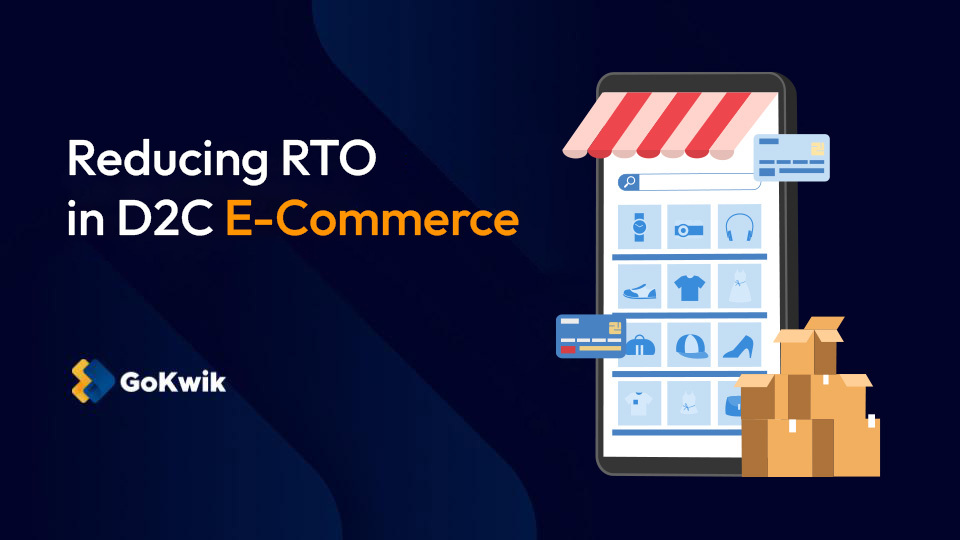
Atul leads marketing at GoKwik, championing D2C brand building, growth strategies, scalable GTM for e-commerce, and data-driven customer acquisition. A former Amazon leader and IIFT MBA alumnus based in Bengaluru, he brings 15+ years scaling business across e-commerce, and fintech.
Read this blog on your favourite platform
COD orders in Indian e-commerce see RTO rates of nearly 26%, compared to less than 2% for prepaid orders. High RTO costs compound fast across forward shipping, reverse logistics and operational costs that land on the brand regardless of whether revenue is recovered.
Reducing RTO requires looking at the entire order journey. Warning signs appear before dispatch. Identifying and acting on these pre-dispatch signals helps prevent losses. Brands with access to an end-to-end view are better positioned to protect margins and avoid constant cash pressure.
This guide covers what causes high return-to-origin rates and how to reduce RTO in e-commerce using proven strategies.

What Is RTO in e-commerce and How Is It Calculated?
RTO (Return to Origin) is when a dispatched order returns undelivered to the warehouse. Each event creates double logistics costs, wasted packaging, QA expenses, and zero revenue. High RTO rates are a direct threats to cash flow and profit margins for D2C brands offering COD.
Here is the formula to calculate RTO:
RTO Rate = (RTO Orders / Total COD Orders Dispatched) x 100
Let’s understand the calculation with the help of an example.
If a brand dispatches 1,000 COD orders in a month and 250 return undelivered, the RTO rate is 25%. Each of the 250 orders represents forward shipping costs, reverse logistics fees and blocked inventory with zero revenue.
RTO is different from customer-initiated returns (RTV) in a fundamental way. It happens before or at the delivery stage, while RTV happens after the customer accepts the product, pays for it, and then feels unsatisfied with the purchase.
RTO Rate Benchmarks for Indian D2C Brands
The average RTO rate in Indian e-commerce sits between 20-25%, going up to 40% in high-risk product categories and pin codes.
Here are some RTO benchmarks to help you assess your current position:
What Causes High RTO Rates for D2C Brands in India?
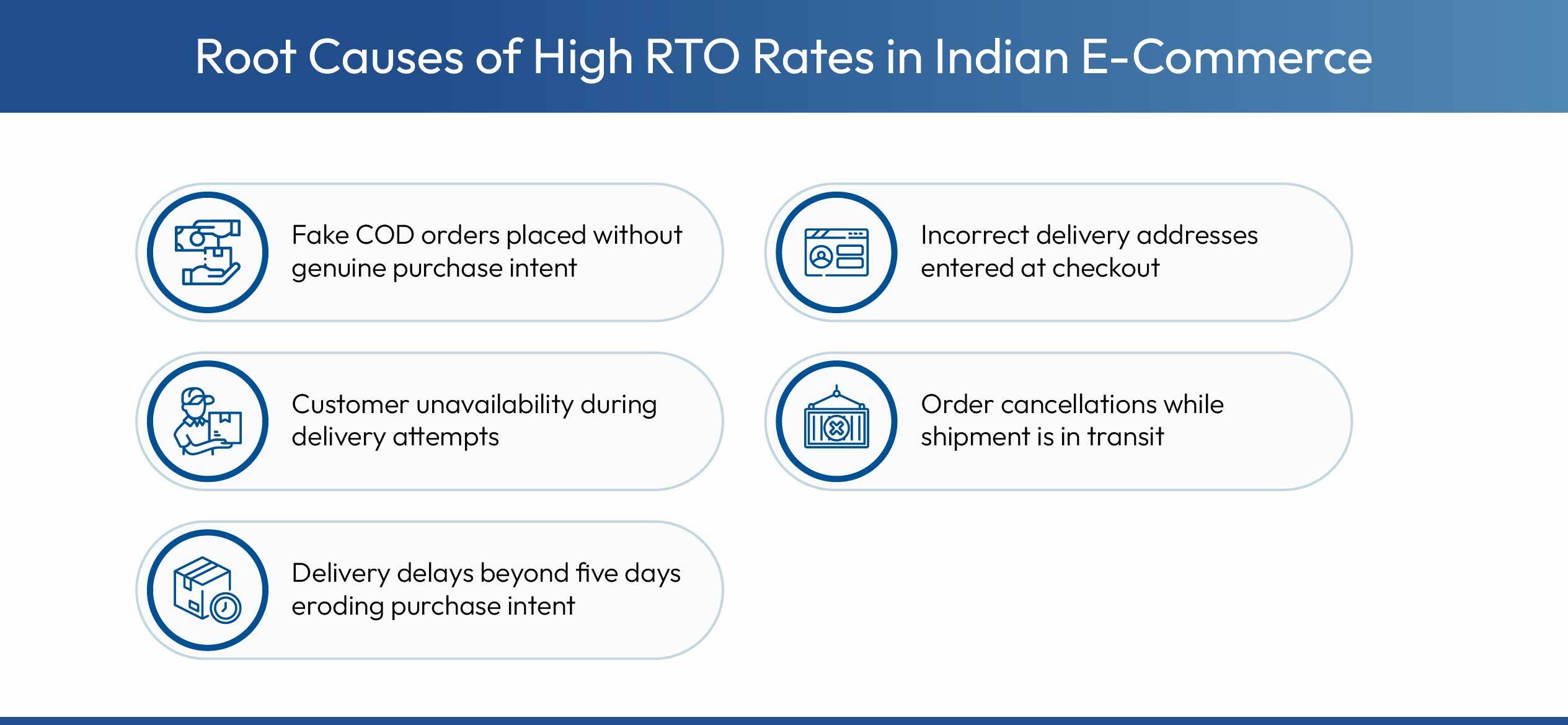
High RTO rates rarely have a single root cause. They accumulate across pre-dispatch and post-dispatch stages, and addressing only one stage consistently leaves significant RTO volume unresolved.
Pre-Dispatch Causes
- Fake or low-intent COD orders placed by shoppers who have no genuine plan to accept delivery when the package arrives.
- Incorrect or incomplete address details entered at checkout cause a significant share of failed delivery attempts across all categories.
- Fraudulent orders involving deliberate misuse, often originating from high-risk pin codes or repeat offenders.
Post-Dispatch Causes
- Customer availability issues during delivery windows result in missed attempts that accumulate into undeliverable orders over multiple days.
- Delivery delays beyond five days measurably erode purchase intent, with orders delivered in one to two days showing 22% RTO versus 35% for shipments delayed beyond five days.
- Delivery refusal at the door due to changed intent or price sensitivity produces RTO events that no amount of post-dispatch communication can prevent once they occur.
- Order cancellations made while the shipment is already in transit force the courier to return the parcel at full reverse logistics cost to the brand.
How to Diagnose Your RTO Problem Before Choosing Solutions
Most brands start solving RTO by implementing tools without understanding which RTO causes the most losses. A brand losing 60% of RTO volume to delivery delays will not see improvement from address validation tools, no matter how well those tools are implemented.
Run this diagnostic before selecting RTO reduction strategies:
Step 1: Classify your last 100 RTO orders by cause
Pull your last 100 RTO orders from your logistics dashboard. Categorize each by the NDR reason code or courier remarks:
- Fake/unverified orders (customer unreachable, phone switched off at first attempt)
- Address issues (incomplete address, wrong pin code, landmark missing)
- Customer unavailability (multiple failed delivery attempts, customer not home)
- Delivery delays (order placed >5 days before delivery attempt)
- Explicit cancellation (customer refused at door, cancelled while in transit)
Step 2: Calculate cost per RTO cause
For each category, multiply the number of RTO events by your average RTO cost per order (forward logistics + reverse logistics + operational costs). This shows you where the largest losses concentrate.
Step 3: Match causes to intervention points
- Fake/unverified orders → Solve at order placement with COD verification
- Address issues → Solve at checkout with address validation and autocomplete
- Customer unavailability → Solve post-dispatch with proactive delivery communication
- Delivery delays → Solve with logistics partner SLA negotiation or partner switching
- Explicit cancellation → Solve at checkout with prepaid conversion incentives
If the maximum of your RTO volume comes from fake orders but you have no COD verification in place, that is your highest-ROI starting point. If the maximum comes from delivery delays, investing in checkout tools may not move the metric.
The Real Cost of RTO for D2C Brands
Every RTO event carries costs that extend well beyond the failed delivery fee. Here is what each undelivered COD order costs your brand:
- Each forward shipment incurs a logistics cost that the brand pays whether the order is delivered or returned to the warehouse.
- Reverse logistics fees layer on top of the forward cost, meaning every RTO event generates double the shipping expense with zero recovered revenue.
- Inventory tied up in transit and post-return processing sits unavailable for resale, creating a hidden drag on inventory management and working capital cycles.
- COD orders take 15 days to settle under standard logistics agreements. RTO recovery takes even longer, compressing cash flow for fast-growing brands.
- Fashion and apparel return rates range between 25% and 40%, the highest of any category, making return rate in this vertical a direct business survival problem.
The total cost of every RTO event can be calculated using this formula:
Total RTO Cost = Forward Logistics + Reverse Logistics + Operational Costs + Potential Inventory Damage.
For a ₹1,000 order, this formula typically produces a ₹200 to ₹250 loss per event. At 500 RTO events per month, that translates into ₹1 lakh to ₹1.25 lakh in pure monthly losses before accounting for the opportunity cost of blocked inventory or the impact on brand reputation with delivery partners.

Proven Strategies to Reduce RTO in e-commerce
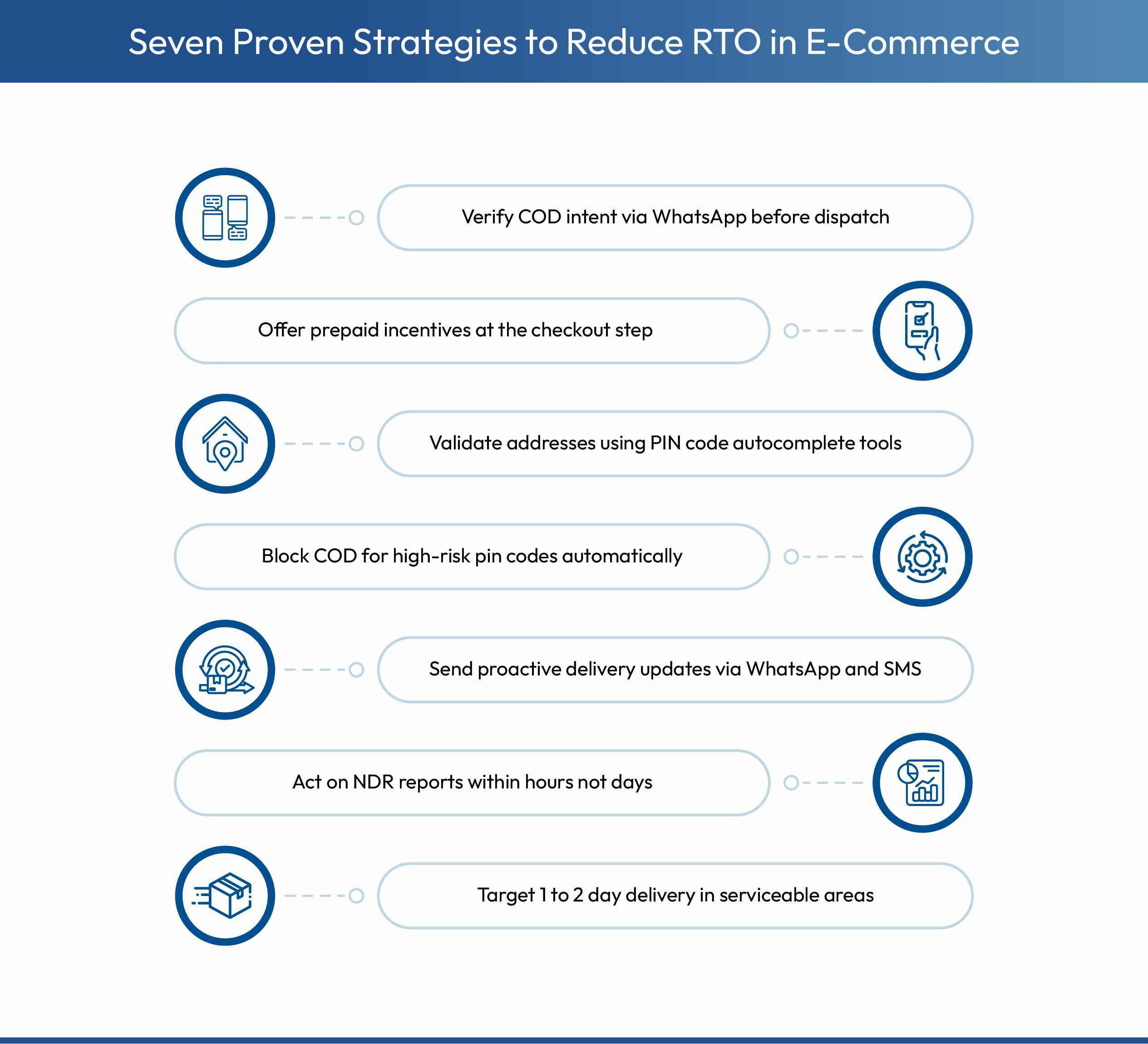
Brands that consistently achieve lower return rates apply these strategies across the entire order journey, not just at the dispatch stage.
COD Order Verification via WhatsApp or IVR
Sending an automated WhatsApp confirmation to every COD buyer immediately after placing the order verifies purchase intent before the brand incurs any shipping costs. This single step eliminates a measurable share of fake and low-intent COD orders before dispatch and is one of the most cost-effective RTO reduction strategies available.
How to implement:
- Set up automated WhatsApp Business API integration with your order management system.
- Send confirmation within 5 minutes of order placement (response rates drop 40% after 30 minutes).
- Include order summary, delivery timeline, and one-tap confirmation button
- Auto-cancel unconfirmed orders after 2-4 hours (configurable based on your dispatch SLA).
- Track confirmation rates by pin code and product category to identify patterns.
Prepaid Conversion Incentives at Checkout
Surfacing a small prepaid discount or benefit at the payment step shifts COD-intent buyers to prepaid orders, which carry a minuscule RTO rate compared to COD orders. This is the single highest-impact lever available for brands that want to reduce RTO in e-commerce at the source.
How to implement:
- Add a prepaid discount banner (5-10% off or free shipping) visible only when COD is selected.
- Test discount threshold: start at 10%, reduce to 5% if conversion holds.
- Position the offer immediately above or below the COD radio button.
- Track prepaid conversion rate by discount percentage and product category.
- A/B test messaging: "Save ₹50 + faster delivery" vs "Get 10% off prepaid orders".
Address Verification at Checkout
Mandatory phone number fields, PIN code validation, and address autocomplete during the checkout process reduce failed delivery attempts caused by incomplete or inaccurate address details. Improving address verification at entry eliminates a class of RTO events that no post-dispatch tool can resolve afterward.
How to implement:
- Integrate Kwik Pass, Google Maps API or equivalent address autocomplete at the address field.
- Make landmark field mandatory (not optional) for pin codes with >20% address-related NDR.
- Validate phone numbers for correct digit count and remove spaces/special characters automatically.
- Show pin code serviceability status in real-time (serviceable vs non-serviceable vs high-RTO zone).
- Block checkout if address contains obvious errors (missing house number, incomplete pin code).
Risk-Based COD Blocking
Using historical customer data and pin codes intelligence to restrict COD for flagged profiles removes high-risk orders from the prepaid vs COD decision entirely. Brands applying predictive analytics to order scoring consistently report measurable improvements in first-attempt delivery success rates across serviceable areas.
How to implement:
- Export last 6 months of RTO data and flag pin codes with >35% RTO rate.
- Block COD for first-time customers in flagged pin codes (offer prepaid only).
- Maintain a blacklist of phone numbers with 2+ previous RTO events in your system.
- Allow COD only for repeat customers with verified delivery history in high-risk zones.
- Review and update pin code risk scores monthly based on rolling 90-day RTO data.
Proactive Delivery Communication
Sending WhatsApp and SMS shipment updates at every stage of transit reduces delivery failures caused by customer unavailability or surprise delivery windows. Proactive measures like pre-delivery notification with a two-hour delivery window improve customer availability and first-attempt success rates measurably.
How to implement:
- Send an order confirmation message immediately after dispatch with a tracking link.
- Send an "out for delivery" message 2-4 hours before the delivery window with the delivery agent contact.
- Include interactive buttons: "Reschedule delivery" and "Update delivery address".
- Send a delivery slot reminder 30 minutes before expected arrival time.
- Track message delivery rates and response rates by courier partner and pin code.
NDR Management Automation
Acting on non-delivery reports within hours rather than days dramatically reduces the share of NDR orders that convert into full RTOs. Delivery agents who receive reattempt instructions within four hours of a failed attempt recover a significantly higher share of orders than those waiting for next-day system updates.
How to implement:
- Set up real-time NDR alerts from your logistics partner (API integration or daily report automation).
- Create automated WhatsApp flow: NDR triggered → message sent within 2 hours asking for reattempt confirmation.
- Offer 3 options: confirm reattempt, reschedule delivery, cancel order (with prepaid refund if applicable).
- Route confirmed reattempts back to courier partner within 4 hours of NDR.
- Track NDR-to-delivery conversion rate by response speed (2-hour vs 24-hour response).
Faster Dispatch and Delivery
Targeting one-to-two-day delivery windows in serviceable pin codes protects purchase intent before delivery delays give the buyer time to change their mind or find a competing product. Delivery times under 48 hours correlate directly with lower RTO rates across all product categories in Indian e-commerce data.
How to implement:
- Negotiate same-day or next-day pickup SLAs with logistics partners for Tier 1/2 cities.
- Set internal dispatch SLA: orders placed before 2 PM dispatch same day.
- Prioritize express courier partners for pin codes within 500km of your warehouse.
- Track delivery speed by pin code cluster and identify zones where 3+ day delivery is unavoidable.
- Consider regional inventory placement if 40%+ of your orders come from a specific metro cluster.
How GoKwik Helps D2C Brands Reduce RTO at Scale
_1779878752.png)
Most D2C brands stitch together point solutions for RTO reduction: one tool for address validation, another for WhatsApp messaging, a third for checkout optimization. This creates two problems that prevent scale.
First, point solutions lack cross-stage visibility. A checkout tool cannot see post-dispatch delivery data, so it cannot learn which pin codes convert NDR to RTO at high rates. Without feedback loops, it keeps approving risky orders.
Second, point solutions cannot share network intelligence. A brand processing 500 orders monthly has limited fraud pattern data. A network processing 50,000+ daily orders across thousands of brands detects high-risk signals no single brand would see.
GoKwik's integrated platform solves both problems with network-level intelligence built for Indian D2C e-commerce:
- Kwik Checkout with RTO Intelligence: Kwik Checkout scores every COD order in real time using GoKwik's network data across thousands of D2C brands, applying over 70 active interventions to flag and manage high-risk orders. It restricts COD for identified risk profiles and surfaces prepaid incentives at the payment step, converting COD-intent buyers at the source before dispatch costs are incurred.
- Kwik Engage for COD Verification and Prepaid Nudges: Kwik Engage sends automated WhatsApp order confirmation messages to every COD buyer immediately after placement. It verifies intent through a natural conversation before the brand dispatches the shipment. Kwik Engage also runs post-dispatch delivery update flows that keep buyers informed at every transit stage, reducing delivery failures caused by customer unavailability or surprise delivery windows.
- GoKwik Cart for Prepaid Conversion: GoKwik Cart surfaces prepaid incentives directly within the cart view before the buyer reaches the payment step, converting COD-intent shoppers to prepaid earlier in the funnel. Converting at the cart stage is lower-friction than converting on the payment screen because the buyer has not yet committed to a payment method.
- Kwik Pass for Address Accuracy: Kwik Pass pre-fills verified address and contact details for returning shoppers across the GoKwik network, eliminating the incorrect address details that cause a significant share of failed first delivery attempts. When a shopper's address is verified at the network level rather than entered manually, the address verification problem is solved before the order is ever placed.
- Return Prime for Post-RTO Recovery: Return Prime converts unavoidable returns into exchange or store credit outcomes, reducing the revenue loss per RTO event and retaining the customer within the brand ecosystem. A buyer who accepts store credit instead of a cash refund has committed to a future purchase. This preserves customer loyalty and customer trust that a straightforward refund will permanently end.
Book a demo with GoKwik today and see how the full product suite helps your D2C brand reduce RTO in e-commerce at scale.
Frequently Asked Questions

AUTHOR
Atul Bansal
Head of Marketing