Your 2026 D2C Calendar mapped day by day - Powered by real data from India’s biggest D2C shopping network
Your 2026 D2C Calendar mapped day by day - Powered by real data from India’s biggest D2C shopping network
Your 2026 D2C Calendar mapped day by day - Powered by real data from India’s biggest D2C shopping network
Your 2026 D2C Calendar mapped day by day - Powered by real data from India’s biggest D2C shopping network
Kwik Engage
24 Types of Emails Every D2C E-Commerce Brand Should Send
 15 Apr 2026
 14 Min Read
Atul leads marketing at GoKwik, championing D2C brand building, growth strategies, scalable GTM for e-commerce, and data-driven customer acquisition. A former Amazon leader and IIFT MBA alumnus based in Bengaluru, he brings 15+ years scaling business across e-commerce, and fintech.
Read this blog on your favourite platform
Most D2C brands send emails. But few send the right types of emails, at the right moment, to the right customer.
That gap is costing you revenue.
Email remains the highest-ROI channel in e-commerce today. The global average return is $10 for every $1 spent. A well-run email program consistently contributes to total store revenue.
But here's what most guides won't tell you: The brands capturing that outsized return are not sending more emails, they are sending the right types of emails, triggered by real shopper behavior.
This guide breaks down all 24 types of emails your D2C brand should send. We have organized them across five stages of the customer lifecycle, so you know not just what to send, but when and why. Whether you are just setting up your first flows or auditing a mature program, this is your blueprint.

Essential Transactional and Lifecycle Emails for D2C Growth
Every D2C brand needs these automated flows to maintain operations and capture immediate revenue. We have organized these 24 email types according to the customer lifecycle.
Category 1: Essential Transactional and Operational Emails
These emails form the backbone of your store operations and build fundamental trust with customers. They are triggered automatically and carry some of the highest open rates of any email type because customers actively look for them.
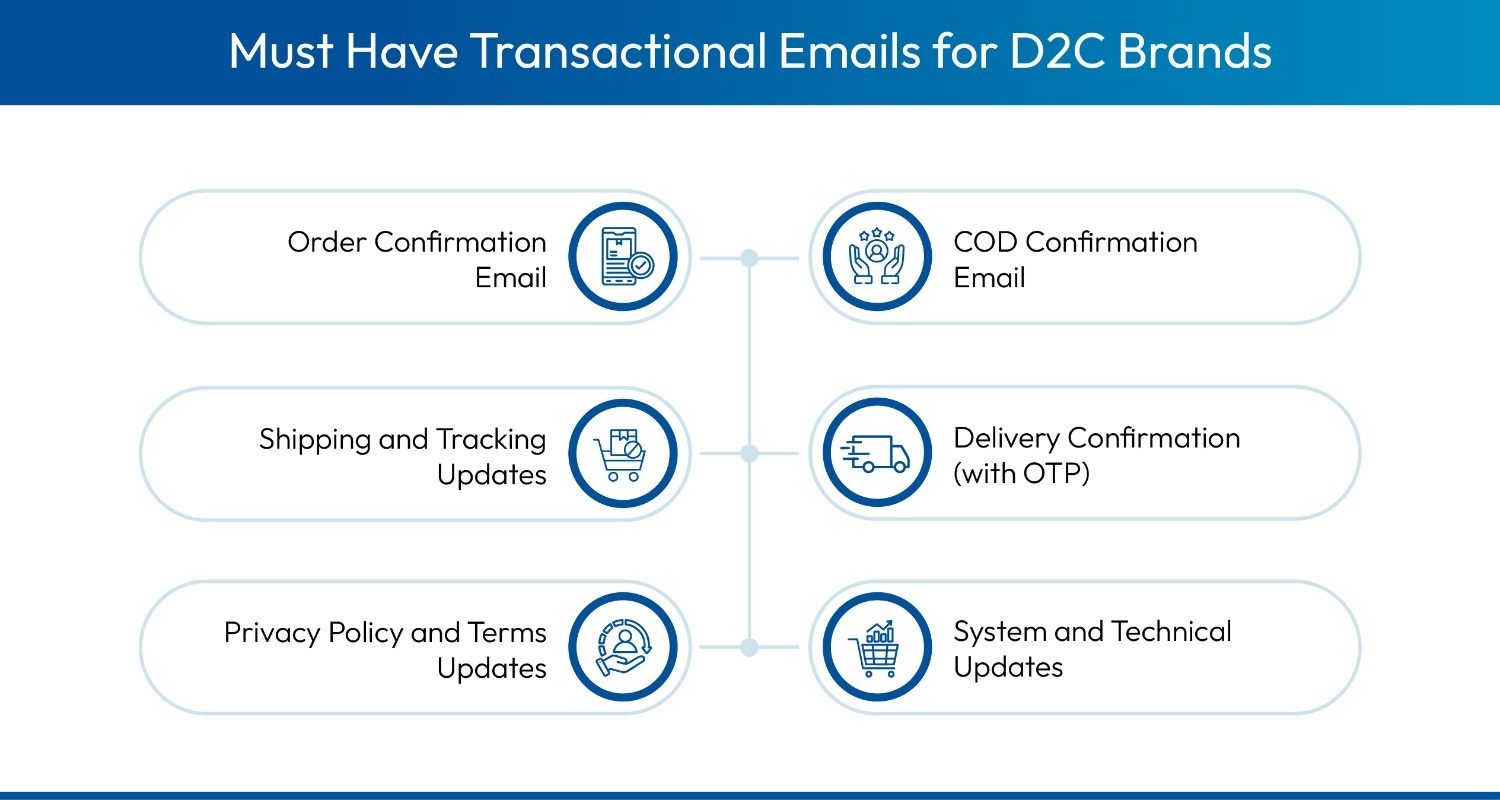
1. Order Confirmation Email
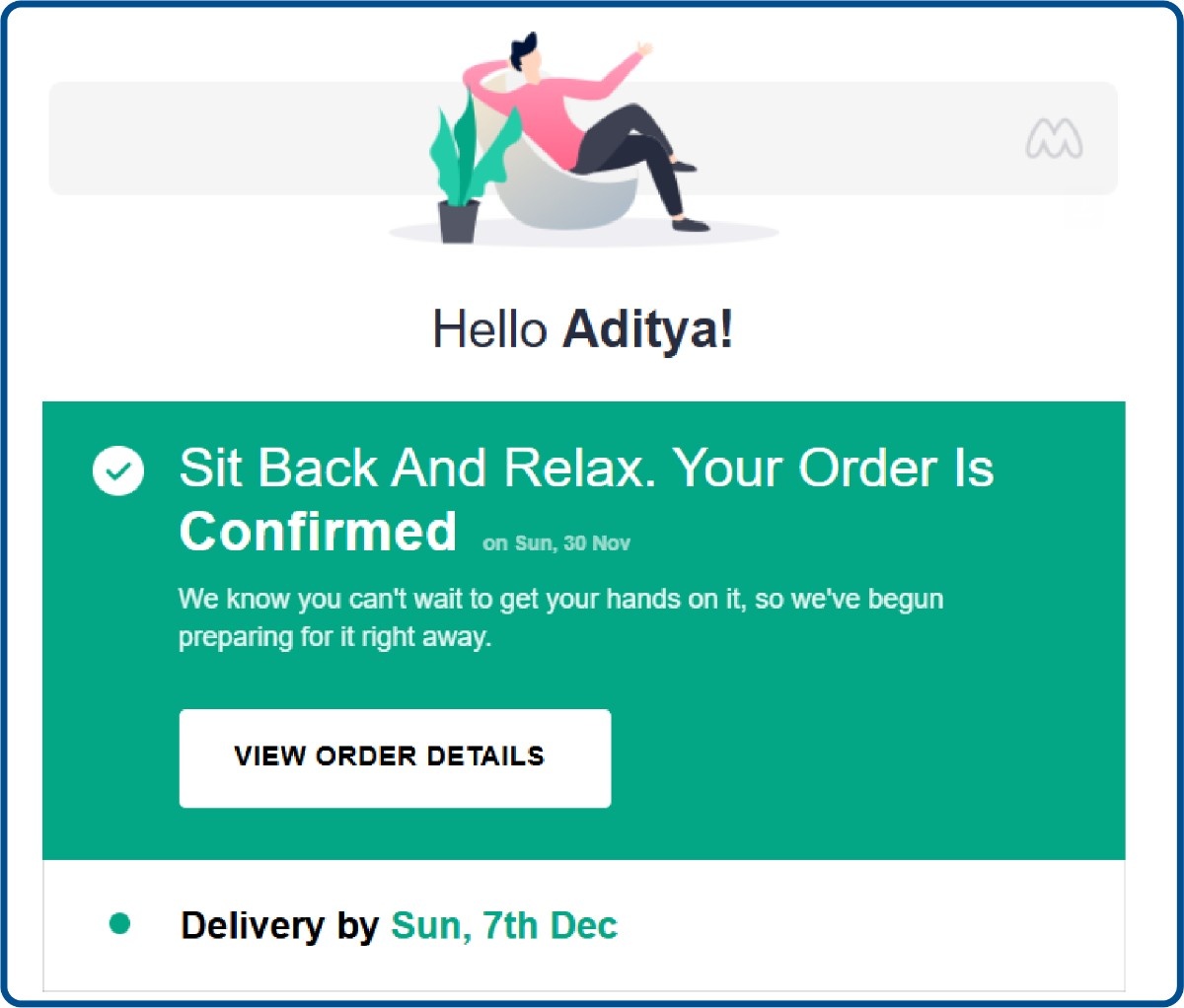
Send this immediately after a purchase. Include full order details, itemized pricing, estimated delivery window, and a clear "Thank You" message to confirm the transaction. This is the most-opened email your store will ever send, do not waste it with a bare-bones receipt.
What to include: Order number, product summary with images, shipping address, payment confirmation, customer support contact.
Pro tip: Add a product cross-sell or a referral prompt in the footer of your order confirmation. Purchase intent is highest right after checkout, capture it.
2. COD Confirmation Email
Specific to Cash on Delivery orders, this email asks the customer to confirm their intent via a simple link or button. This single step significantly reduces RTO (Return to Origin) rates, one of the most expensive problems for Indian D2C brands.
Without a COD confirmation flow, brands routinely see 30-50% RTO rates on unverified orders. A single confirmation email can cut that in half.
Pro tip: Kwik Checkout automates all delivery-related emails including COD confirmation, reducing manual follow-ups and shrinking RTO rates at scale.
3. Shipping and Tracking Update
Provide real-time tracking links as the order moves through the logistics chain. This email dramatically reduces "Where is my order?" (WISMO) support tickets and sets clear delivery expectations.
Send at each key stage: order dispatched, out for delivery, delivery attempt. The more specific, the better.

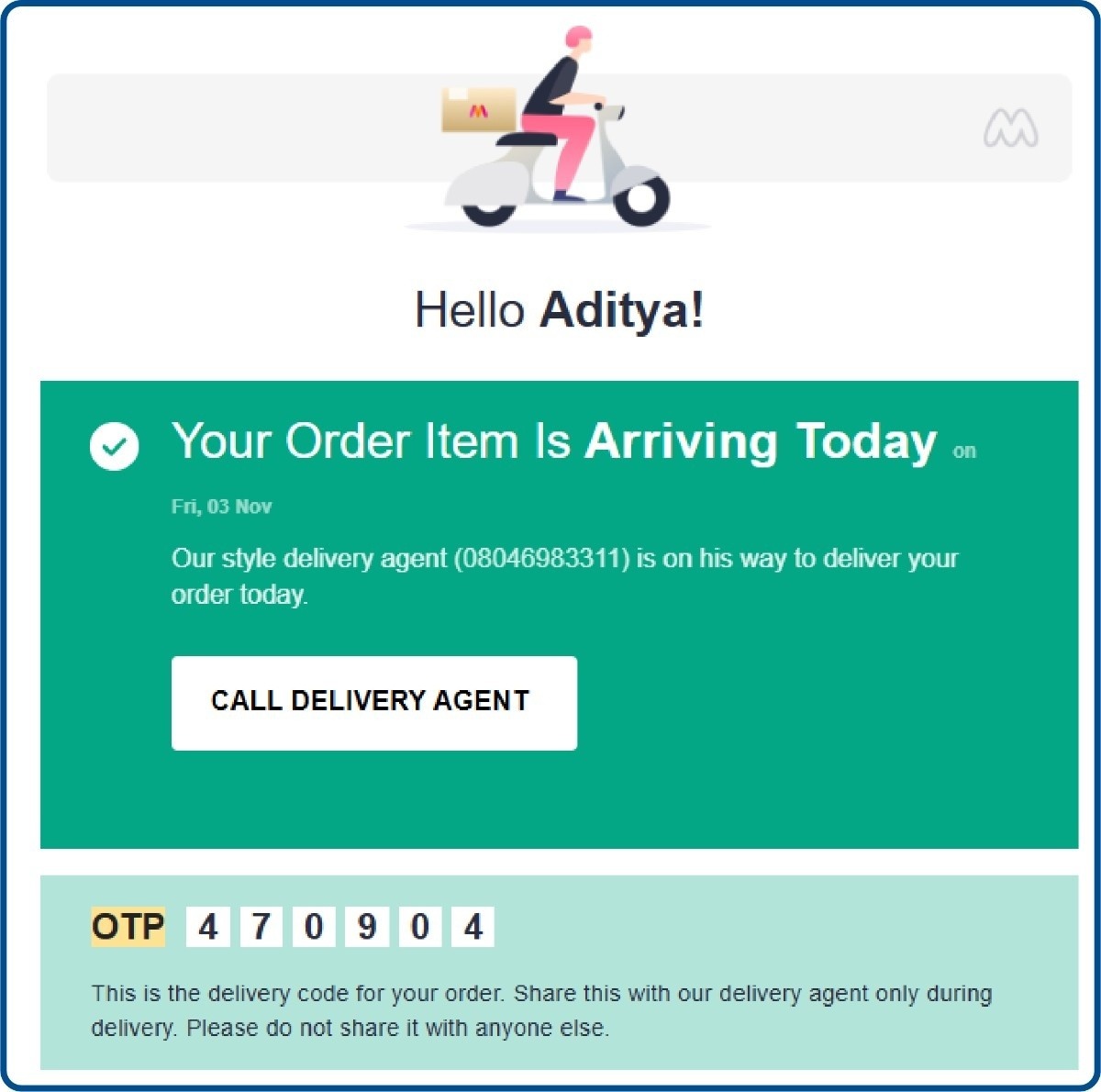
4. Delivery Confirmation (with OTP)
Confirm successful delivery with an OTP for secure handover. This protects both the customer and your brand from false "not delivered" claims and ensures a premium, accountable post-purchase experience.
5. Privacy Policy and Terms Update
Notify users of any changes to your data handling practices, store policies, or terms of service. This maintains legal compliance and builds transparency, increasingly important as data privacy regulations tighten globally.
6. System and Technical Announcement
Alert users about scheduled maintenance windows, platform migrations, or new feature rollouts that directly affect their shopping experience. Proactive communication here prevents confusion and protects your brand reputation during transitions.
Category 2: High-Intent Recovery and Behavioral Emails
These emails trigger based on specific shopper actions to recover revenue that would otherwise be lost permanently. They are the highest-leverage email type for D2C brands, automated, behavioral, and deeply personalized.
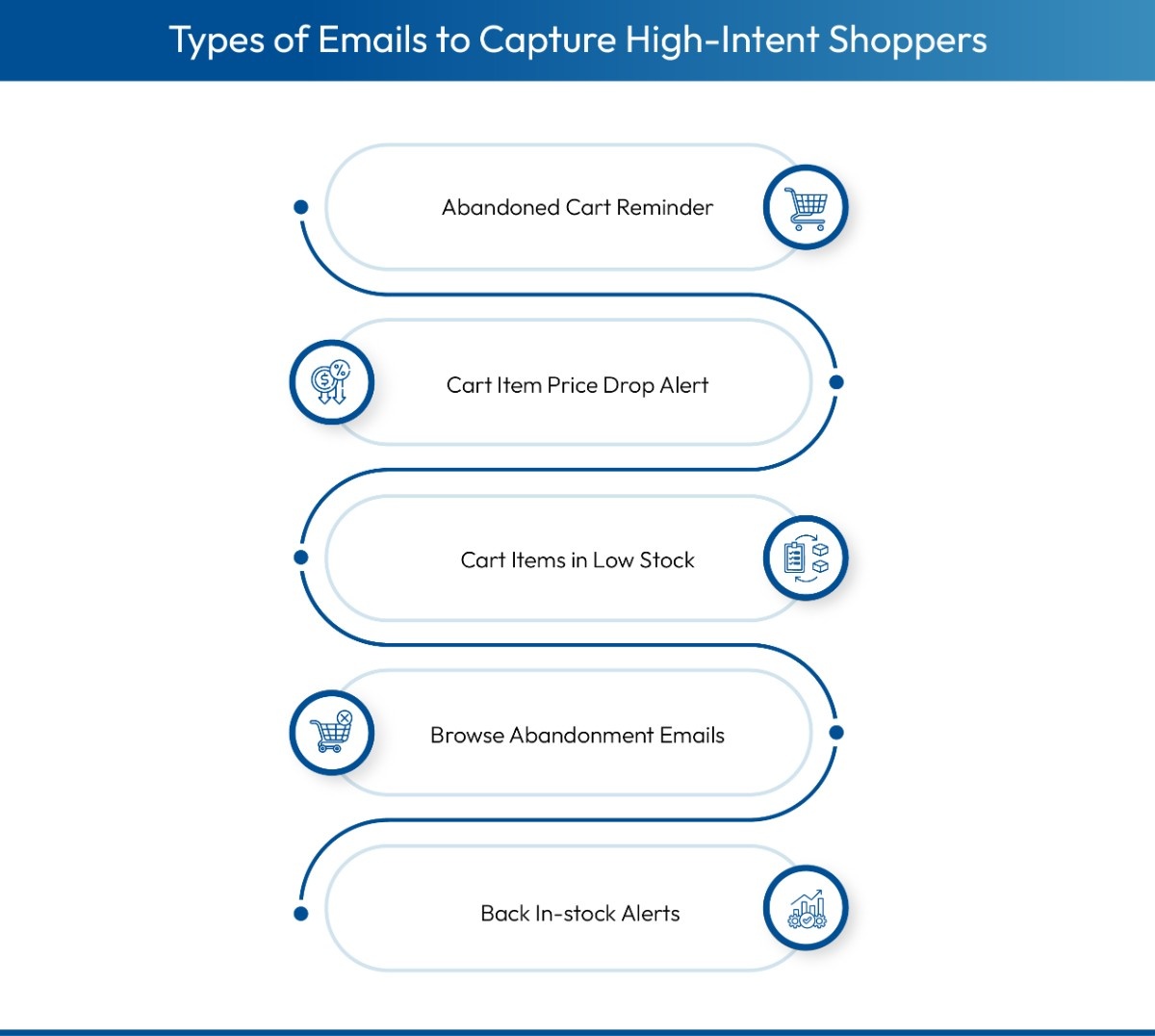
7. Abandoned Cart Reminder
Trigger these automatically for shoppers who add items to their cart but leave before checking out. A three-email abandoned cart series consistently outperforms single emails, one study found a three-email sequence generated more in recovered revenue versus from a single send.
You can refer to our blog on 17 abandoned cart email examples for more inspiration ideas.
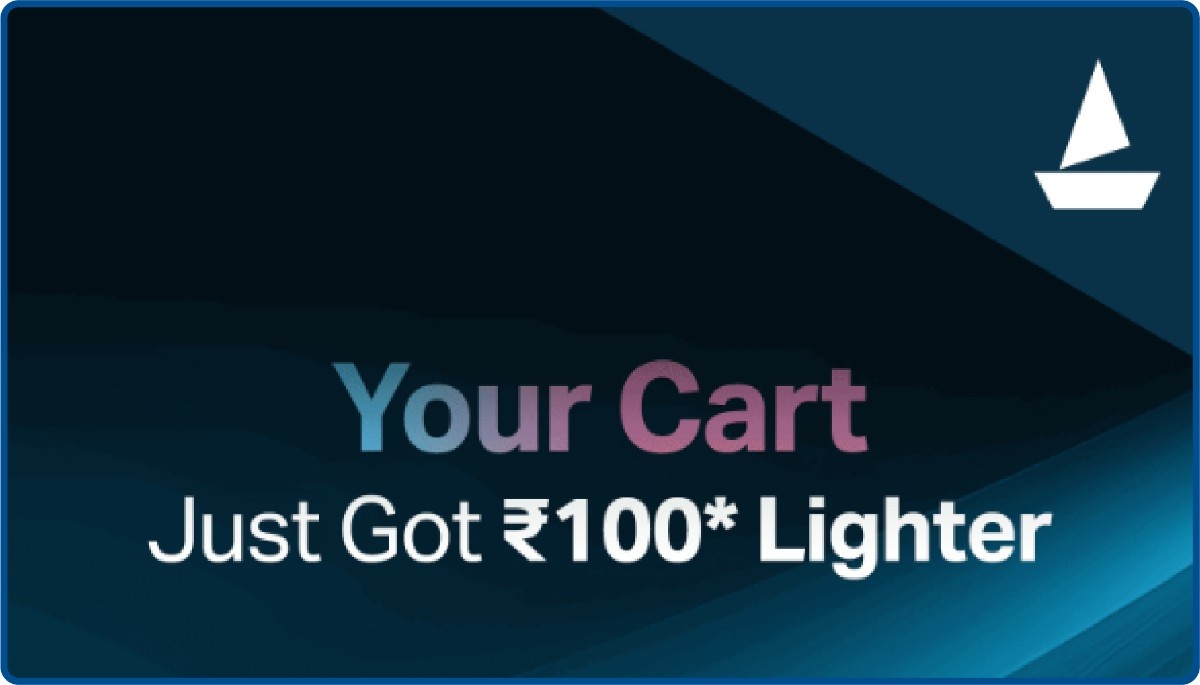
Timing framework:
- Email 1 (30-60 min): Friendly reminder, no discount. Focus on removing friction.
- Email 2 (24 hours): Add social proof, reviews, or urgency (low stock, limited time).
- Email 3 (48-72 hours): Introduce a limited time offer if needed.
Do not lead with a discount on email one, many customers will complete the purchase without it, protecting your margins.

Pro tip: Kwik Engage identifies shoppers that standard CRMs miss, doubling your reachable audience for cart recovery. Brands using GoKwik's checkout integration recover 20% or more of abandoned cart revenue.
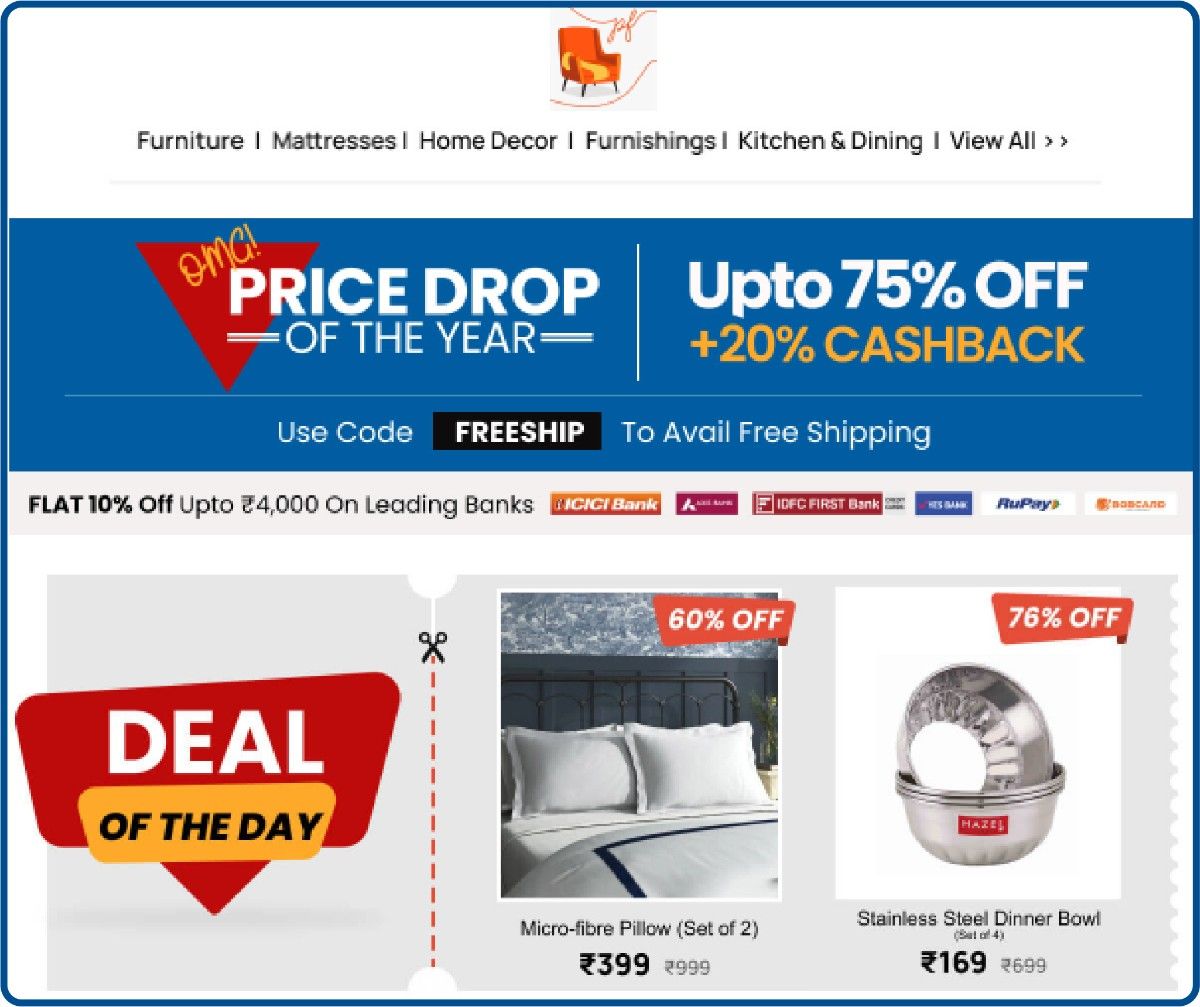
8. Cart Item Price Drop Alert
Automatically notify a shopper when an item they left in their cart has gone on sale. This creates a logical, data-driven reason to return, the customer does not feel sold to, they feel informed. Conversion rates on price drop alerts consistently outperform generic promotional emails.
9. Low Stock / Scarcity Nudge
Send an alert when items in a user's cart or wishlist are running low. Genuine scarcity is one of the most powerful conversion triggers in e-commerce. Use it honestly, customers who discover the scarcity was fabricated will not return.
10. Browse Abandonment Email
Target shoppers who viewed specific product pages but did not add anything to their cart. These customers are earlier in the consideration stage, so the email should educate and inspire rather than push for an immediate purchase. Suggest similar items, share reviews, or highlight what makes the product stand out.
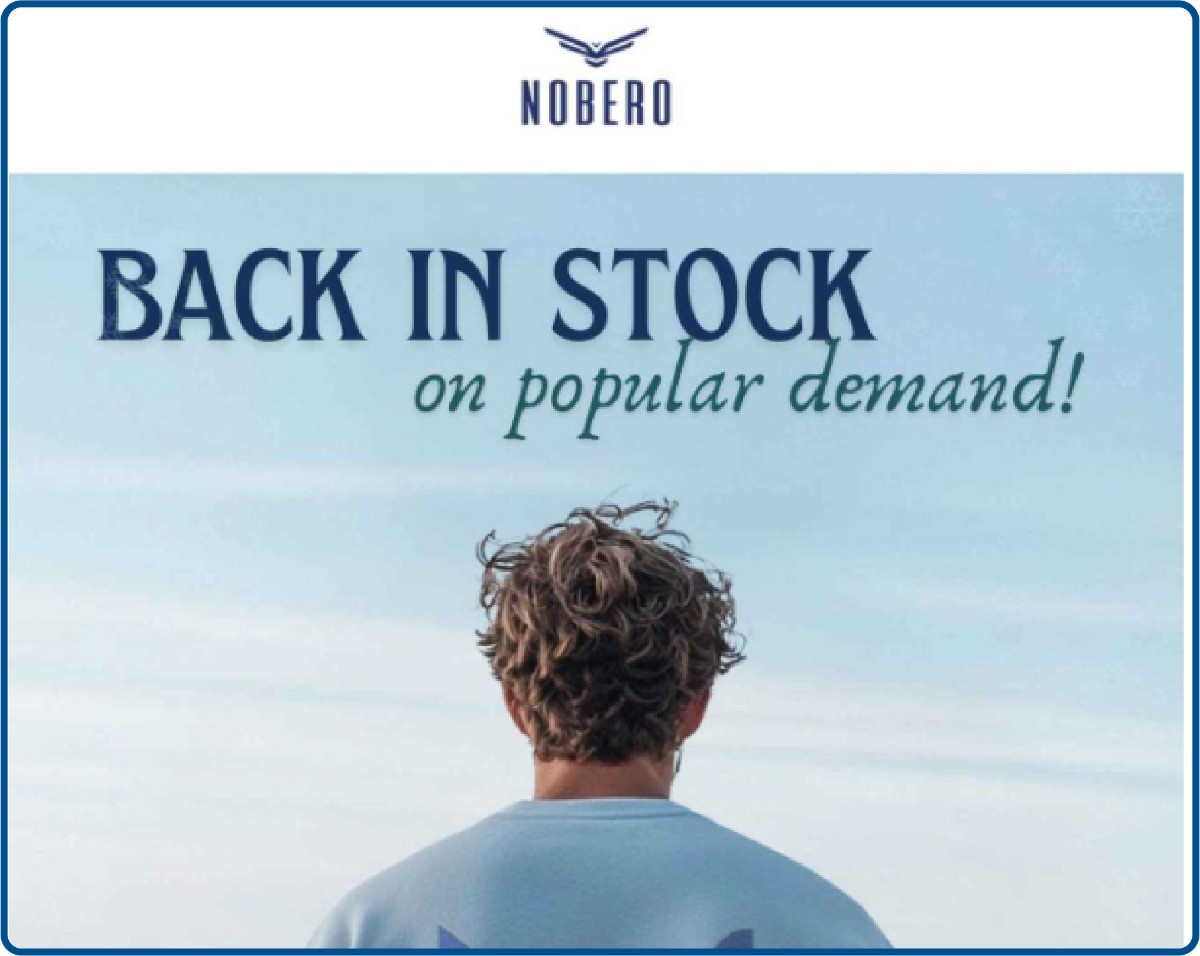
11. Back-in-Stock Alert
Notify shoppers the moment a product they previously viewed, wishlisted, or specifically requested is back in stock. These emails go to high-intent buyers who have already self-selected, they convert at exceptionally high rates with minimal creative effort required.
Pro tip: Add a "Notify me when back" button to your out-of-stock PDPs. Every opt-in is a warm lead with explicit purchase intent.
Category 3: Lifecycle and Retention Emails
The most profitable D2C brands focus on the long-term relationship. Acquiring a new customer costs five to seven times more than retaining an existing one. These email types are your customer retention engine, building loyalty, preventing churn, and turning one-time buyers into brand advocates.
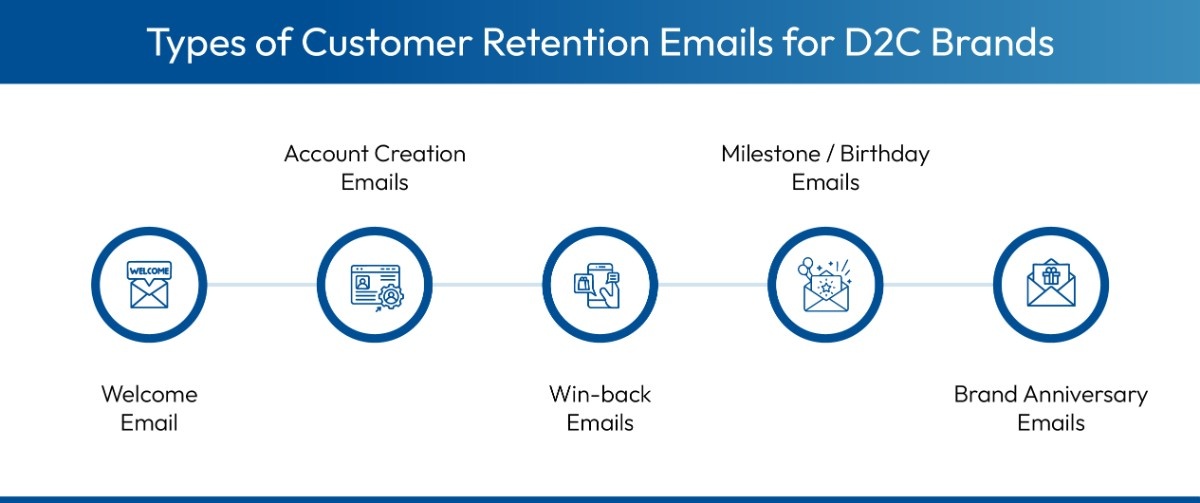
12. The Welcome Email
Your first touchpoint with a new subscriber sets the tone for the entire relationship. A strong welcome email introduces your brand values, shares your origin story, sets expectations for what emails will come next, and typically offers an exclusive first-look or first-purchase incentive.
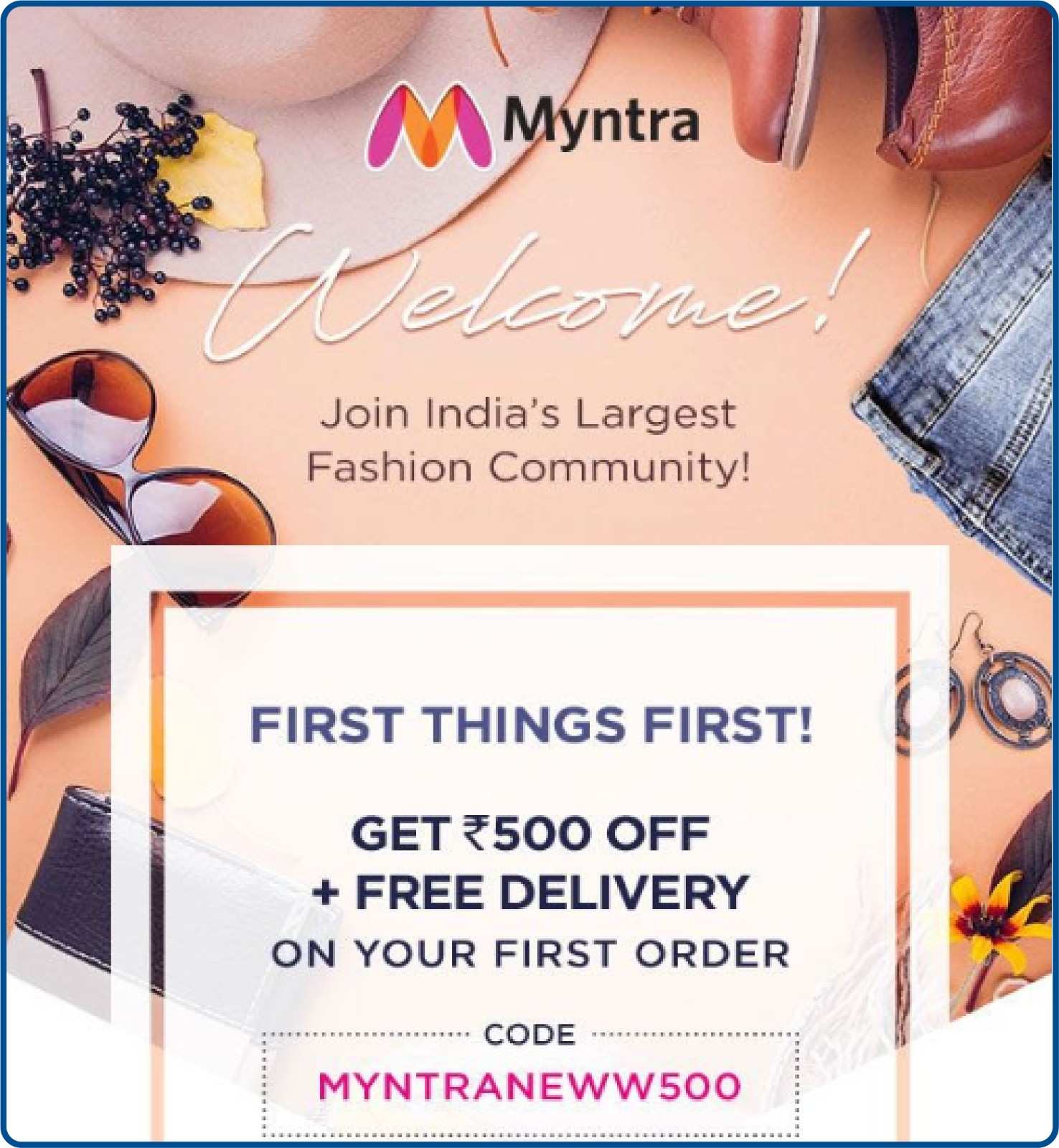
Welcome emails generate higher open rates and click rates than standard campaigns. Do not automate a generic thank-you, make this one count.
What to include:
- Brand story and values (brief, 2-3 sentences)
- What to expect from your emails (content type and frequency)
- A compelling first-purchase offer with a clear expiry
- Social proof: ratings, press mentions, bestseller callout
13. Account Creation Confirmation
Confirm registration and welcome the user to your brand community. Beyond the functional confirmation, this is an opportunity to highlight the benefits of having an account, order tracking, saved addresses, exclusive member pricing, and early access.
Pro tip: Use Kwik Pass to recognize registered users across the GoKwik network for frictionless one-click login and checkout, reducing drop-offs at the account stage.
14. Re-engagement / "We Miss You" Email
Target customers who have not purchased in 60 to 90 days. A well-designed re-engagement flow is your last line of defense before a customer goes permanently dormant. Use a high-value incentive, a fresh product angle, or social proof of what they have been missing.
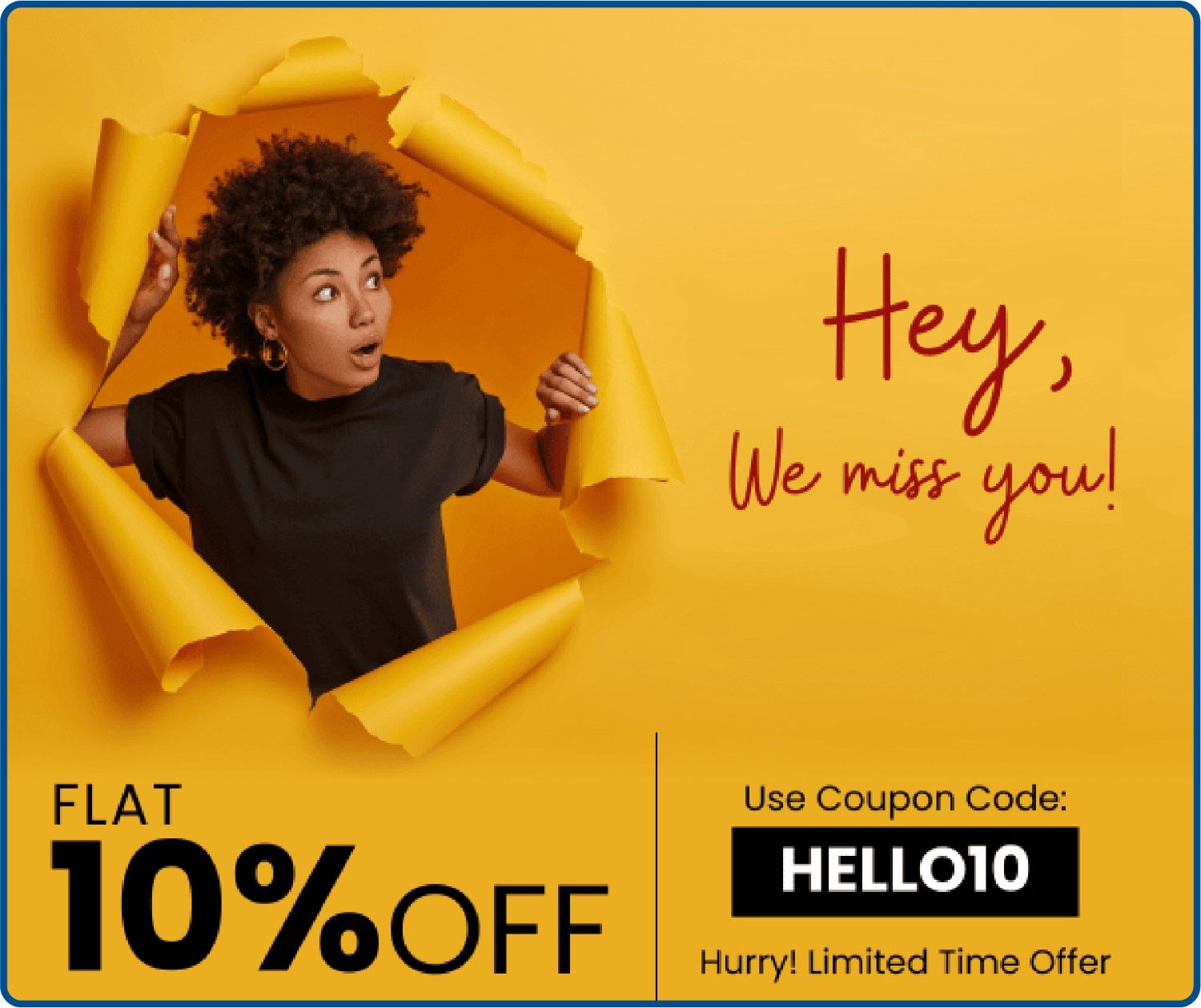
If a subscriber does not engage after your re-engagement sequence, remove them from your active list. A clean, engaged list always outperforms a bloated, unresponsive one.
15. Milestone / Birthday Email
Celebrate the customer's birthday with a personalized gift, a discount, free shipping, or an exclusive product. Birthday emails are among the highest-converting lifecycle emails in e-commerce, generating up to 342% more revenue per email than standard promotional sends (Experian).
Keep it personal, keep it simple. One clear offer. One clear CTA.
16. Brand Anniversary Email
Acknowledge the anniversary of the customer's first purchase with your brand. This reinforces their history with you, signals that you value the long-term relationship, and creates a natural, non-intrusive reason to reach out with an exclusive returning-customer offer.
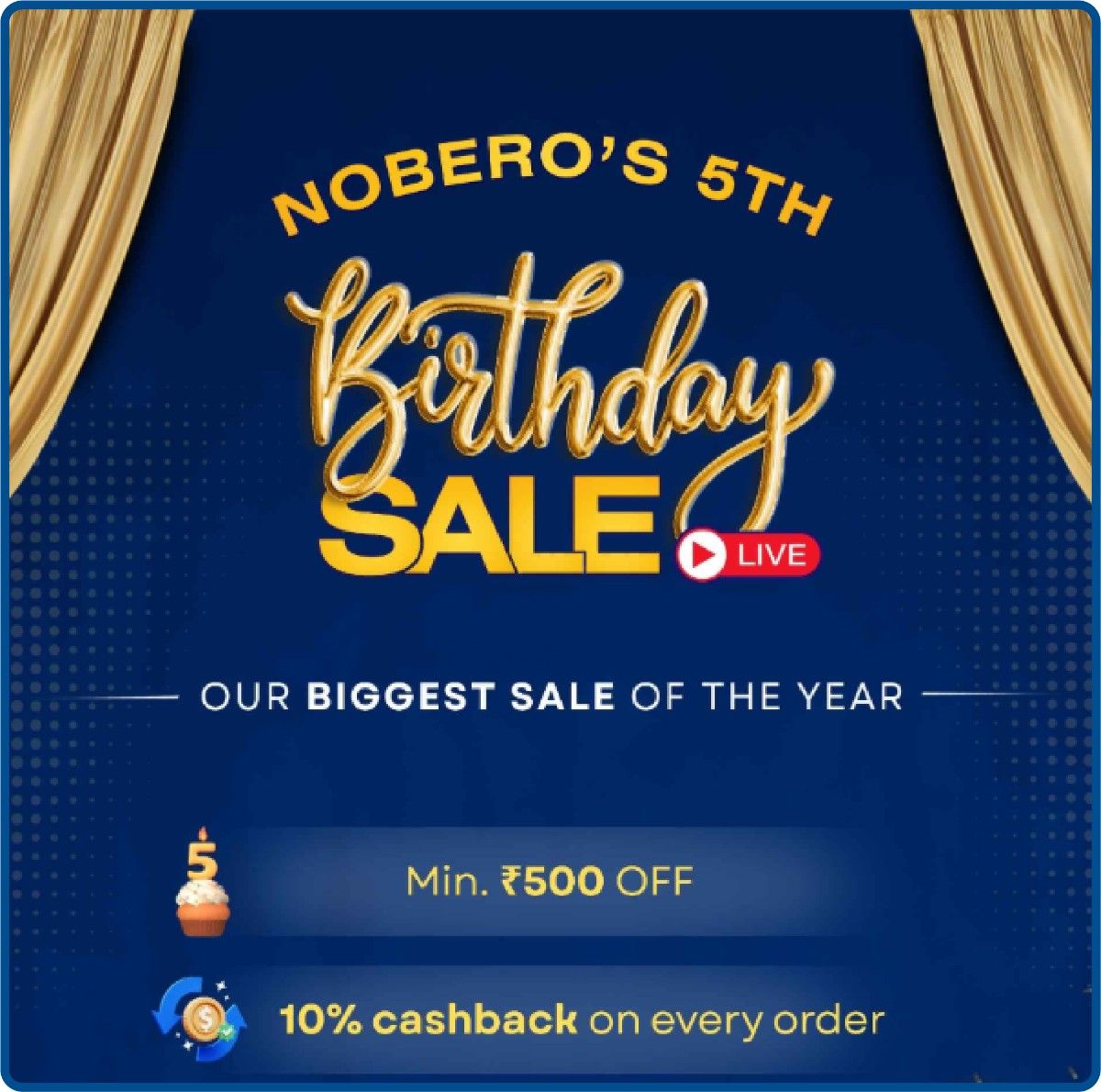
Pro tip: Kwik Engage offers deep segmentation to build anniversary, birthday, and milestone lists directly from your customer database, no manual list management needed.
Category 4: Value-Add and Growth Emails
These email types drive Customer Lifetime Value (CLTV) by deepening product engagement, generating social proof, and turning your existing customer base into a low-cost acquisition channel.
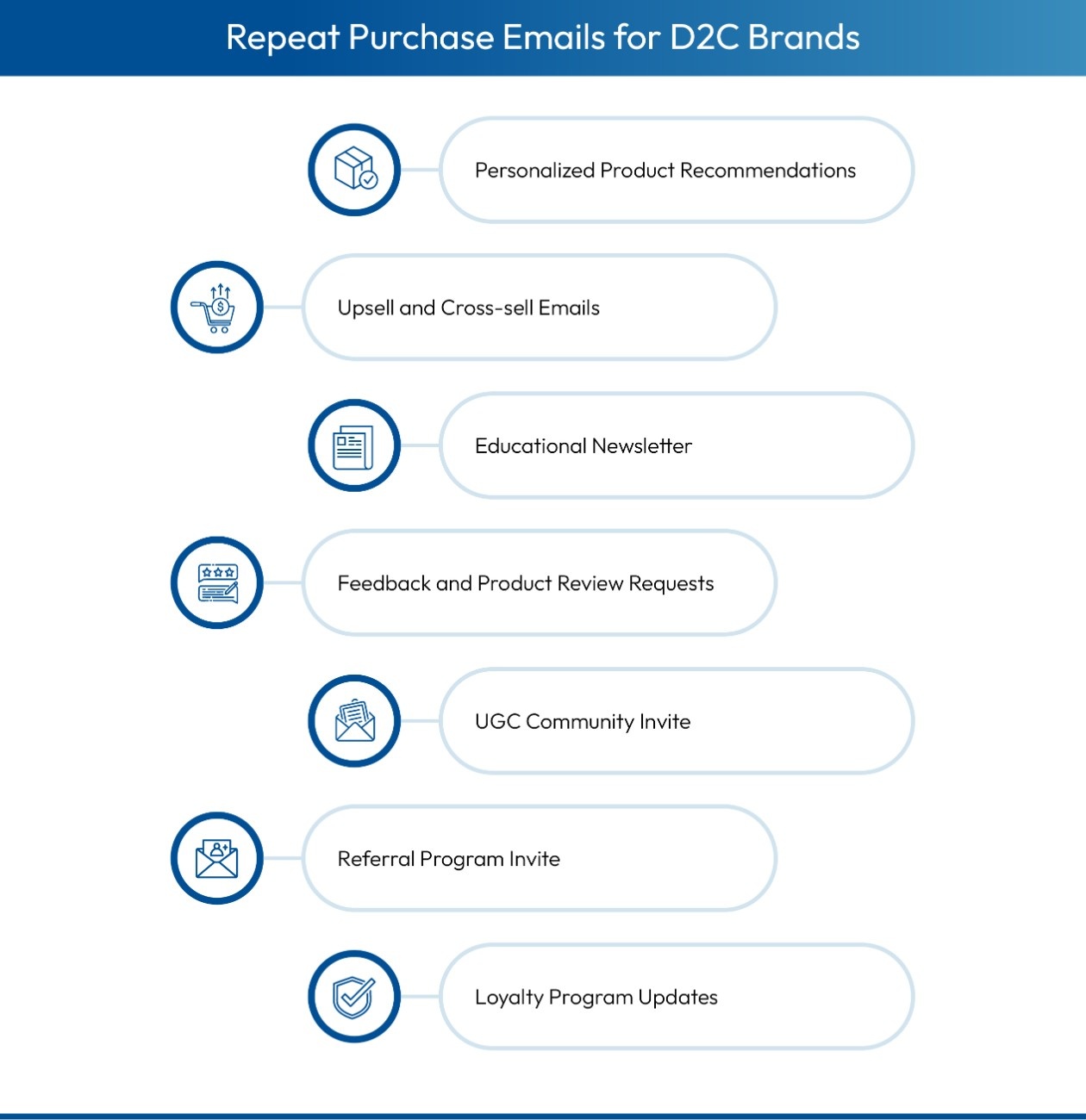
17. Personalized Product Recommendations
Suggest products based on a customer's past purchase history, browsing behavior, or product affinities. Personalized recommendation emails outperform generic newsletters by a wide margin, Experian found that personalized promotional emails generate 6x higher transaction rates than non-personalized versions.
The key is timing: send these when purchase intent signals are highest, after a recent browsing session, at replenishment intervals for consumable products, or following a completed purchase with complementary items.
Pro tip: Kwik Insights allows you to send recommendation emails based on real-time intent signals rather than generic schedules, increasing both relevance and conversion.
18. Upsell and Cross-sell Emails
Encourage customers to upgrade to a higher-value product variant or suggest accessories and complementary items that pair with a recent purchase. These emails work best in the post-purchase window, when the customer's interest in the product is highest.
- Upsell example: A customer buys a skincare moisturizer → recommend the SPF upgrade or the full AM/PM routine bundle.
- Cross-sell example: A customer buys running shoes → recommend socks, insoles, or a hydration pack.
19. The Educational Newsletter
Share how-to guides, usage tips, styling inspiration, ingredient deep-dives, or industry content that genuinely helps your customer get more value from your products, or from adjacent interests. The goal is not to ask for a sale but to build authority and trust.
Brands that consistently provide educational value through email see higher long-term engagement and stronger reactivation rates than those who exclusively push promotions.
20. Feedback and Product Review Request
Send this email three to five days after confirmed delivery. Ask for a rating and a brief review. Customer reviews are one of the most powerful forms of social proof in e-commerce, they directly impact conversion rates for future shoppers.
Keep the ask simple: a star rating and one to two sentences. Make it mobile-optimized. A low-friction review request gets significantly more responses than a lengthy survey.
21. User-Generated Content (UGC) Invite
Encourage customers to share photos or videos of your products on social media, and feature the best submissions in future emails, on your website, or on your social channels. UGC drives trust in a way brand content cannot replicate, it is authentic, peer-driven validation.
Incentivize participation with store credit, exclusive discounts, or the chance to be featured. Many customers who love your products will create content if you simply ask.
22. Referral Program Invitation
Turn your happiest customers into a low-cost acquisition channel. A referral email invites them to share a unique link with friends, with a reward for both parties when the referral converts. This dramatically lowers your Customer Acquisition Cost (CAC) while bringing in buyers who already have social proof from a trusted source.
Send this after a positive post-purchase moment, after a glowing review, a repeat purchase, or a loyalty milestone. Timing matters: strike when advocacy intent is highest.
23. Loyalty Program Updates
Keep customers informed of their current points balance, reward tier, and how close they are to the next milestone. Remind them to redeem points on upcoming purchases. The psychology here is powerful, customers who know they have unredeemed value are significantly more likely to return.
Segment these emails: send a "You're close to Gold tier" email to mid-tier customers, and a "Burn your points before they expire" email to dormant loyalty members.
Pro tip: Kwik Engage automates all 24 email types at scale, including loyalty updates, with intelligent segmentation built on real purchase behavior.
Category 5: Promotional Launch Emails
Use this category strategically to drive massive spikes in traffic and revenue during key business periods, product launches, seasonal campaigns, and major sale events.
24. New Product Launch / Teaser Email
Build anticipation with a countdown series leading up to a new drop. Start with a teaser 7-10 days before launch, follow with a "reveal" email 2-3 days out, and send a launch-day email with early access for your most loyal subscribers.
Giving your existing email list first access to new products creates exclusivity, drives Day 1 revenue, and deepens loyalty. Customers who feel like insiders buy more and stay longer.
Launch email sequence structure:
- Teaser email: "Something new is coming. Be the first to know."
- Reveal email: Product preview with key benefits, 48-hour countdown.
- Launch email: Early access link, limited quantity framing, clear CTA.
- Last-chance email: 24 hours left for early-access pricing or exclusive bundle.
Optimizing Your Email Strategy with GoKwik
Executing all 24 email types manually is not realistic at scale. GoKwik's ecosystem is purpose-built to automate, personalize, and optimize this entire communication stack for D2C brands.
Kwik Checkout: Automates all transactional and delivery-related emails, from order confirmation to OTP delivery, while reducing RTO rates through COD confirmation flows.
Kwik Engage: Identifies shoppers that standard CRMs miss, doubling your reachable audience for behavioral and recovery emails. Handles automation for all 24 email types at scale with deep segmentation built on real purchase data.
Kwik Insights: Delivers real-time purchase intent signals so your recommendation and promotional emails reach the right customer at the moment they are most likely to buy, not on a generic weekly schedule.
Kwik Pass: Recognizes registered customers across the GoKwik network for frictionless one-click checkout, reducing drop-offs and increasing the effectiveness of every email-driven traffic session.
The GoKwik ecosystem manages over 1.4 billion shopper interactions, giving D2C brands the data depth and automation infrastructure needed to consistently hit 10x+ email ROI.
Conclusion
Email is not just a marketing channel for D2C brands, it is infrastructure. It is how you fulfill orders, recover lost revenue, build loyalty, and scale customer relationships at a cost that no other channel can match.
The brands that win with email do not send more. They send smarter. They map communication to customer behavior. They automate the moments that matter. They treat the inbox as a place to deliver value, not just push promotions.
These 24 types of emails give you the complete playbook, from the first order confirmation to the referral invite a year later. Build them systematically. Optimize each one. And use GoKwik to run them at scale with the behavioral intelligence your customers expect.
Ready to build your D2C email engine?
Book a free demowith GoKwik and see how brands in the GoKwik network achieve 10x email ROI across all 24 email types.
What is the right time to send marketing emails?
The right time to send marketing emails depends on the email type and your email marketing strategy. Behavioral triggers like abandoned cart, back-in-stock, and price drop should fire immediately. For email newsletters and promotional email campaigns, Tuesday through Thursday, 9 to 11 AM works best. Always A/B test different subject lines and send times against your own email subscribers to find what drives the most customer engagement.
What are some important email marketing compliances?
Email marketing compliance means sending the right message only to subscribers who opted in, with a visible unsubscribe link in every email. Key frameworks include CAN-SPAM (US), GDPR (EU), and India's DPDP Act. These protect potential customers and your sender reputation, both critical for keeping future campaigns out of spam folders.
Which is the best email marketing tool for D2C e-commerce?
The best tool depends on scale. For Indian D2C brands, GoKwik's Kwik Engage is a great example of a platform built for different types of emails, from welcome series to recovery flows, with deep segmentation to reach the right audience with relevant content. Globally, Klaviyo and Omnisend are strong for Shopify-based brands.
How does GoKwik help with D2C e-commerce emails?
GoKwik automates all 24 different types of emails across the customer lifecycle, from the first email in your welcome series to loyalty updates and referral invites. Kwik Engage uses real purchase behavior to send valuable content at the right moment, turning email into a sales funnel that drives customer loyalty and repeat revenue at scale.

AUTHOR
Atul Bansal
Head of Marketing

Explore Related Blogs
Kwik Engage
What is Promotion Mix and How E-commerce Brands Can One for Maximum Sales?
13-Apr-202614 Min Read
Kwik Engage
Exit Intent Pop-ups for Ecommerce: 9 Ideas and 6 Best Practices
13-Apr-202614 Min Read
Kwik Engage
17 Best E-commerce Marketing Strategies Brands Can Try in 2026 (With Examples)
10-Apr-202619 Min Read