Table of Contents
eCommerce brands are witnessing significant growth and disruption, thanks to many advancements in the online shopping and digital marketing industry. As brands strive to establish their presence in the market, online retailers continue to face many challenges while selecting an effective digital marketing channel for their businesses. WhatsApp vs email or anything else?
With the rise in conversational platforms, brands have multitude opportunities to directly connect with their target audience. In today’s digital landscape, conversational platforms are serving as one of the most valuable tools for marketers looking to enhance customer engagement. Here, WhatsApp is leading the race as one of the leading conversational platforms. It is performing exceptionally well in the market opening an additional revenue stream for businesses. Where several brands want to continue to stick to the traditional mode of communicating through emails, they’re thinking beyond the basics now.
The decision regarding which marketing tool to invest in is having a profound impact on an eCommerce brand’s success. That’s because it directly influences customer reach, engagement, and overall brand positioning.
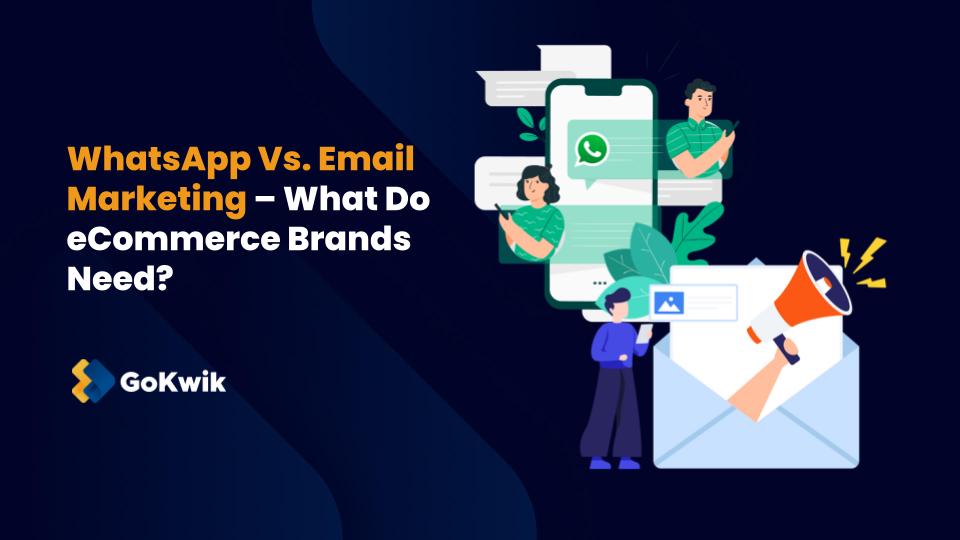
Therefore, in this blog, we will discuss in detail – WhatsApp vs Email marketing and which marketing tool is best for eCommerce brands.
Let’s start by understanding the basic concepts behind WhatsApp vs Email Marketing.

Email Marketing – The OG/Evergreen Marketing Tool
In simple words, email marketing refers to a digital marketing strategy where a brand sends targeted messages and promotional content directly to a recipient’s email inbox. It is a widely used strategy by eCommerce businesses and is an effective way to engage with customers, build relationships, promote products or services, and drive conversions.
Contrary to the popular belief that email marketing is dying, brands continue to be active on this platform. Both large and small brands, leverage email as part of their marketing efforts.
As per estimations, nearly 30% plus eCommerce brands increased their email budget in 2022. However, it’s always harmful to overuse any channel. Customers have a low tolerance for spam or content that are irrelevant to them.
Email marketing is a cost-effective channel as compared to printing and electronic media advertising including WhatsApp marketing. It is a great platform for sending targeted and personalised messages. It is scalable, i.e. brands can use emails to reach wider audiences and smaller target groups based on the marketing requirement.
However, the open rate of emails is low (approx. 20%) and a major challenge making eCommerce brands think twice. Chances are high that the content may land up in the spam or junk folder.
The customer response rate is also low when compared to WhatsApp. The chances of customers ignoring the emails are high as they tend to receive tons of emails on a daily bases from a plethora of brands.
WhatsApp Marketing – New Kid In Town
When we compare WhatsApp vs email marketing, it is interesting to note that the former, despite being a newcomer in the market, it is gaining massive momentum. Both brands can customers are relishing it over other mediums.
According to a popular belief – ‘if you aren’t marketing on WhatsApp in 2026, you aren’t marketing at all.’ The statement is enough to measure the popularity of WhatsApp vs email. It is also one of the most preferred marketing channel options today by over 15 Million businesses only in India having a 400 million plus audience base!
There are majorly three versions of WhatsApp:
WhatsApp Messenger is the standard version used by individuals for personal messaging, while WhatsApp Business is designed for small and medium-sized businesses. The WhatsApp Business API is an enterprise-level solution for larger businesses and service providers.
Being a conversational marketing channel, WhatsApp,
Though it has strict guidelines and policies that eCommerce brands need to adhere to, ultimately it enables them to build a more direct and stronger relationship with customers.
, a GoKwik-powered WhatsApp solution, helps eCommerce brands leverage this marketing tool to their benefit.
With Kwik Engage, 300+ eCommerce brands have been able to,
WhatsApp vs Email Marketing – What’s Best For Your eCommerce Brands
Choosing the right marketing channel depends on your company’s goals, needs, target audience and nature of business. Ideally, it is essential for marketers to strategically utilise both WhatsApp and email to maximise customer reach, and engagement, and ultimately drive business success.
However, from a comparison point of view, as mentioned above, it is evident that conversational platforms are on the rise. Thus, WhatsApp is the best option for eCommerce brands if they are looking for quick, conversational and effective ways to connect with their end consumers and drive business growth.
WhatsApp facilitates instant communication and responsiveness, creating a sense of immediacy and convenience for buyers.
With the rise of mobile usage and messaging apps, customers increasingly expect prompt responses to their inquiries and concerns. Platforms like WhatsApp enable marketers to meet customer expectations by providing timely support and resolving issues in a personalised manner, thus enhancing the overall user experience.
eCommerce brands can drive exponential growth using WhatsApp vs email as a marketing channel in the following ways.
As an eCommerce brand, you can easily generate and acquire leads using WhatsApp chatbot. Email does not give you this leverage.
Chatbot helps increase conversion rates up to 7x. It indulges in a one-on-one interaction with the customers and captures all the critical details. This information helps an eCommerce brand enhance their customer experience strategies and generate a solid sales pipeline. Chatbots also supports various media types, including images, videos, and voice notes, which enhance product demonstrations or customer interactions.
Using interactive UI elements like List Messages, Reply Buttons, Single and Multi-product Messages etc. brands can offer a seamless shopping experience to customers via WhatsApp. Certainly email can only be used for information dissemination and redirection to website purposes.
Navigation tools like NLP and text search in WhatsApp enable eCommerce brands to figure out the exact requirement of their consumers without hassle. Besides this, brands can also leverage features like headless checkout offered by Kwik Engage to ensure customers are able to complete the entire purchase on WhatsApp itself. Such features collectively help eCommerce brands reduce drop offs, increase conversions, and a seamless shopping experience causing repeat purchase.
Brands can improve upsell and cross-sell opportunities by suggesting customers the right add-ons at the right time based on their past buying history and other contextual information using WhatApp. Emails too can be leveraged here, but the impact noted is typically lower than its counterpart.
Besides, WhatsApp enables eCommerce brands to help customers explore upsells and cross-sells on the messaging app itself, hence, significantly increasing the chances of additional purchase.
Research suggests that more than 50% of online shoppers today want to buy directly via messaging apps. Therefore, eCommerce brands can leverage WhatsApp here and offer swift payment option to customers. This will increase the chances of conversions and ensure a smooth buying journey as well. Browse, shop and pay!
By seamlessly handling the FAQs regarding tracking orders, return orders, managing refunds, payment solutions etc. eCommerce brands can deliver exceptional customer experience via WhatsApp. Compared to emails, WhatsApp is faster, real-time, and more effective. Such efforts extensively improve customer satisfaction, loyalty and retention.
To Conclude,
Some businesses may benefit from utilising both channels in a complementary manner, i.e. they can integrate email for broader reach and automation and leverage WhatsApp for personalised and real-time interactions. It’s imperative to consider your specific business context and conduct surveys to determine which platform aligns best with the business goals. Striking the right balance is crucial for D2C brands to effectively reach their target audience, optimise their marketing budget, and eventually drive growth in an increasingly competitive market!



![WhatsApp Catalog: How To Sell Products on WhatsApp [A Complete Guide]](https://panel.gokwik.co/storage/app/public/images/use_kwikengage_for_a_seamless_whatsapp_catalog_setup__1772512572.jpg)