Over the last half a decade, there has been a fundamental change in how customers interact and engage with eCommerce brands. Just a couple of years ago, customers were happy buying stuff from a brick-and-mortar store. The pandemic came and the eCommerce business sector boomed exponentially. So much so that global eCommerce sales are expected to close at USD 5.7 trillion by the end of 2022. And now, it's the era of WhatsApp Commerce. Every alternate year has brought about a new change in the online store scenario. Another change seen amidst the pool of innovations is the rise of conversational commerce. This very segment is also fast replacing websites and apps. It’s on the verge of becoming the main communication interface between brands and consumers.
A byproduct of this innovation is WhatsApp Commerce. In this blog, we’ll explain how brands are leveraging WhatsApp to enhance personalised interaction with prospects and customers as well as open new channels of sales.
What Is WhatsApp Commerce
In the simplest of terms, WhatsApp commerce means using WhatsApp as a primary platform to conduct a commercial business. Ideally, brands were using the messaging app, particularly its Business app, to only enhance a customer’s pre-purchase and post-purchase journey.
They are now leveraging WhatsApp Business to empower their end-to-end shopping experience. WhatsApp Business allows businesses to:
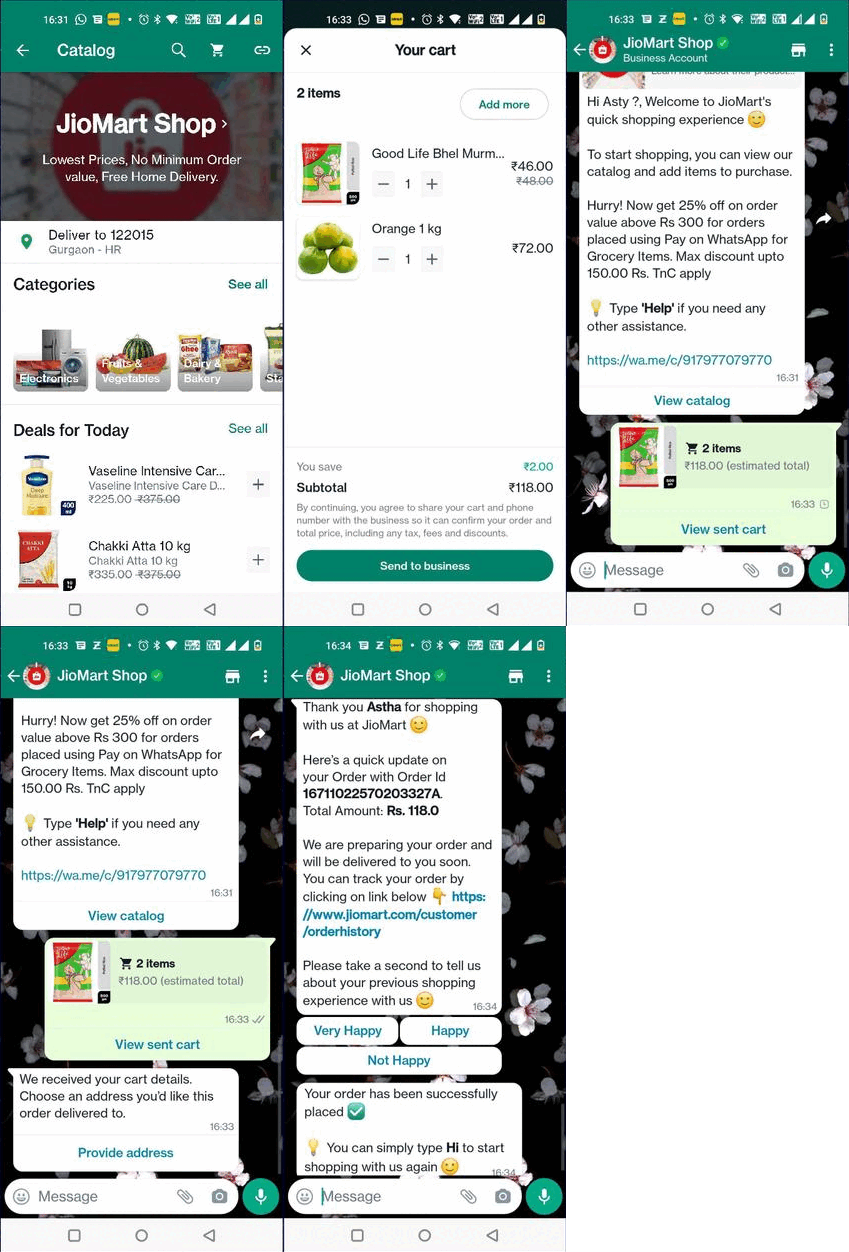
Here’s an example how JioMart is leveraging WhatsApp Commerce to scale its business and capture a wider audience base
With this, WhatsApp Business's captive user interface has opened a direct customer communication channel and revolutionised the future of shopping. It has given brands another way to engage with customers and provide a seamless buying experience.
Scope Of WhatsApp Commerce In India
WhatsApp was launched in India in November of 2009. Back then, no one had even the slightest idea that one day WhatsApp will become huge. That it will become a prominent go-to channel for shopping.
At present, India accounts for approximately 487.5 million WhatsApp users. Meanwhile, reports suggest that nearly 190 million Indians rigorously shop online. This means the potential of WhatsApp is allowing brands to capitalise on the potential market and grow their business X times in the coming years.
If 190 million people are hypothetically catering to USD 74.8 billion in eCommerce sales in a year. Imagine what the sales numbers will be when WhatsApp commerce becomes a mainstream eCommerce channel in India.
Advantages Of WhatsApp Commerce
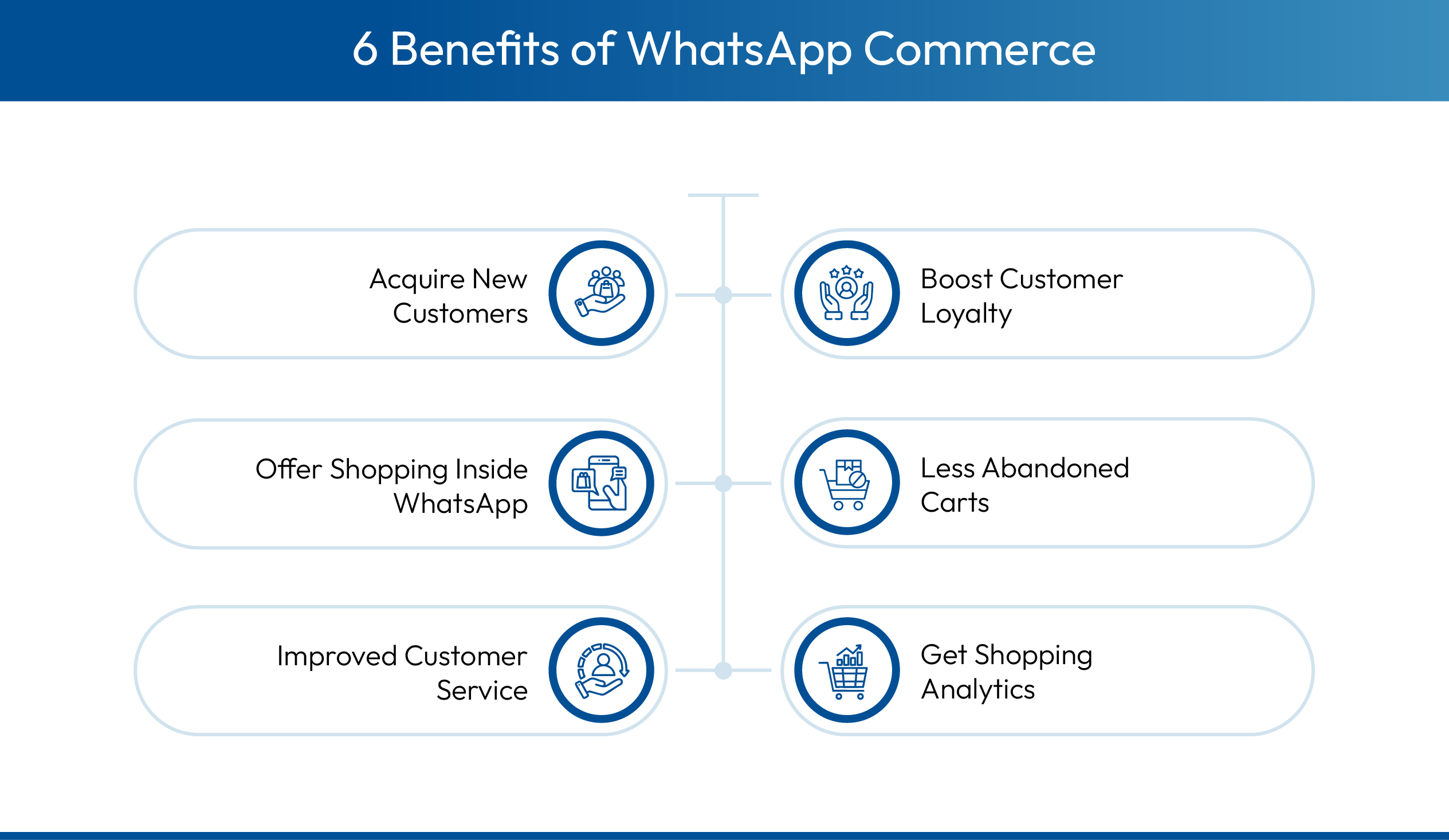
So, what are the key benefits of online buying via WhatsApp? Let’s take a look.
WhatsApp is evidently one of the most popular apps for communication across the globe. It’s simple, easy to operate, gives you the leverage to create groups for mass communication, and offers many more features that competitive apps fail to offer.
Its Business version comes with even more fascinating features. For instance, the WhatsApp business platform allows online brands to run lead-generation campaigns. This helps acquire new customers. Through these marketing campaigns, brands can reach every individual who visits their site and develop a personalised relationship with them and establish a better sense of ease and trust.
One of the best things about WhatsApp is that it keeps adding and introducing new features. These benefit both the general public and the businesses. From simply being an app for chatting with friends, WhatsApp now allows you to shop for product listings on its platform itself.
It eliminates the need to download a brand’s app and go through the otherwise tedious process. Again, JioMart is the perfect example to quote here. The Reliance Industry home-grown brand has elevated the overall customer experience of its user base.
Customers can now,
But, that’s not all. JioMart takes the experience to the next level. It constantly updates you about your order. It regularly shares,
WhatsApp commerce is completely transforming the way India will shop in the coming years and many D2C brands are set to follow suit.
Offering consistent customer service throughout the purchase cycle has become much more important today than a couple of years ago. It serves as a critical differentiating factor from competitors.
In this regard, WhatsApp aces the game. As mentioned above, the way WhatsApp has been designed ensures a personalised relationship with customers, and even allows brands to understand the expectations of their customers. WhatsApp has opened the gates for two-way customer conversations allowing customers to interact with brands anytime they want.
It has,
WhatsApp allows businesses to constantly be in contact with customers. It helps promptly solve their customer inquiries, update them about their orders, upcoming flash sales, etc. This automatically helps boost customer loyalty towards the company.
Moreso, such loyal customers further convert into brand advocates. They bring in an entirely new set of customers that otherwise sat in the resistance groups. In technical terms, your brand leverages in terms of the reduced customer acquisition cost, higher revenue gains, and a wider customer base.
Meanwhile, businesses can also make use of gamification on WhatsApp. The technique helps boost customer engagement and advocacy by using advanced technologies like AI chatbots.
Similar to any other engagement platform, WhatsApp commerce too allows brands to see a comprehensive view of how customers are interacting with their platform. This helps gather
Brands must pay attention and utilise this information gathered to improve customer experience and stay ahead of competitors.
Companies like Tellephant offer a robust infrastructure that businesses can use to scale their operations, track performances, and leverage the gathered information. The platform is self-explanatory and easy-to-use. It also allows you to engage with your prospects then and there leaving no room for procrastination.
Another advantage of WhatsApp commerce is that it helps lower the cases of drop offs. Since a customer is able to place orders via Whatsapp itself, this reduces the chances of cart abandonment.
Additionally, WhatsApp Business allows brands to evaluate the behaviour of customers. It offers insights which can be used to improve customer satisfaction, further reduce abandonments. For instance, a brand can implement AI chatbots to understand customer preferences, answer product-related questions, and even recommend similar products (open up-sell/cross-sell opportunities) without being too invasive or aggressive.
WhatsApp API – Offering Additional Features To Boost WhatApp Commerce
Consider WhatsApp API as an advanced version of WhatsApp Business. Where the latter fails, the former opens the door for many new possibilities. Here’s how WhatsApp API features can further help brands boost their commerce on this conversational platform.
One of the best ways to ensure that your customers keep transacting with your brand is by constantly re-engaging with them. Moreso, when done correctly, customers not only bring in more value to your business but also help you to understand how to scale further.
Templatised messaging works in the same manner. These pre-approved message formats help make sure that your communication with customers is concise, to the point, and valuable enough to ensure conversion rates.
While WhatsApp serves as an excellent platform to elevate a customer’s purchase experience, it also allows you to solve their queries post-purchase.
For instance, by using WhatsApp’s AI-powered FAQ engine, brands can address many customer queries like how to cancel an order, how to modify their order, how to check refund status, and much more.
FAQ chatbot on WhatsApp helps reduce frequent drop-offs while ensuring that every common query is resolved easily.
Nowadays, brands use several third-party tools to help them function smoothly and stay on track. Be it their CRM systems or payment gateways, they crave a centralised platform to access all their tools.
This is where WhatsApp API proves beneficial. It not only makes commerce simple but allows brands to integrate external tools on its platforms to ensure that brands deliver a highly personalized user experience all the time.
Have you ever noticed a green tick beside a brand’s name on WhatsApp? It’s a sign stating their authenticity. While anyone can claim to be a legitimate business, WhatsApp’s green badge helps customers identify the difference.
WhatsApp has an extensive verification process including thorough background checking and credential verification to ensure that any brand claiming to be an authentic one is indeed them. This helps build credibility and user loyalty in the market.
While WhatsApp Business API can only be accessed on 4 simultaneous platforms per business account, WhatsApp API has no such limitations. Multiple users can login to one WhatsApp API account allowing businesses to become more efficient.
They can solve more incoming customer interactions, and scale their WhatsApp commerce business with personalised attention to all users.
Although the new-age, AI-powered chatbots have the built-in capability to solve customer queries to a great extent, at some point there may arise a situation where human intervention would become necessary.
Based on a customer’s query, relevant context, and collected data, the smart routing feature by WhatsApp enables AI-powered chatbots to intelligently forward queries to the best-qualified agent.
This entire scenario ensures high customer satisfaction, retained customer loyalty, and the least impact on the business.

How to Get Started with WhatsApp Commerce in India?
Starting your journey on this business platform is straightforward. By following a structured approach, you can quickly move from setup to sales, ensuring you capture the potential of WhatsApp immediately.
You cannot access the API alone; you need a Business Solution Provider. Choose a partner that supports marketing platforms and offers robust customer relationship management integration to handle your scale.
To gain customer trust and that coveted green tick, you must verify your business account. Submit your official documents to Meta to prove you are a legitimate business app user.
Select a dedicated phone number for your brand. This number will become your digital identity, so ensure it is not linked to any personal WhatsApp business account previously.
Create engaging message templates for order updates or product recommendations. Submit them to Meta for approval to ensure they meet the guidelines before you start your email marketing alternative campaigns.Also read:- 40+ Copy-Paste WhatsApp Bio Templates to Boost Trust & Sales
The Secret to a Frictionless Journey - GoKwik Integration
Having WhatsApp is great, but pairing it with GoKwik’s smart checkout solutions is like putting a turbocharger on a sports car. We streamline the buying process every step of the way.
By combining WhatsApp's reach with GoKwik's tech, you aren't just chatting; you are selling. Ready to transform your WhatsApp conversations into revenue? Book a demo
- The One-Click Wonder: Enable users to complete purchases instantly within the chat, reducing friction and boosting conversion rates significantly.
- The RTO Shield: Identify high-risk orders before they ship. Our AI analyzes data to prevent returns, protecting your bottom line better than standard payment links.
- Seamless Payments: Integrate UPI and other methods directly. Users can complete transactions without leaving the app, making the point of sale feel invisible and effortless.



![WhatsApp Catalog: How To Sell Products on WhatsApp [A Complete Guide]](https://panel.gokwik.co/storage/app/public/images/use_kwikengage_for_a_seamless_whatsapp_catalog_setup__1772512572.jpg)