Table of Contents
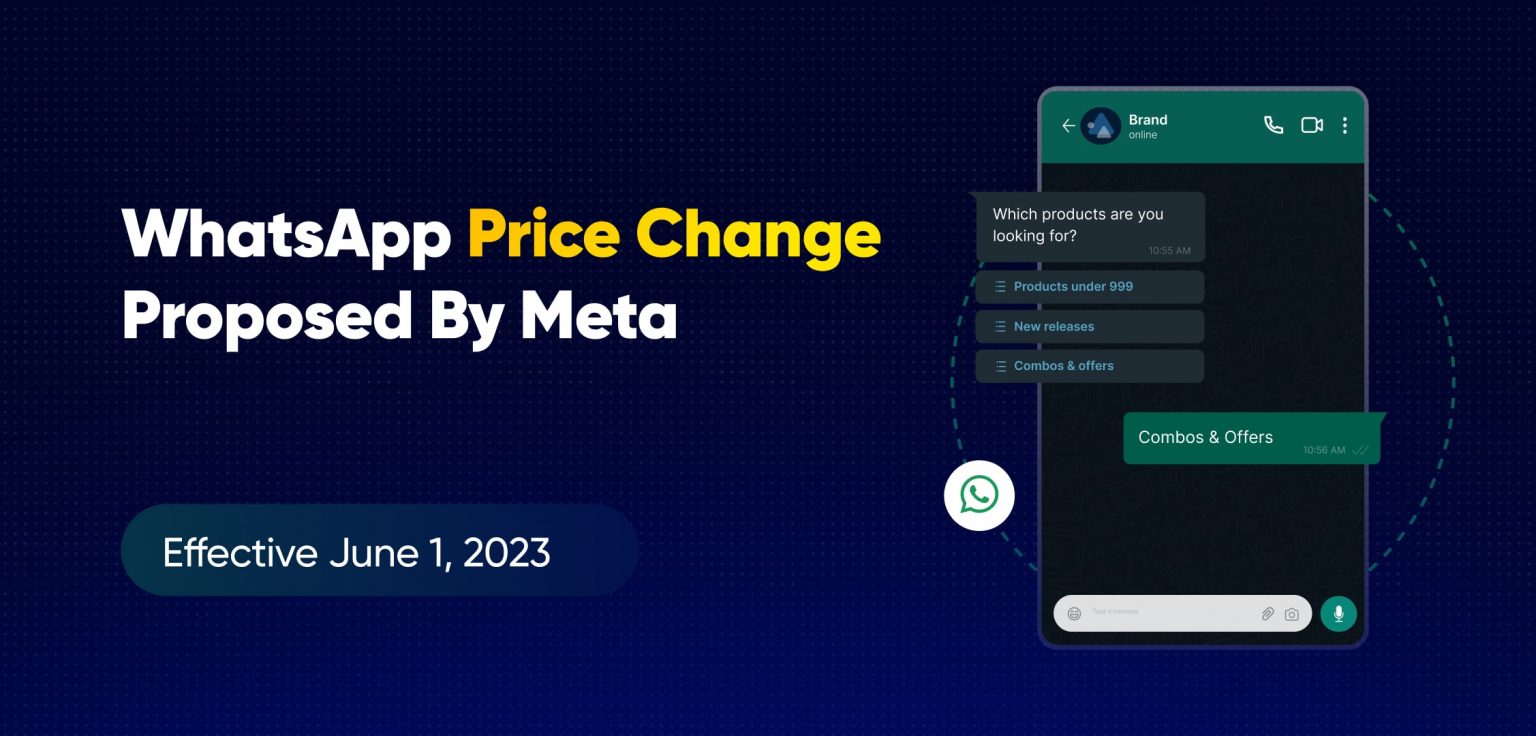
In recent times, the popularity of WhatsApp commerce has suddenly spiked among Indian businesses. So much so that nearly 15 million companies are rigorously using WhatsApp Business to build and enhance customer communication. The WhatsApp Business platform facilitates fast message exchanges over various devices, including smartphones, laptops, desktop computers, tablets, and smartwatches. This enables companies to engage in meaningful one-on-one conversations, leading to successful conversions. While the shift has proved beneficial to the e-retailers, Meta, the parent company of WhatsApp, has increasingly started monitoring the activities and has decided to take some necessary steps. One such step has been to upgrade WhatsApp pricing to align with the diverse use cases and experiences offered by the platform. The new WhatsApp pricing will be effective from June 1st, 2023.
Let’s dive deep and see what these changes mean for your business.
- The Old WhatsApp Pricing Model
- The New WhatsApp Pricing Model
- Different Types Of Conversation Categories 1. Utility Conversations
- 2. Authentication Conversations
- 3. Marketing Conversations
- 4. Service Conversations
- Hack No. 1 – Use The Click-to-WhatsApp Ad Strategy
- Hack No. 2 – Use Conversational Messaging
- Hack No. 3 – Abandoned Checkout Strategy
- Hack No. 4 – Smart Segmentation
- Hack No. 5 – Engage Throughout The Customer Life Cycle
The Old WhatsApp Pricing Model
Under the old pricing model (until June 2023), businesses were being charged based on conversations rather than individual messages. For instance, delivery notification.
Ideally, a fee was applied per 24-hour conversation window, irrespective of the number of messages exchanged between a business and its customers. The fee depended on who initiated the conversation.

The New WhatsApp Pricing Model
Starting June 2023, the new WhatsApp pricing model will sustain its primary characteristic, i.e. the conversation-based approach. However, it will lay more emphasis on the different types of conversations occurring throughout the customer journey.
WhatsApp Business will now encompass service-related interactions along with marketing messages, notifications, and other exciting features. These will be more aimed at delivering the ultimate customer experience at various touch points rather than just exchanging messages.
Changes in a nutshell:
Let’s now define different types of conversation categories and see what they entail.
- WhatsApp will not charge businesses per message but per 24-hour ‘sessions’ or ‘conversation windows’
- Cost per conversation will be charged irrespective of who starts the conversation – business or customer/user
- Within the 24-hour conversation window, WhatsApp will charge for both user-initiated or business-initiated conversations but depending on the country code of the user’s phone number
- A business will incur WhatsApp cost only when it sends a message to the customer either in response to a query or while sending a push message to customer
- The first 1,000 conversations per month will be free for each WhatsApp business API account
- Conversations that start from Ads that Click-to-WhatsApp or Page CTAs on Facebook will be free
- Meta enables businesses to send more types of messages to users who opt-in to receive them. These include, personalised product recommendations, informational alerts, relevant offers, and more.
Different Types Of Conversation Categories
To reflect its vision via the new WhatsApp pricing model, Meta has introduced four conversation categories. These are as follows.
These are business-initiated conversations which typically entail transactions, such as,
As per Meta’s new WhatsApp pricing plan, utility conversations have become cheaper with an aim to enhance customer service and experience.
As the name suggests, Authentication conversations are those that prioritise security.
Businesses ideally use authentication templates to verify user identities through one-time passwords during login or verification processes, including account registration and recovery.
While Meta is yet to reveal the final WhatsApp pricing for Authentication conversations, it’s expected to be lower than the existing rates and are aligned with Utility conversation cost.
Marketing conversations refer to business-initiated communication for promoting products or services to customers. Businesses can use Marketing templates to send relevant offers, deals, product restocking information, and more such messages to customers. Any business-initiated conversation that does not fit into the Authentication or Utility category falls under Marketing.
The rates for Marketing conversations have been increased. However, this category also offers a higher return on investment compared to other messaging channels.
Service conversations are typically user-initiated conversations and primarily aim to resolve customer inquiries. For instance, a conversation initiated by a customer for tracking their order or to know more about a particular product or service offered by a business.
The fees for Service conversations has been kept similar to the current user-initiated conversations owing to the nature of the category.
Note,
Since business-initiated conversations are more template-driven, Meta will now use these templates to determine the conversation type of the (24 hour) conversation window. Businesses will be able to switch between categories to start a new conversation. However, these will also be charged, but accordingly.
For instance, if you begin a conversation with a Marketing template to promote your newly launched products, it will fall under the Marketing category. And, you will be charged as per the new Marketing conversation fee.
However, if during the conversation, you switch to a Utility template, a new 24-hour window will begin and you’ll be charged as per the Utility conversation fee structure.
All the existing WhatsApp Business templates have been categorised under these four categories starting April 1, 2023.
Kwik Engage: 5 Hacks To Make The Most Of The New WhatsApp Pricing
Enable users to click on the pre-filled text ad CTA
Once a user lands on your WhatsApp chat, start a conversation with a click-to-view automated menu
The user can then navigate their way to discover your products or services and take a decision
Enable users to click on the pre-filled text ad CTA
Once a user lands on your WhatsApp chat, greet them with a welcome message
Send a follow-up message and connect the user to an agent for real-time conversation and query resolution
Initiated polls among fans, encouraging them to predict the match winner
Used CTA buttons to make predictions easier
Offered discounts as rewards to the winners
Offered exclusive discounts to fans supporting both the team
Ran additional campaigns to ensure engagement
- Initiated polls among fans, encouraging them to predict the match winner
- Used CTA buttons to make predictions easier
- Offered discounts as rewards to the winners
- Offered exclusive discounts to fans supporting both the team
- Ran additional campaigns to ensure engagement



![WhatsApp Catalog: How To Sell Products on WhatsApp [A Complete Guide]](https://panel.gokwik.co/storage/app/public/images/use_kwikengage_for_a_seamless_whatsapp_catalog_setup__1772512572.jpg)