A Comprehensive Guide To WhatsApp Automation For Shopify Sellers
 06 Jan 2026
 11 Min Read
Let’s be honest - Most Shopify sellers didn’t start their businesses dreaming of replying to the same “Where’s my order?” message 50 times a day on WhatsApp. Yet, that’s exactly where they end up. Juggling manual WhatsApp chats, switching between apps, missing high-intent conversations, and scrambling for order details mid-conversation quickly becomes the norm.
This is where WhatsApp automation changes the game. It lets you scale conversations without scaling headcount. From automatically nudging shoppers who abandon carts to personalizing offers based on intent, it manages all without your intervention. In this guide, we will take you through the A-Z of WhatsApp automation, including what it is, how to do it, real-life examples, and some handy tips to master it.
What is WhatsApp automation?
WhatsApp automation for business is the use of predefined workflows and rule-based logic to handle customer interactions on WhatsApp without manual intervention at every step. So, instead of responding to each message individually, you can automate conversations based on user actions or their intent. The core objective of WhatsApp automation is simple - to scale one-to-one conversations without compromising speed or relevance.
What are the benefits of WhatsApp automation for Shopify sellers?
For Shopify sellers, automation doesn’t just transform WhatsApp into an intelligent support tool. It turns it into a revenue and customer retention lever that helps them scale efficiently. Here are the most observable benefits of WhatsApp automation:
- Improved Customer Engagement: WhatsApp automation lets you respond instantly to common queries. You can also offer proactive updates to customers across their entire shopping journey. Such real-time and conversational interactions feel far more natural and personal than email or SMS. This results in higher customer engagement.
- Helps Scale Faster: By automating routine conversations and notifications, WhatsApp automation lets you manage growing message volumes without increasing support teams. This means you can scale operations efficiently.
- Higher Sales: Behavior-triggered messages help you reach shoppers at high-intent moments with relevant product recommendations and offers. This improves conversion rates and sales.
- Reduce Checkout Abandonment: WhatsApp automation makes it possible to follow up instantly on abandoned carts and address last-minute concerns. It can nudge shoppers back to checkout. All these significantly reduce drop-offs.
- Higher Loyalty Due to Better Customer Engagement: Consistent post-purchase communication and regular order updates can create a smoother customer experience that builds trust and encourages repeat purchases.
Key use cases of WhatsApp automation for Shopify sellers
Here are the most impactful WhatsApp automation use cases, across three different customer lifecycle stages:
- Catalog Sharing: Catalogs are sent automatically to your customers, who can browse products, view prices, variants, and availability directly within WhatsApp. It reduces friction and helps customers move faster from discovery to consideration.
- Targeted Offers & Discounts: Targeted promotions are sent automatically based on customer behavior or segments to create urgency and nudge shoppers toward a purchase.
- Reply to Product Queries: Questions related to pricing, sizing, materials, shipping timelines, return policies, availability, etc., are answered without human intervention.
- Abandoned Carts Reminders: Timely follow-ups are sent when shoppers drop off at checkout. Such follow-up reminders usually share cart details and checkout links.
- COD Conversion: Messages after a COD order are sent to nudge customers toward prepaid payment. This helps reduce RTO rates and improve successful order fulfillment.
- Order Confirmation Messages: Order details, next steps, and support information are sent in a timely manner to build trust and reduce post-checkout anxiety.
- Shipping & Delivery Updates: Customers can be kept informed at every fulfillment milestone, reducing “Where is my order?” queries.
- Collect reviews and feedback automatically: Customers can be prompted automatically to share reviews or feedback after delivery.
- Send reorder reminders for consumable products: Customers can be automatically reminded to restock products based on typical usage cycles.
- Trigger upsell and cross-sell suggestions: Complementary or higher-value products can be recommended based on what the customer has already bought. This increases average order value.
- Run loyalty programs or VIP customer workflows: Repeat or high-value customers can be automatically rewarded with exclusive offers or special communication flows that strengthen long-term brand loyalty.
How to implement WhatsApp automation for Shopify sellers?
Implementing WhatsApp automation successfully requires more than just enabling automated messages. Here is a step-by-step framework for Shopify sellers to build high-performing WhatsApp automation -
As the first step, look for a WhatsApp automation tool that goes beyond “messaging”. It should ideally combine personalization, analytics, behavioral segmentation, and the ability to manage marketing, transactional, and support conversations, all from a single system.
When a tool understands ecommerce workflows and the WhatsApp ecosystem equally well, automation shifts from messaging to measurable revenue outcomes.
A platform that meets all these requirements is Kwik Engage. It is a revenue-first CRM designed with WhatsApp automation at its core.
Once the platform is chosen, connect your Shopify store to enable real-time data flow. This integration typically syncs products, collections, customer profiles, orders, checkout events, fulfillment updates, etc.
This step is critical because it ensures WhatsApp messages are triggered by actual shopper behavior, such as product views, cart additions, failed checkouts, COD selections, or repeat purchases, rather than static lists or manual uploads.
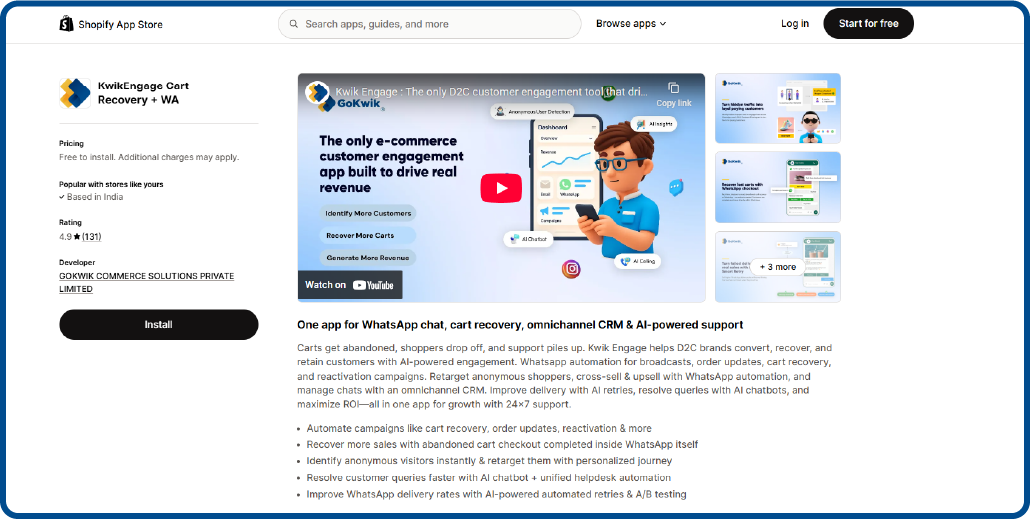
Connecting Kwik Engage with Shopify is a simple process. Just download the Kwik Engage app from the Shopify App Store. The app will guide you through basic setup, and before you know it, you will be all set for configuring your first WhatsApp automation flow.
Start with automation flows that directly impact revenue or customer experience. For instance, you can start with abandoned cart recovery, COD confirmation, or post-delivery follow-ups.
Kwik Engage lets you build event-based WhatsApp automation with great ease. You can set up workflows triggered by real user actions, such as COD-to-prepaid conversions, order and delivery updates, and RTO-risk-based workflows.
In addition to WhatsApp marketing automation, you can also set up customer support automation workflows in Kwik Engage. Our platform supports a majority of routine queries and delivers real-time, human-like responses. Best part - All conversations are managed through a unified support dashboard, ensuring consistent experiences for your customers and operational efficiency for your internal teams.
Another unique aspect of Kwik Engage is the AI-powered retries. Messages that fail due to Meta’s marketing limits are automatically retried at the right time. This is typically based on real-time customer and network conditions. Such intelligent retries improve delivery rates and conversions.
Effective WhatsApp automation should feel personal, even when you are engaging thousands of shoppers at scale. This is achieved by using easily available customer data to tailor messages dynamically. When personalization is done right, WhatsApp messages arrive with the right context at the right time. It makes them feel relevant and helpful rather than generic or repetitive.
Kwik Engage offers a clear data advantage for enabling personalization at scale. Through Kwik Insights, you can gain access to deep behavioral intelligence, including purchase frequency, payment preferences, RTO risk, and category affinity. These insights allow you to go beyond surface-level personalization and align each message with real shopper intent.
Apart from this, Kwik Engage also supports the creation of dynamic user cohorts based on buying behavior, engagement patterns, shopping frequency, and risk indicators. These segments help deliver highly relevant messages at scale, while maximizing conversions and retention.
Before launching automation flows, thorough testing is essential. Validate triggers, personalization tokens, message timing, payment links, and fallback scenarios. Testing ensures that your shoppers always and only receive accurate information, and broken journeys are avoided. Most importantly, it will ensure that the experience feels smooth from day one.
WhatsApp automation is not a one-time setup. You should continuously track performance using the built-in analytics of the WhatsApp automation platforms. With Wiz Engage, you can track key metrics related to ROAS, cart recovery, total revenue influenced, engagement (delivery, open, conversion), and campaign-level performance. All of these can be tracked through the built-in dashboard.
Real-life examples of WhatsApp automation
Here are three real-life examples showing how brands have used WhatsApp automation to boost conversions and operational efficiency:
Xplosive Ape is a direct-to-consumer fitness and apparel brand. The brand implemented WhatsApp automation via Kwik Engage to tackle the classic ecommerce issue of high cart abandonment. By sending automated follow-ups/nudges after every abandoned cart, Xplosive Ape was able to recover a significant portion of lost carts. Read the full case study.
Amydus is a lifestyle brand focused on quality consumer products. This brand used Kwik Engage’s WhatsApp automation capabilities to deepen engagement with its existing customer base. By creating behavior-triggered message flows, Amydus was able to re-engage past buyers and build repeat purchase behavior. Read the full case study.
Vembley is a fashion and accessories brand. The brand integrated WhatsApp automation to streamline customer support and nurture sales simultaneously. Automated chatbots were deployed to handle routine queries, significantly reducing manual intervention and freeing up support teams for higher-impact tasks. In addition, automated abandoned cart reminders and confirmations helped boost checkout conversions. Read the full case study.

Best practices for Shopify store WhatsApp automation
To get the most out of WhatsApp automation and drive measurable business outcomes, follow these best practices:
Want additional tips to master WhatsApp automation? Find out in this guide: 10 WhatsApp Automation Tricks to Boost Engagement for D2C Brands
- Avoid a spammy tone: Stick to approved message templates that sound conversational and human. Do not use pushy language. It can quickly lead to opt-outs and lower engagement.
- Always offer clear opt-out options: Give customers an easy way to unsubscribe or pause messages. This keeps you compliant and ensures you’re engaging only genuinely interested shoppers.
- Keep messages crisp and value-led: WhatsApp is a fast-moving channel. Focus on one clear action per message. Whether it’s completing a purchase or discovering a product, clearly communicating the value to the customer is more important.
- Respect frequency and timing of messages: Even relevant messages can backfire if they are sent too often or at the wrong time. Set sensible frequency caps. More importantly, align message timing with shopper intent. This will help avoid fatigue and disengagement.
- Design for two-way conversations: WhatsApp works best when it feels interactive. Enable quick replies and handoffs to the support team when needed.
Kwik Engage: Best WhatsApp automation tool for Shopify sellers
Kwik Engage is currently the best WhatsApp automation tool for Shopify sellers because it is built with a clear focus on revenue-first engagement. Our platform supports all the key use cases of WhatsApp automation, right from COD conversions to sharing timely order updates. With deep Shopify integration and data-driven segmentation at its core, our platform lets you convert more shoppers and retain customers at scale. So if you’re looking to turn WhatsApp into a fully automated revenue engine, get in touch with us today.
Frequently asked questions about WhatsApp automation

AUTHOR
Suhag Vamja
Head of Product Marketing @ GoKwik


![WhatsApp Catalog: How To Sell Products on WhatsApp [A Complete Guide]](https://panel.gokwik.co/storage/app/public/images/use_kwikengage_for_a_seamless_whatsapp_catalog_setup__1772512572.jpg)