The Indian eCommerce market is expanding at a rapid pace. Every year, the industry is witnessing the opening of newest conversion channels and is penetrating in areas where business once seemed impossible. However, amidst such expansion, the overseas market still remains a case in study. That’s primarily because selling products abroad comes with a plethora of challenges. These include, partnering with the right payment gateway that offers overseas payment acceptance services, paying high cost per transaction, going through endless security compliances and more. Amidst this, UPI global comes as a blessing in disguise for the Indian eCommerce brands.
With UPI going global and now available across 10 countries, Indian eCommerce brands can now tap into these markets as well and expand their business horizons. At present, UPI is available in Singapore, Nepal, Bhutan, United Arab Emirates, France, Saudi Arabia, Bahrain, Maldives, Oman, and The United Kingdom.
The Government of India is rigorously working on developing policies to enable people from these countries to easily pay via UPI without the need for an Indian mobile number or bank account. India has also signed MoU with 13 more countries that want to adopt India’s UPI payment model and make transactions seamless between the countries.
We believe this development will boost the Indian D2C brands that can now easily sell in these international markets and receive payments via UPI.
While we’ve established the overarching benefit of UPI going global, let’s deep dive and get to know the nitty gritty as well.
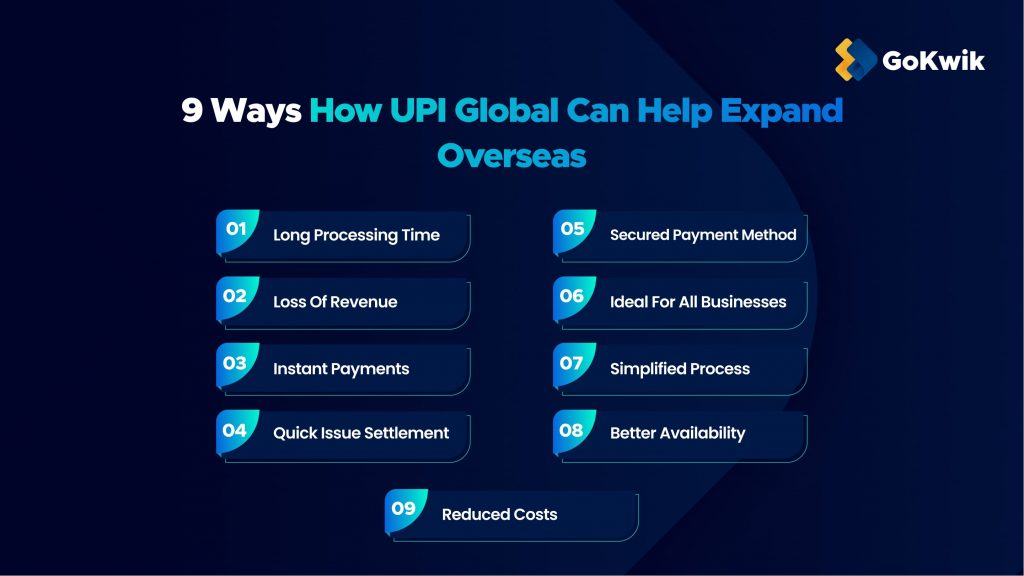
9 Ways How UPI Global Can Help Expand Business Overseas
Cross-border payment traditionally has been a cumbersome and slow process that involved a lot of paperwork with long transaction time leading to a poor customer experience.
Let’s look at some of the challenges that customers face in a traditional system and how UPI can solve them in the overseas market.
Many existing payment players that offer overseas payment services have rolling reserves. Meanwhile, the payments received via them are not immediately accessible to the merchants. If you have already been using the services of one of these payment players, you know how it impacts your cash flow.With instant processing through UPI, you don’t need to wait for the payment to happen. You can enjoy seamless and constant cash flow.
Traditional international payment channels take significant commission cuts per international transaction. This impacts profitability on the sales received and on the company’s overall revenue. On top of it, D2C brands also have to run discounting campaigns every now and then to entice customers. This further digs a hole in their pockets. On the flipside, since there’s no commission cut involved in UPI, a brand’s bottom line is not impacted. Additionally, unlike traditional payment methods such as credit card transactions, UPI transactions do not involve interchange fees, merchant discount rates, or setup fees.
The traditional cross-border payment is time-taking. It can take almost 5 to 7 days for a payment to arrive. That’s also because most overseas payments are done via credit cards. Meanwhile, by the time these payments arrive, products may get sold out or go out of stock. So it becomes difficult to process orders on time. This also often results in returning money to the client or facing backlash due to delayed deliveries.
But with UPI, this problem can be solved easily. UPI’s payment cycle works in a very different manner. When a payment is processed through UPI, settlements happen on an instant basis. This means more cash in and less waiting, confirmed orders, and better inventory planning.
In a traditional payment set up, settlements can take days depending on the channel or platform you use. For instance, PayPal can take anywhere between 3 to 5 business days to address issues like non-payments and chargebacks.UPI, on the other hand, resolves issues much faster. Its average time is about 2-3 days, keeping the businesses capital flowing.
Consumers want their funds to be safe. And, UPI offers that. Being an NPCI-product, UPI is much safer than many other payment options available on the market today. Besides using a 2-factor authentication system that includes the use of MPIN (similar to OTP), it also ensures that only authorized parties can complete a transaction.This adds an extra layer of security to the payment process. And, in the case of UPI global, security measures will be much stricter. This will give eCommerce businesses the breather they need and in turn, assure overseas customers the assurance of safe and secure payment transactions.
As seen in many cases, traditional payment methods are not one-size-fits-all. Besides, many of them may also have their own set of rules and regulations pertaining to different D2C business categories. For instance, PayPal and Payoneer do not offer their services to a certain category of health companies owing to different rules and regulations. Such companies either need to find some other way to do overseas business or not do it at all.
However, UPI is a one-size-fits-all solution. It allows all types and sizes or companies to do international transactions. With UPI global, everyone will be able to transfer and accept payments without any hassle.
UPI transactions are super simple compared to many traditional payment methods. One of the major advantages of UPI payments is that it uses proxy identities for payments. This makes transactions easier and only a linked ;mobile number is needed here.
Meanwhile, if we take the example of a credit or debit card, a shopper is needed to enter all the details on the payment page of an eCommerce brand, authenticate it, and then complete the payment. UPI eliminates the hassle and streamlines the process.
The best part, UPI is replicating the same mechanism in overseas countries. This means, just select UPI as a payment mode, open the UPI app or scan the QR, and authenticate payment. A 1 minute hassle reduced to a couple of seconds.
As often seen, most international payments can usually only be accepted by certain types of credit and debit cards in India. This means, eCommerce merchants of the nation can only target those international customers who have these specific credit/debit cards. In layman’s terms, in a pond of thousands of fishes to catch and fry, you can only pick one or two.
But, UPI global breaks these barriers. As established above, international shoppers do not need any Indian phone number or bank account, they just need the app on their phone. This means, anyone and everyone living in the 10 UOI-enabled countries can now shop from Indian eCommerce sites.
With UPI global coming into the picture, now businesses don’t just get access to the entire pool of fishes but fry as many as they want.
Since local taxes, cross-border fees, and exchange rates are not going to impact the overall cost of UPI, it will reduce the transaction charges for cross-border transactions. It can also help in reducing bank charges.Plus, the payment interface is super easy. So, it will simply be the corresponding relationships between international banks, thus reducing the time for each transaction. As a result, the bank will charge a lesser transaction fee.
5 Ways To Highlight The Advantages Of UPI Payment And Increase Overseas Sales
According to a post published by the Economic Times, credit cards alone clocked transactions worth USD 13 trillion in 2022. They’re also the most widely used payment method across the globe followed by debit cards. Asking people to shift their daily routine of using credit and debit cards over another payment method can be challenging.
However, owing to the successful adoption rate of UPI in India, it’s just a matter of effort before the entire world gets hooked to this most simplest payment method.
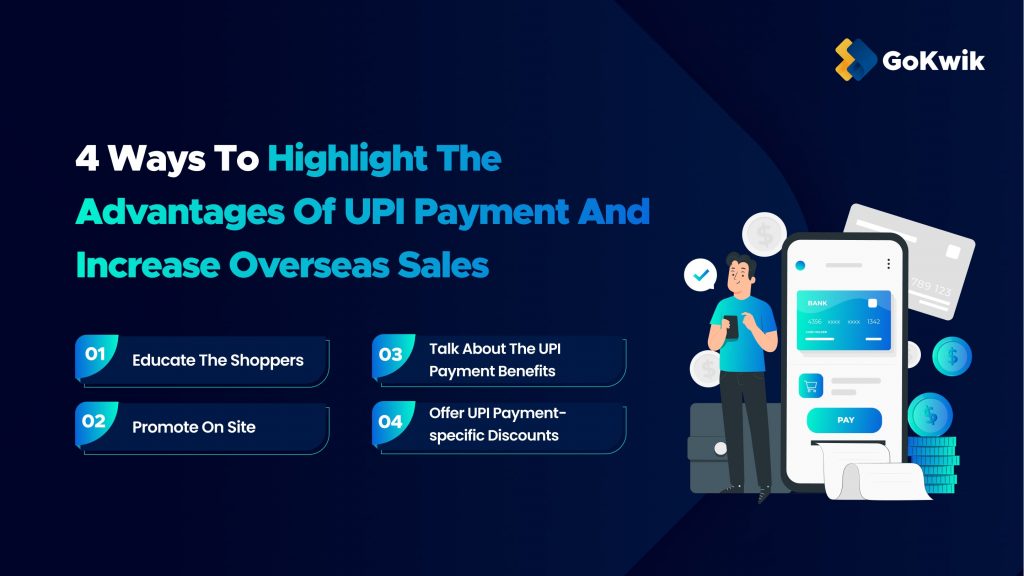
So, listed below are some ways Indian eCommerce brands can highlight the advantages of UPI payments to increase overseas sales.
Needless to say, educating your foreign audience on how UPI works and how simple it is can encourage your overseas shoppers to take the leap. For this, WhatsApp campaigns can work wonders for you.
Here’s why. WhatsApp is a globally used communication tool. By leveraging it, you can send targeted campaigns to your overseas audience and inform them how fast and secure UPI payments are. You can also share demo videos to give them a view into how the process works.
Most importantly, since WhatsApp now offers headless checkout with UPI integrated payment system, you can spread awareness around the same.
Your online store is the face of your brand. It’s where people engage with you and make the purchase. So, use it to your advantage. Rigorously use your site’s homepage to highlight that your store,
You can also add a demo link on how to use UPI global to make payments for shoppers to understand and feel more comfortable.
Besides this, take your promotions to social media sites as well. Use platforms like Instagram, Facebook, and even Twitter to spread awareness. Highlight the benefits of cross-border UPIs for your international customers.
Mention how easy it is to use UPI.
Most importantly, don’t forget to mention how safe and secure it is to make payments via UPI global over other modes of payments.
Another way to increase the adoption of UPI overseas and bag international sales is by offering freebies and discounts when the customer pays via UPI.
For instance, GoKwik enables its partner merchants to offer discounts on UPI payments to end customers. This technique has helped many eCommerce businesses increase prepaid orders and steady flow of cash in their bank accounts.
From a customer’s point of view, everyone loves discounts. No matter if they get it by making payment via UPI or any other means. So, leverage this psychology to your advantage.
Conclusion
Being able to take UPI payments can be a game-changer for your business growth strategy. And with GoKwik, we want to make it simpler by helping you create an easy-to-use checkout interface on your store as well as through popular channels like WhatsApp.
Ready to take cross-border orders from customers? Book a demo with GoKwik today.


![WhatsApp Catalog: How To Sell Products on WhatsApp [A Complete Guide]](https://panel.gokwik.co/storage/app/public/images/use_kwikengage_for_a_seamless_whatsapp_catalog_setup__1772512572.jpg)