According to Baymard Institute, the average shopping cart abandonment rate is around 70%. And more than half of these instances happen during the payment stage of the checkout process. This can be attributed to a variety of reasons, including a lack of payment options (accounts for 9% of abandoned carts) and transaction decline (accounts for 4%). If you’re running an e-commerce business, with a high abandonment rate at the payment stage means you could be missing out on significant sales. So, it’s essential for you to analyse the reasons and take action to reduce them.
What stands out is that customers who abandon their carts at the payment stage are not just browsing. They have already made the decision to purchase, but due to certain limitations on your e-commerce site, they abandon their carts right at the time of the payment. To address this, it’s crucial to improve the payment process and streamlined it to ensure a positive customer experience and minimize cart abandonment rates.
So, in this article, we will look into the top reasons for shopping cart abandonment at the payment stage and the right strategies to overcome the issue.
Top Reasons Behind Shopping Cart Abandonment At The Payment Stage
Some shoppers may be reluctant to share their credit card information, especially if they are visiting your e-commerce site for the first time. They could also be from an older generation, and hence less comfortable with online transactions. To avoid losing these potential sales, it’s important to offer various payment options that cater to different preferences, such as Cash, UPI, Debit Cards, and other digital payment methods.
By providing multiple payment options, you can reassure customers that their financial information is secure and make buying stuff easier.
When a transaction fails at the final stage of a customer’s purchase journey, it leaves a negative impression and impacts their overall experience. So, it’s important to identify the root causes of transaction failures, which could be technical issues, incorrect payment information, or payment gateway integration problems, among others. The customers may not be aware of all of these. In such a case, they will assume that the fault lies solely with your e-commerce site. They may fear losing their money, be sceptical about your e-commerce site, and may even abandon your site forever.
To address the issue, start by fixing any technical glitches on your website. Optimise your payment process for all devices — laptops, desktops, and phones. Fix the payment integration issues, by partnering with reliable payment gateways like PayPal, Amazon Pay, WePay, Stripe, Square, etc.
What else is required is to inform customers why their transaction is failing. If they have entered the wrong credit card information, show them an error message so that they can retry. Providing quick and user-friendly visual cues to guide customers through the payment process reduces the risk of errors or confusion. Furthermore, offering customer support, such as a chatbot or live support, can assist customers in completing their transactions.
It is quite possible that the pricing on your e-commerce site is based on the physical location of your business. But e-commerce stores having international presence display prices in different foreign currencies. If customers can’t find the pricing in their native country’s currency, they may get confused and opt out of your site.
Ensure that prices are displayed in the right currency for the customer’s country location using IP address. Customers should also be given the option to change the currency by selecting the country.
Hidden or unreasonable shipping prices can be a major turnoff for customers shopping on your e-commerce store. Customers are extremely frustrated when they see a high shipping price, especially on the payment page when they’re about to make a purchase. This leads to
To prevent this, it’s important to be transparent about your shipping costs. Offer clear information upfront so that customers can make informed purchasing decisions and do not experience any remorse later.
- negative perceptions of your business
- causes customers to rethink their decision
- makes them abandon your site forever
Strategies To Reduce Shopping Cart Abandonment At The Payment Stage
Not many brands understand the importance of a good payments page. According to many studies, a transaction failure is more dangerous than a slow checkout process. Listed below are some effective strategies to reduce shopping cart abandonment at the payment stage.
This is more like a known fact yet often missed by most D2C eCommerce brands. In India, people are finally adopting the concept of online payment. And, many new digital payment modes being introduced every now and then. For instance, UPI, BNPL, et. These are increasingly becoming the go-to payment options of today’s generation. So, to ensure negligible drop offs at this stage, ensure to embed all the top and most popular payment modes on your payments page.
Offering multiple payment options is one part. Ensuring that transactions don’t fail is the other important aspect. No matter how many payment options you offer, if transactions fail, its game over. To ensure this doesn’t happen, partner with a good payment service provider, like GoKwik.
Since Gokwik itself partners with multiple payment gateways, ensures least transaction failure, further eliminating the risk of customer remorse and permanent abandonment. If a transaction fails on the server of one payment gateway, it seamlessly re-routes the payment via another payment gateway to make sure that transaction doesn’t fail.
This is a tried and tested technique that helps reduce cart abandonment at the payments stage.
Discounts is something that has the power to enNot having any discounts or special offers at the payment can really turn off customers. They might think the price is too high and start to have second thoughts. Plus, if they can’t find any promo codes or deals on shipping, they might feel let down.
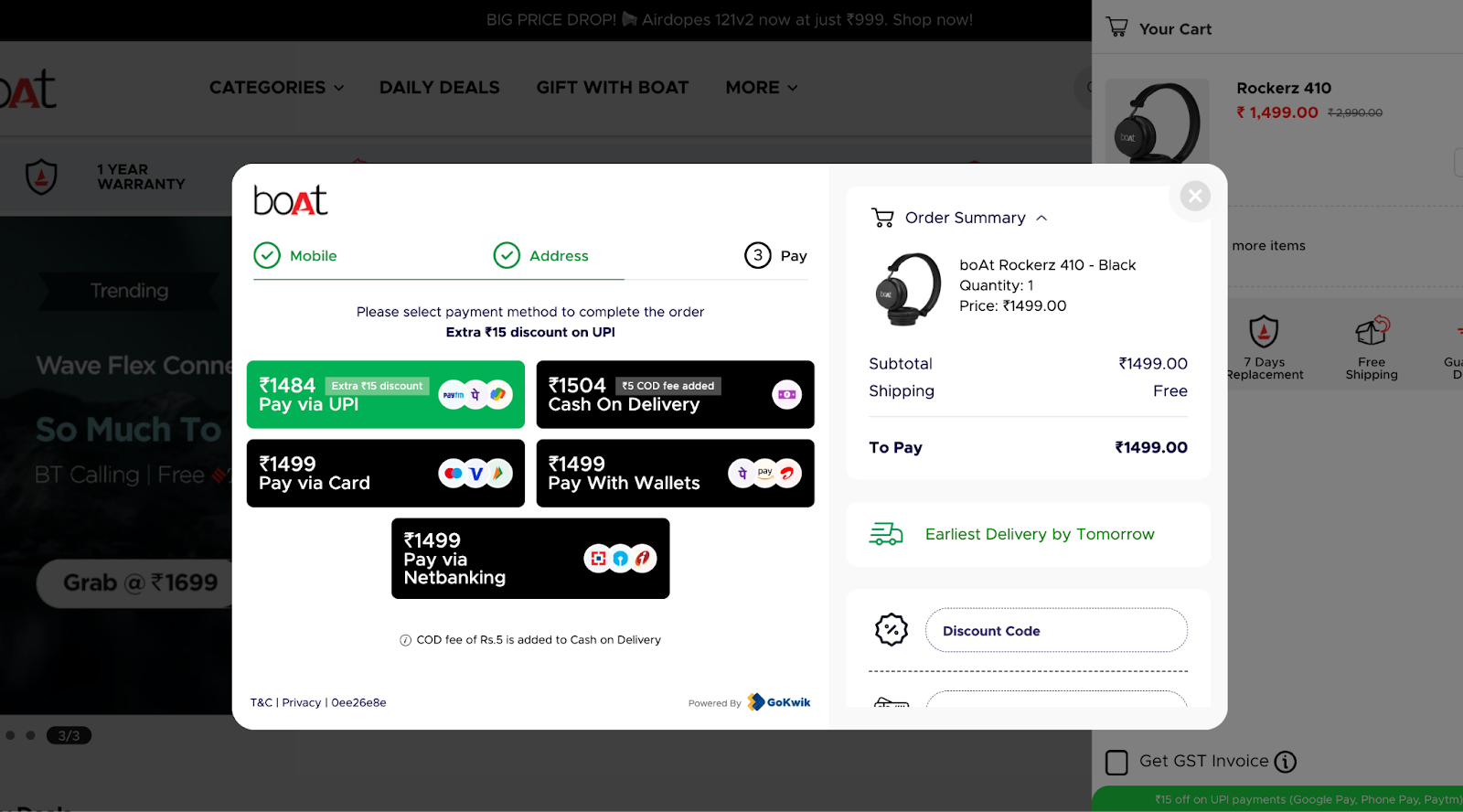
Offering discounts at the payment stage is always a good surprise customers would want to have. For instance, a customer can save INR 100/- by completing the purchase via UPI on top of the regular discount offered by you on products.
Boat is a good example here – “Save 15% by completing the purchase using UPI”. This helps reduce the chances of abandonment.
Users can be confused and frustrated at the payment stage for multiple reasons. This can be due to poor website design, confusing navigation, and unclear instructions for payment. They may become frustrated and spend an excessive amount of time attempting to complete their purchase. This can lead to a higher likelihood of cart abandonment at the payment stage.
To make sure customers don’t abandon their cart during payment, look to e-commerce giants like Amazon for inspiration. Create an easy-to-navigate site with clear payment buttons and instructions. And, don’t mess with the customer’s payment intent! Keep it simple, secure, and be straightforward, and you’ll build trust and boost sales.
Conclusion
Losing customers at the payment stage can seriously put a dent in your profits. By taking into account the reasons we’ve discussed and putting these strategies into action, you can earn your customers’ trust and make payments a breeze for them.
You’ll establish trust with your customers and make it easier for them to make purchases without any unnecessary obstacles in the way. Ultimately, this can lead to increased sales and a positive customer experience.


![WhatsApp Catalog: How To Sell Products on WhatsApp [A Complete Guide]](https://panel.gokwik.co/storage/app/public/images/use_kwikengage_for_a_seamless_whatsapp_catalog_setup__1772512572.jpg)