Table of Contents
What is PCI DSS Compliance? Why is PCI DSS Compliance Important? 1. It Offers Customers Peace Of Mind 2. It Minimises the Risk of Breaches 3. It Provides A Security Standard 4. It Helps Save Money What Are The Basic PCI DSS Requirements? Basic PCI DSS Requirements GoKwik Is Now PCI DSS Compliant The outbreak of the COVID-19 pandemic has prompted financial inclusion – driving a massive increase in digital payments in India. According to sources, the country clocked 8,840 crores worth of transactions in FY 2021-22 and is all set to witness a massive surge by the end of FY 2022-23. Nearly one-fourth of these account for credit and debit card transactions. As a known fact, the risk of security breaches in the case of online payments, especially credit and debit card transactions, is fairly high. To mitigate the risk, there’s an ever-increasing need for online businesses to build/embed a secure payment platform that ensures customer data safety and security at all times.Payment Card Industry Data Security Standard otherwise known as ‘PCI DSS’ is one such regulation that protects the interest of customers as well as online businesses. Any business involved in processing online payments must comply with PCI DSS rules to safeguard customer data.While this is the gist of it, let’s now get into the nitty-gritty of things. In this blog, we’ll talk about the importance and basic requirements of PCI DSS and why GoKwik felt the need to become PCI DSS compliant.
- What is PCI DSS Compliance?
- Why is PCI DSS Compliance Important? 1. It Offers Customers Peace Of Mind
- 2. It Minimises the Risk of Breaches
- 3. It Provides A Security Standard
- 4. It Helps Save Money
What is PCI DSS Compliance?
Payment Card Industry Data Security Standard, or PCI DSS was jointly established by many top-tier credit card companies back in 2004. The regulation primarily includes a broadly accepted list of policies and procedures typically meant to optimise the security of credit and debit card transactions in the country and protect the personal information of cardholders against any wrongful use. Any merchant or service provider that processes, transmits, or stores a cardholder’s data must be PCI DSS compliant. If an entity fails to comply with PCI DSS rules and regulations, they stand a chance to lose their card processing privileges and even be penalised for their actions.
Why is PCI DSS Compliance Important?
The control measures defined under the PCI DSS regulations help reduce the risk of customer data loss and identity theft. They also come packed with many best practices to detect, prevent, and remediate data breaches, and help merchants carry out their business without worry. This ultimately helps instil a level of trust among customers that their data will be kept safe and hence, offers them peace of mind.
What Are The Basic PCI DSS Requirements?
The Payment Card Industry Security Standards Council (PCI SSC) has laid down 12 requirements under 6 categories to ensure customer data safety and payment process security. Each of these 12 requirements is necessary for any business to comply with and become a PCI DSS-compliant entity.
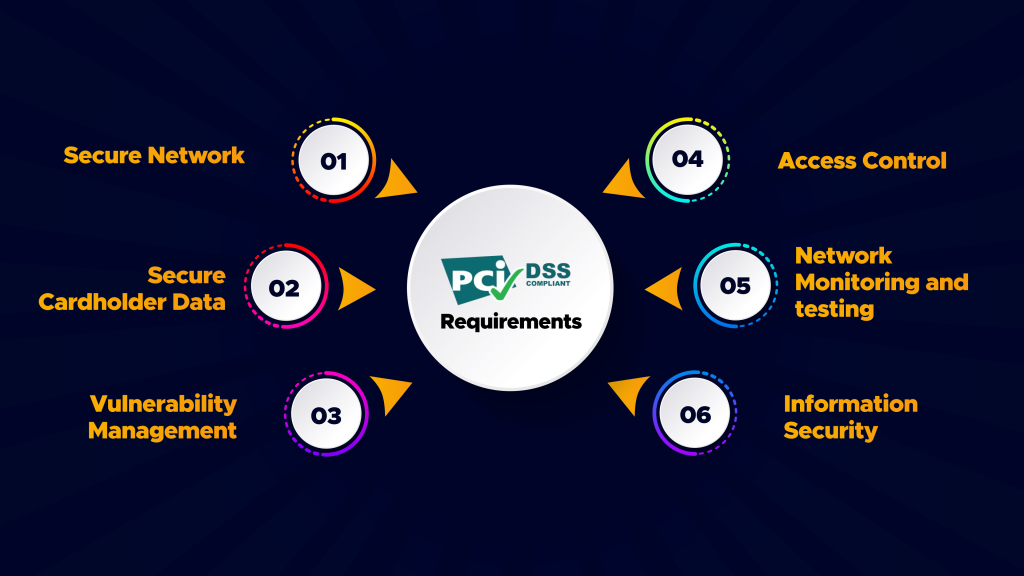
Basic PCI DSS Requirements
A business must install and maintain a fireball configuration.
System passwords must always be unique and original, and not supplied by the business.
Protect a cardholder’s stored data at all times.
Encrypt a cardholder’s data in the case of transmissions across public networks.
Use and regularly update anti-virus software to eliminate the risk of breaches.
Develop and maintain secure systems and applications.
Restrict cardholder data access on a business need-to-know basis.
Assign a unique ID to every individual with access to a business’ customer data.
Restrict physical access to cardholder data.
Regularly track and monitor network resources and cardholder data access points.
Regularly analyse and test business security systems and processes
Maintain policy dealing with the information security system
GoKwik Is Now PCI DSS Compliant
GoKwik understands the importance of customer data. Hence, we have invested heavily in building an industry-standard infrastructure along with gaining PCI DSS certification to ensure that the private data of our customers never gets compromised.While PCI DSS compliance is a prerequisite, we also use the highest assurance SSL certificates and have incorporated a very robust risk management system to ensure no unauthorised individual can access any of GoKwik’s sensitive data over the internet or causes harm in any manner possible. Access GoKwik’s PCI DSS Certification from here.



![WhatsApp Catalog: How To Sell Products on WhatsApp [A Complete Guide]](https://panel.gokwik.co/storage/app/public/images/use_kwikengage_for_a_seamless_whatsapp_catalog_setup__1772512572.jpg)