Table of Contents
Offering discounts on purchases is one of the most effective ways to draw consumers into your eCommerce store. When shoppers get to save those extra bucks, they’re buying more. However, slashing prices just to get those fence-sitters to convert into paying customers may work wonders at first, but not always. They’ll just shrink the margins and significantly affect business revenue. So, how to offer eCommerce discounts yet earn profits? Build the right discount pricing strategies.
In this blog, we’ll help you,
- What Is A Discount?
- What Is An eCommerce Discount Pricing Strategy?
- Different Types Of Discounts To Boost Sales 1. Bundled Discounts
- 2. Percentage Discount
- 3. Absolute Discounts
- 4. Loyalty Discount
- 4. Buy X, Get Y Discounts
- 5. Promotional Discount
- 6. Payment Discounts
- 7. Tiered Threshold Discounts
- 8. Gift Cards
- 1. Use X% Discount Instead Of $ (Also Known As The Rule Of 100)
- 2. Study And Protect Perceived Value
- 3. End Your Discount Pricing At .99 Instead Of .00
- 4. Free Shipping If You Spend Over X Amount
- 5. Use Discount Floor Pricing To Curb Losses
- Understand the importance of discount pricing
- Discover different types of eCommerce discounts for your business
- Explore smart ways to utilise discount pricing strategies to reduce cash burn
What Is A Discount?
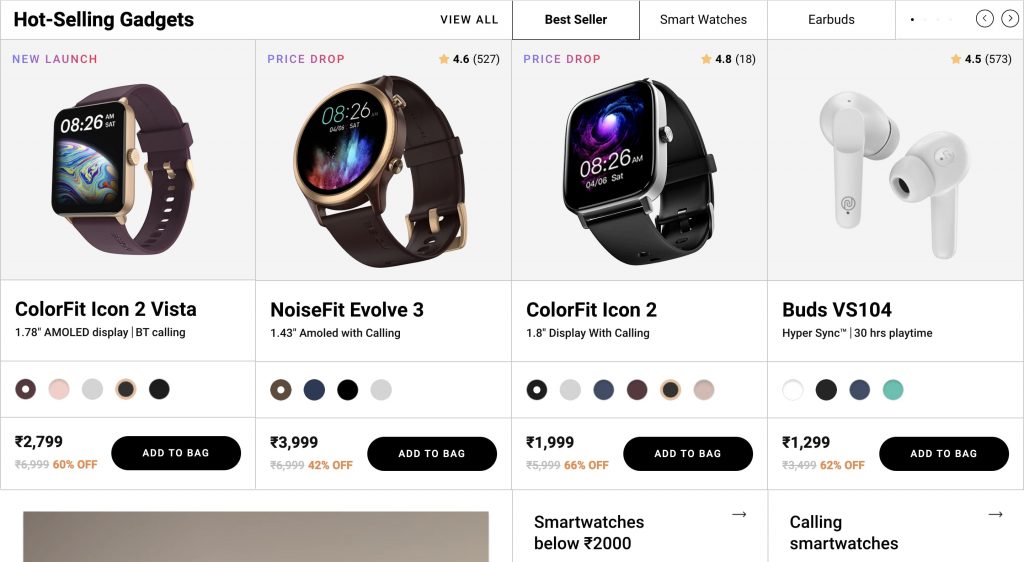
eCommerce discounts are a kind of promotion activity that helps businesses across the retail domain to attract customers, increase average order value, and ensure a high conversion rate. For instance, Noise uses different types of discounting strategies to invoke a sense of urgency in the minds of customers prompting them to buy the product(s) before the sale ends.Businesses can use discounts to unlock non-moving inventory, promote new items or simply to attract new shoppers onto their platform. eCommerce discounts also offer much value to shoppers, especially to those people who find it easier to make purchasing decisions due to the lower prices.
What Is An eCommerce Discount Pricing Strategy?
An eCommerce discount strategy is a means to provide the right deals and offers to the right target audience at the right time across various products and services. Consider it as a way for eCommerce brands to boost sales. By reducing the prices of goods or offering promotional deals, brands can lure customers to make a purchase.
Let’s take an example to understand this statement.
For instance, say Diwali is just round the corner. It’s one of those times when you know that people across your target segment shop the most. Meanwhile, your competitive brands too are gearing up to increase their conversions during this period. So, to enjoy an edge,
Since discounts are often temporary, they’re an excellent way to create a sense of urgency in the minds of shoppers and urge them to shop before the offer is gone.
While this makes sense, what you need to consider beyond this is to find the right types of discounts which can add value to your entire eCommerce discounting strategy. Let’s take a look at them in the section below.
_1697114527.png)
Different Types Of Discounts To Boost Sales
As an eCommerce brand, you can leverage a variety of discounts to boost conversions and generate high business revenue. Some of top, most popular, and conversion-centric discounting types are as follows.
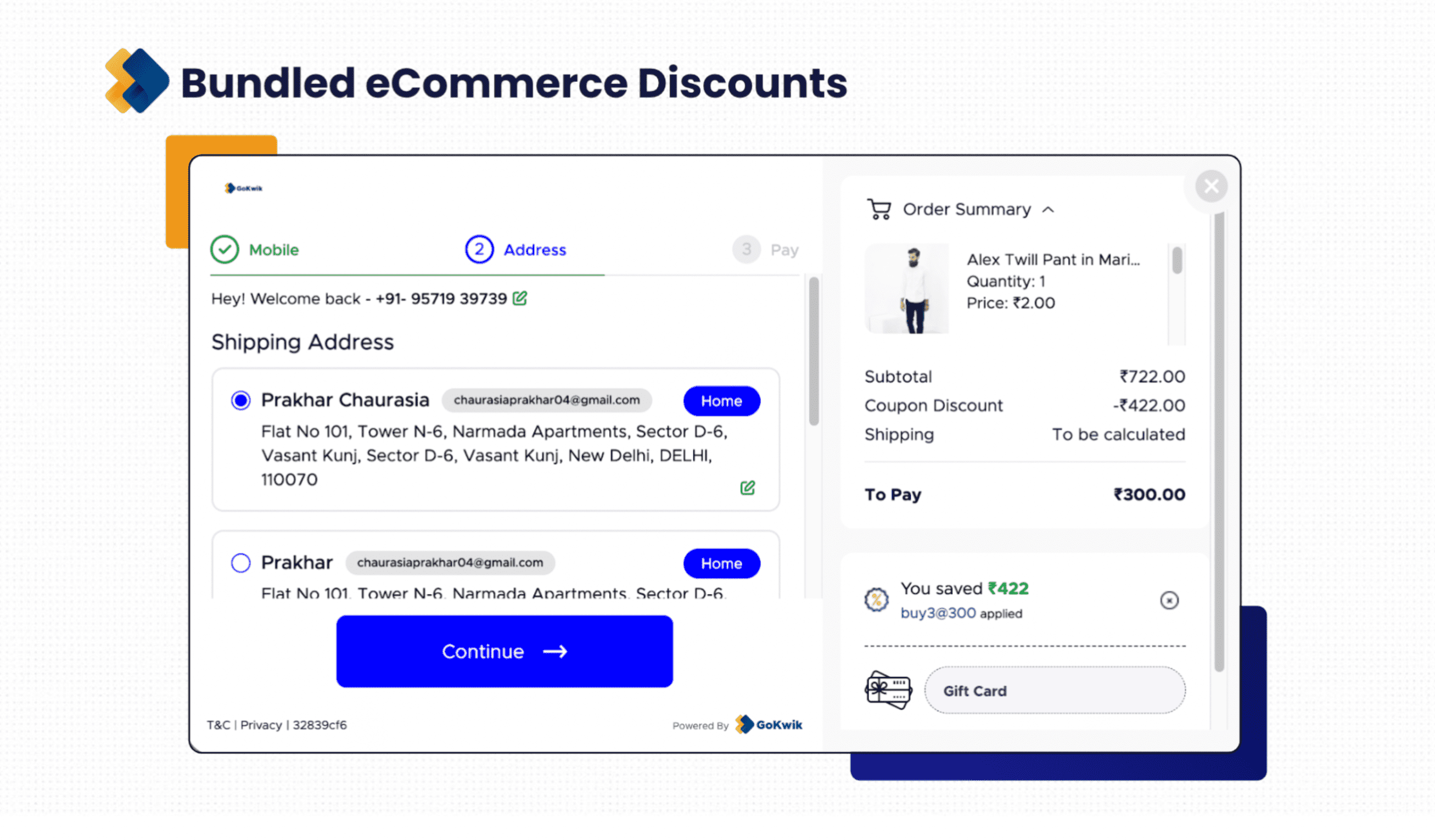
Bundled discounts are ideally those eCommerce discounts that allow you to offer multiple products together at a reduced combined price as compared to purchasing each of them separately or individually. The discount approach has many advantages. They,
For instance, "Buy 3 products at just INR 999/-,” “Buy 2 products for just INR 399/-," “Get 10% off on a purchase worth INR 2000/-,” “Buy products worth INR 3000/- and get a 30% off on total cart value," and more. Bundled discounts work best for those eCommerce brands where customers want to buy,
As the name suggests, percentage discount refers to those types of eCommerce discounts where a brand offers a certain percentage off on a purchase made by a buyer. In other words, a brand deducts a certain percentage from the original price of a product or order to entice customers to make the purchase. They are often expressed as a percentage off the regular price.
The primary purpose behind offering such eCommerce discounts is to,
There are many ways to offer Percentage discounts. For instance,
Percentage discounts help pique a shopper’s interest and give them an extra push to buy their desired products at a cost lower than the MRP.
GoKwik recommends using this discounting type on high-value items. Percentage off makes the product seem more desirable, hence, increasing the chances of conversions.
Absolute discounts are those where a specific amount is subtracted from the original price of the product or order. They’re more like a fixed reduction in price when compared to percentage discounts. The benefits of offering such discounts are as follows.
The best example of absolute eCommerce discounts would be, “Save INR 399/- on your purchase of INR 3999/- or more," or “Get 200 off on the purchase of items worth INR 1499.” Read More: Maximise Black Friday Sale Profits With GoKwik’s 200+ Discount Configurations
A loyalty discount is a way to reward your loyal customers with incentives on price or discount rates. It’s a way of showing appreciation to customers who stand by your business.
A good example of this discounting strategy in eCommerce is Fire Boltt. The audio and wearables brand has developed a unique loyalty program for its users in the form of gamification. Every time a user walks a certain number of steps, listens to music on the Boltt Play App or plays a game, they earn coins. Users can then use these coins to make in-app purchases.
The core value? Customers think that they’re buying products for free at discounted prices, but Fire-Boltt is gaining in terms of engagements, app downloads, brand loyalty, and even increased conversions.
Similar to Fire-Boltt, GoKwik has partnered with some leading Loyalty Points apps enabling many of its D2C partner merchants to allow their customers to earn and burn points while increasing the brand’s GMV as well as conversion rates.
Buy X, Get Y eCommerce discounts are by far the most effective and widely used pricing discount strategies used by online retailers in India. Here, shoppers ideally purchase one or more items at the regular price and receive additional items at reduced or discounted prices, or for free. Such deals are highly effective because they,
Dr Vaidya’s a great example to quote here. One of the leading ayurvedic brands of India, Dr. Vaidya’s uses BX,GY eCommerce discounts to incentivise shoppers to purchase more items.
Another great thing about using BX,GY eCommerce discounts is that you can create personalised product bundles that make sense to your buyers. This, in turn, helps increase the chances of conversions and even repeats. From a business perspective, you move your surplus products or increase the sale of less desirable items out of the warehouse faster than usual.
Some possible BX,GY discounting conditions and examples are as follows.
Example: "Buy one pair of everyday slippers, get another pair for free."
Example: "Buy a Dress at Full Price, Get the Second Dress (of equal or lesser value) at 50% off."
Example: "Buy one hoodie and one pair of jeans, and get the lower-priced item at 50% off."
Example: "Buy a laptop, and get 30% off any laptop bag."
Example: "Purchase items worth INR 799/-, and Get Free Shipping on Your Entire Order"
Example: "Buy Beauty Products Worth INR 5999/-, and Get Noise Cancellation Headphones By Y Brand Free"
It’s basically an eCommerce sales strategy where brands try to attract prospects and customers by reducing the prices of products for a short period. The short-time discount boosts the value of a product as it creates a sense of scarcity. Cost-conscious customers are very much attracted to making purchases.
For instance, as you can see in the image below, OZiva is running a Super Summer Deal offer for customers to avail up to 40% discount on select products but for a limited time period only.
While the above-mentioned discounts on online shopping are great, prepaid payment discounting can act as the cherry on top. Offering discounts on payment methods such as “10% discount on UPI payment” can help eCommerce businesses increase prepaid orders. This discounting technique is especially useful for businesses where return-to-origin as a result of cash-on-delivery orders is very high.
To give you an example, Ek By Ekta Kapoor increased prepaid orders from 43.75% to 51.78% by implementing GoKwik-powered Payment Discounts on its website.
Offering discounts on payment methods lures shoppers to avail additional rebates on their purchases. From a business point of view, you reduce the chances of CODs resulting in RTOs, get those funds faster in your account, and register more profits. Moreover, prepaid payment discounts can,
Tiered threshold discounts are another way to encourage shoppers to shop more and increase their average order value. Some examples here could be “Purchase 4 items, get a free Perfume worth INR 999,” “Get 20% off your purchase of INR 2000,” “Shop for items worth INR 149 and get free delivery,” etc.
This discounting technique is especially useful for eCommerce businesses that sell low-value ticket items, like online grocery stores, beauty stores, etc.
See how smartly Sugar Cosmetics uses Tiered Threshold Discounts to their leverage.
Gift cards make for another great discount type for eCommerce businesses. These are an appropriate gifting option that you can send to your customers to lure them to purchase on your eCommerce website. These could be promotional or could be sent to loyal customers to tell them that they’re valued.
Besides, from an economic point of view, offering gift cards helps reduce the instances of exchanges and returns. That’s because gift cards, once used, cannot be redeemed again if a person returns the item. it comes with an under-written statement that if you use it once, it cannot be used again.
Read More: Maximise Sale Profits With GoKwik’s 1000+ Discount Configurations
How Do Discounts Affect Customer Behaviour?
Believe it or not, discounts have a captivating charm. Be it customers or eCommerce stores themselves, discounts manage to lure everyone. After all, offering discounts is a win-win situation for everyone.
As per a survey conducted by Springer Open, it was found that people who avail discounts feel happy, excited, and pleased. The chances of them converting into repeat customers is also quite high. From an eCommerce point of view, discounts help spike sales. They help increase conversion volume by a minimum 2x in a single day. So why not use them to the brand’s benefit?
Beyond this, discounts also affect how consumers perceive and interact with your brand. If your eCommerce store constantly offers discounts to its customers, the chances of brand loyalty increase even further.
Additionally, when you offer discounts, you also gain customer trust. This certainly helps build a brand reputation as well. Just to give you an example, boAt constantly runs discounts on its platform. Unlike the general perception around brands offering discounts, boAt proves that offering discounts is a way to gain trust in people and convert into brand loyalists.
In fact, according to many studies, it has been proved that discounts help reduce the propensity of customers to shop around. When a brand constantly offers discounts to its shoppers or matches the competitive discount pricing of its competitors, shoppers will stick to your brand no matter what.
Last but not least, discounts create a sense of urgency in the minds of shoppers. They entice them to shop for their products before the deal is gone. From a shopper’s perspective, they want to encash every steal-deal possible. From a brand’s perspective, you’re shipping out high-ticket-size orders, generating more revenue, and even in some cases, moving that stuck inventory out of your warehouse.
_1697114527.png)
4 Discount Pricing Strategies That Help Reduce Cash Burn
There’s a science behind this concept. A marketing professor, Jonah Berger, in his book “The Rule Of 100” says,
Therefore, the way you showcase your discounts to customers plays a crucial role in your success.
Discounts don’t necessarily go well with every brand, product, and customer. They can sometimes impair the perceived value of the brand.
For instance, people perceive luxury goods as superior simply by them being expensive. They conclude that higher-priced goods are made with better-quality materials. It’s simply like buying a Prada or an iPhone. For many others, buying luxury products is a sense of accomplishment and pride.
But when the price drops, consumers view the product as being inferior in quality or something outdated leading to a loss of sales.
Therefore, be mindful when crafting a pricing strategy for your products. Understand human psychology and play around it. The motive is to drive sales while ensuring that your brand perception does not change along the path.
Another interesting fact to note is that shoppers are more likely to pick a product whose price tag ends in .99 than one with .00. It may sound a little off but it’s true.
Psychology says that a person will think twice before buying a product priced at INR 100. But, they’ll take half the amount of time in picking and adding the same product in their cart, if it’s valued at INR 99.
The digit play here makes all the difference. Take Lenskart for example. As visible in the image below, the eyewear brand’s OJOS range starts from INR 1199, which is, in fact, INR 1200 but just a rupee less. The general human perception reads it differently. It reads it as Eleven Hundred And Ninety Nine and Not as Twelve Hundred.
A similar play of digits while offering discounts can also work wonders. So, plan your discount strategy accordingly.
So, it clarifies how listening to your price a certain way can have more benefits.
Free shipping is another interesting example of an eCommerce discount pricing strategy and an effective one to increase sales. Research has shown that 93% of consumers buy more when a free shipping option is available. No matter their cart amount, free shipping helps shape the minds of customers that the brand they’re shopping from is considerate and willing to take some load off the shoulders of the shopper.
Here, as an eCommerce brand, you can leverage this technique by converting it into a discounting strategy. Ask your customers to spend an X amount avail free delivery on their orders. It’s something that giants like BlinkIt, Zepto, and even Swiggy Instamart are using. The benefits you asked? Those would include, increased average order value, logistics cost covered, and high conversion rate.
No matter how strategically you craft your discounting schemes, they do ultimately affect your profit margins even if it’s marginally. But, across some industries, discounts play a major role and implementing a discounting strategy like floor pricing becomes imperative.
Discount floor pricing refers to a phenomenon of setting the price of a product (including modifiers) in a manner that it doesn’t cross a certain threshold. This comes irrespective of how big the discount is.
To give you an example, if you announce that your store is now giving 60% discounts across all its products, then you can set the pricing of your products in a manner that customers get that promised 60% discount and you get to keep your profit margins intact.
_1697114527.png)
Wrapping It Up…
By now, you must have clearly understood that offering discounts to customers is not just vital to gain more traction on your site and increase conversions, it’s about satisfying a customer’s mind’s psychology. And the best part is that even though most people understand the concept of discounts, it still plays them over.
However, implementing the right discounting strategy on your website is equally important. If you embed discounts that are invaluable for most customers it’s a waste of your time and efforts.
If you’re unsure of which discounts you should leverage, contact us. Through our 1000+ discount configurations, Gokwik helps you maximise your sales while helping you keep those profits intact.


![WhatsApp Catalog: How To Sell Products on WhatsApp [A Complete Guide]](https://panel.gokwik.co/storage/app/public/images/use_kwikengage_for_a_seamless_whatsapp_catalog_setup__1772512572.jpg)