Table of Contents
Customer satisfaction is paramount, especially in an era where the key to the success of a business lies in the hands of customers. This is especially more prominent in the case of online D2C businesses because for them to flourish, they need to meet customers’ needs to ensure high conversions and year-on-year growth. Of these customer needs, offering cash on delivery (COD) as a payment option sits on top of the list. However, from a brand perspective, the disadvantages of cash on delivery are equally high.
In this blog, we’ll touch base on
Let’s get started!
Cash on delivery remains quite prevalent in India even in 2023. That’s because a major chunk of the Indian shopper base lies in Tier 2, 3 and beyond cities where customers are still learning the art of making online payments. Meanwhile, offering cash on delivery in these cities is becoming increasingly important for D2C businesses as tier 2, 3 and beyond cities are collectively contributing more to sales than Tier 1 cities.
From a customer’s perspective belonging to these regions, paying online comes with many cons apart from the usage point of point, and hence, cash remains dominant.
Some prominent reasons why customers prefer cash on delivery are as follows.

How Does Cash On Delivery Benefit D2C Brands?
While speculations claim that cash on delivery is harmful to any eCommerce business, which we will discuss in the section below, many advantages too follow. Let’s take a look at how brands can benefit by offering cash on delivery.
As an eCommerce brand, you understand that trust is critical for your growth. And, if this means offering cash on delivery as a payment option, so be it. Ultimately, customers must feel secure while making the purchase with your brand.
Paying via cash at the time of delivery will effectively increase their trust in the brand. They’ll confer that the brand,
As mentioned above, security is a major concern for shoppers. And why not, they’re spending their hard-earned money. Bands understand that and are taking many necessary steps to ensure security at all steps. From a shopper’s personal data to every online transaction processed, D2C brands are partnering with platforms like GoKwik to ensure end-to-end information security along with encrypted payment systems to prevent fraudulent activities.
Another major benefit of cash on delivery is that customers can make a purchase online without having to depend on debit/credit cards or other digital payment modes. Meaning, customers from suburban rural regions, where a lot of people don’t have access to cards, wallets, etc. can also take advantage of eCommerce and make purchases.
Last but not least, cash on delivery can significantly help your eCommerce business reach areas and pin codes which were once inaccessible. Much has to do with the fact that people in these areas are not well-versed with digital payment systems or are still dependent on cash for their daily transactions. However, by offering COD as a payment option you’re allowing them to make online purchases and own assets they once only dreamt of.
From a business revenue perspective, offering cash on delivery helps you
Lenskart is a great example to quote here. The eyewear brand offers cash on delivery across 26000 pin codes PAN India with a mission to make eyewear accessible to everyone who needs reading glasses.
Also Read – GoKwik Helped Lenskart Increase Pan India Serviceability By 358%
What Are The Disadvantages Of Cash On Delivery For A D2C Brand?
Listed below are some disadvantages of cash on delivery from a business point of view.
One of the primary disadvantages of cash on delivery is that it makes an eCommerce business vulnerable to losses. This is because, when a shopper places an order via COD, they have the option to cancel the order or reject the shipment at the time of delivery. Such rejects, otherwise called return-to-origins (RTOs) cause eCommerce brands to bear losses.
For every RTO that happens, the following additional costs are incurred.
Also Read – Return to Origin in eCommerce: How Brands Can Solve For It?
Cash on delivery is expensive. Many times, when shoppers place orders, they’re unavailable at the delivery location to accept the shipment. This causes the logistics partner to make multiple trips to deliver the parcel. Amidst this, the logistics partner incurs additional fuel expenses, and loss of time, which they charge back to the seller. Such cases burn a hole in the company’s earnings.
This is why, in today’s day and age, not many eCommerce companies, including industry giants, are not ready to offer cash on delivery as a payment option across their entire target group area.
Following the list of disadvantages of cash on delivery Of Cash On Delivery is restricted cash flow. Since customers pay for the product after delivery, businesses run low on capital. It’s particularly hard for emerging or growing eCommerce companies who’re dependent on these sales to pay off their monthly bills such as electricity, labour salaries, etc. Moreso, when customers reject orders and cause RTOs, this causes an additional cash crunch.
Most eCommerce companies partner with more than one logistics company to ensure faster and last-mile deliveries. They also tie up with them for collecting cash in the case of COD orders and pay an additional cost for cash handling. This adds up as an expense for eCommerce brands making COD a less preferred option.
Meanwhile, collecting this cash from the logistics companies and reconciling it with your delivery notes is a tedious task, especially when the volume of cash on delivery transactions is high.
5 Effective Ways To Handle Cash On Delivery Problems
Now that we’ve studied the advantages and disadvantages of cash on delivery, it’s time to look at some effective solutions to address the risk of cash on delivery.
One of the best ways to mitigate the risk of cash on delivery-related issues is to ensure that your shoppers fill in clear and accurate delivery addresses. This is because clear and accurate addresses play a crucial role in timely delivery.
As a business, ask for a complete customer address before preparing the orders for shipment. This is especially important when you’re processing orders for first-time customers. Correctly guide them to mention their house/ward number, nearby landmark, phone number, and pin code while making the orders. You can also embed GoKwik’s Address Prefill feature to automatically fill in the address of customers present on the GoKwik network and use Truecaller to identify/authenticate new users and pre-populate their addresses to ensure authenticity. Here’s how it works.
Every business has to deal with customers of diverse natures. While some customers are faithful and genuine, others are out there to take the wrong advantage of your service. They abuse the easy service of COD and give delivery partners a hard time. Therefore, to prevent such situations, use solutions like RTO Protection Suite by GoKwik.
This artificial intelligence and machine learning-backed technology helps you, as an eCommerce brand, to,
Once done, you can further place necessary interventions at the time of checkout to reduce the risk of cash on delivery failures. For instance, a leading audio and wearable brand saw that a major chunk of its orders were cash on deliveries. The resulting percentage of RTOs from these COD orders was also very high.
To reduce the after-effects, here’s what the D2C company did.
The audio and wearable D2C brand not only saw a reduction in RTO rate by implementing the RTO Protection Suit powered by GoKwik but also opened cash on delivery as a payment option PAN India.
Customers expect their orders to be delivered by the estimated period. Any delay can cause the customers to change their minds and reject the order at the last moment. Such cases were common at the time of the pandemic.
Therefore, using solutions like WhatsApp commerce to keep your customers informed about their orders at every step can eliminate the risk of cash on delivery cancellations. This not only keeps the customer’s mind at ease but reduces their remorse and makes them feel valued.
As an eCommerce D2C platform, setting a minimum and maximum purchase limit on cash on deliveries can significantly help. This can reduce the involved risks and increase average order value as well. Customers will try to purchase more products to avail of the cash-on-delivery option, which will minimise cash on delivery transportation costs.
Meanwhile, putting an upper cap on cash on delivery purchases can minimise many other risks. In fact, many brands that sell high-value items are now using GoKwik’s Split Payment feature. Here, customers have to pay a token amount via UPI or any other digital payment mode and the rest in cash at the time of delivery. This reduces the risk of RTOs by a significant amount.
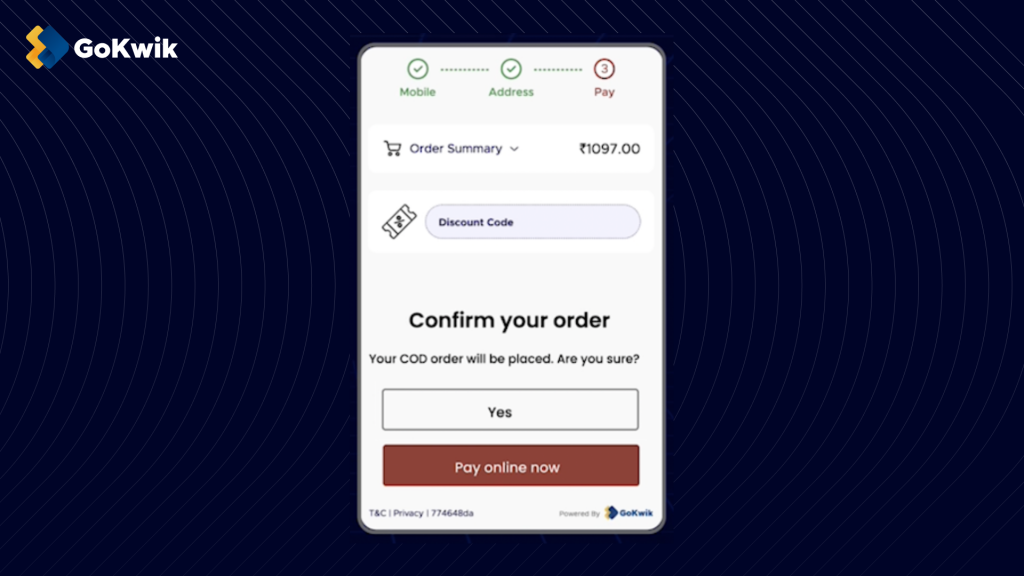
If customers start opting for online payment, half of the problems will get solved there and there. But, it’s hard to convince people to make advance payments. Therefore, eCommerce businesses should incorporate various schemes and tactics to promote digital payments.
To give you an example, offering discounts on digital payment methods can significantly help increase prepaid conversions. That’s because everyone loves discounts, and when it means availing more rebates at the time of payment, a shopper is bound to give it a thought. Meanwhile offering freebies on every prepaid purchase can further act as fuel to the fire.
To Conclude,
Cash on delivery as a method of payment has much to offer to both buyers and sellers. It allows shoppers to stay careful while enjoying the perks of India’s eCommerce industry. Meanwhile, it gives a means for D2C brands to cater a wider audience base and generate more revenue. However, amidst the advantages and disadvantages of cash on delivery, implementing the best practices can help safeguard the interest of both parties.


![WhatsApp Catalog: How To Sell Products on WhatsApp [A Complete Guide]](https://panel.gokwik.co/storage/app/public/images/use_kwikengage_for_a_seamless_whatsapp_catalog_setup__1772512572.jpg)