|
Discount Type |
Purpose |
Example |
|
Quantity-based offers |
Encourage bulk purchases |
Buy 3, Get 20% Off |
|
Prepaid discounts |
Reduce COD orders |
Extra 5% Off on Prepaid |
|
First-purchase incentives |
Convert new customers |
FIRST10 for 10% Off |
|
Cart value tiers |
Increase Average Order Value |
Spend ₹2000, Save ₹200 |
Your 2026 D2C Calendar mapped day by day - Powered by real data from India’s biggest D2C shopping network
Your 2026 D2C Calendar mapped day by day - Powered by real data from India’s biggest D2C shopping network
Your 2026 D2C Calendar mapped day by day - Powered by real data from India’s biggest D2C shopping network
Your 2026 D2C Calendar mapped day by day - Powered by real data from India’s biggest D2C shopping network
Ever watched a customer add items to their cart, click checkout, and then... nothing? They disappear. It happens more often than you'd think, and it's costing you serious revenue.
Key Takeaways:
What is the Checkout Process in eCommerce?
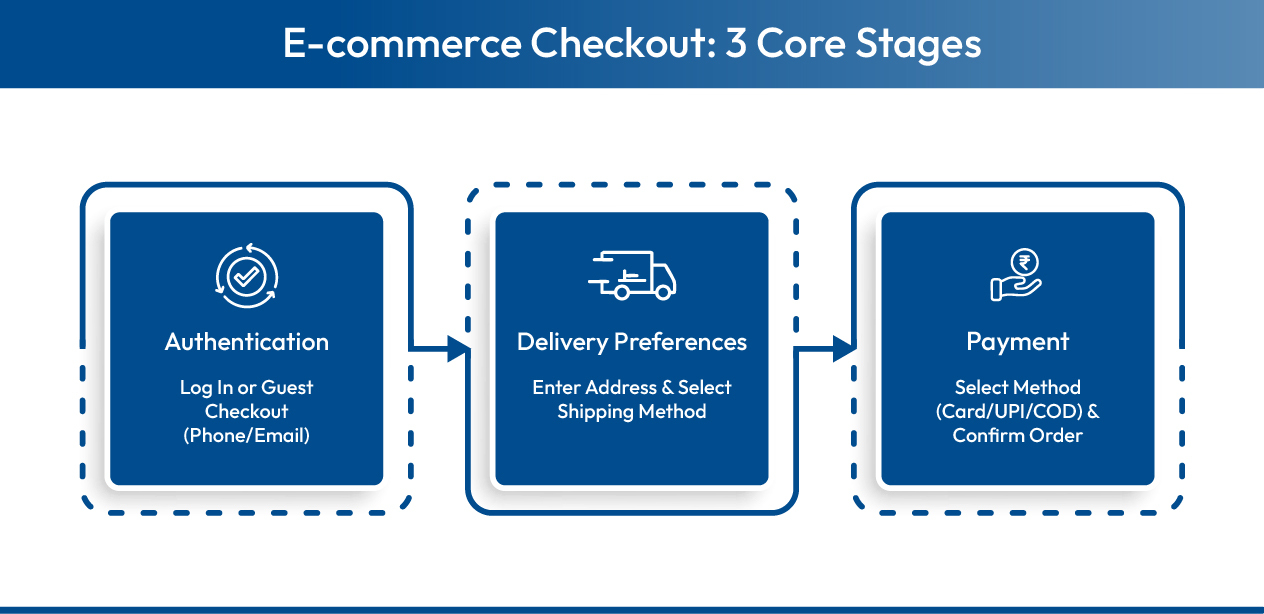
The checkout process is the series of steps a customer completes to finalize a purchase on an eCommerce website. It starts when someone clicks "checkout" from their cart and ends with order confirmation.A typical checkout involves three core stages: Customer Authentication: The shopper identifies themselves through phone number and OTP, email login, or guest checkout. This establishes who's making the purchase and where to send order updates. Delivery Details: Customers provide their shipping address, select delivery methods, and indicate any special instructions. This stage also calculates shipping costs and displays estimated delivery dates. Payment Processing: The shopper selects their preferred payment method (UPI, cards, wallets, COD, etc.), completes the transaction, and receives immediate order confirmation with tracking details. Each stage presents potential friction points where customers might abandon. The goal is making these steps as quick and intuitive as possible, especially on mobile devices where most Indian shoppers complete their purchases. Now that you understand the basic framework, let's dive into the specific strategies that transform average checkouts into conversion machines.
8 Essential Ways to Build a Seamless Checkout Process
How to ensure a clean checkout design:
Here's how to ensure your online store is mobile-friendly:
Benefits of auto-fill on the checkout page:
Implementation tips:
To avoid this, do the following:
Here's how to make the most of the order confirmation page:
Smart discount strategies:
Display "You Saved ₹X" messaging prominently to reinforce value.
What to enable:
Common Checkout Process Mistakes That Kill Conversions
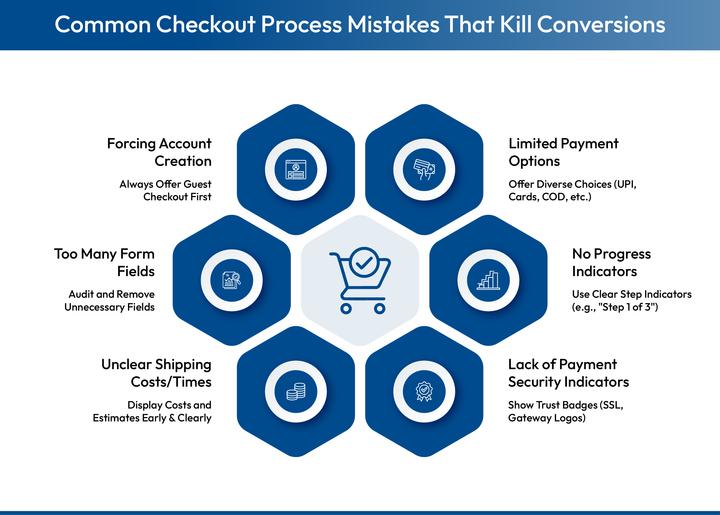
Even with the best intentions, many eCommerce brands unknowingly sabotage their own checkout processes. These mistakes drive customers away right when they're ready to buy.Understanding what not to do is just as important as implementing best practices. 1. Forcing Account Creation Before Purchase Mandatory registration creates friction exactly when you want minimal barriers. Customers must fill extra forms, create passwords, and verify emails when they just want to complete their purchase.The fix: Always offer guest checkout as the default. Encourage optional registration after purchase when customers are satisfied and more receptive. 2. Too Many Form Fields and Information Requests Every additional field increases cognitive load and completion time. Common culprits include redundant billing addresses, non-essential company names for B2C purchases, and marketing preferences that interrupt the eCommerce checkout flow.The fix: Audit every field. Remove anything not absolutely necessary to complete the order. Use smart defaults and only show additional fields when relevant. For Indian eCommerce, pin code alone can determine city and state. 3. Unclear Shipping Costs and Delivery Times Discovering shipping costs late in checkout or not knowing when orders will arrive creates uncertainty that prevents completion.The fix: Display shipping costs on product pages. Show estimated delivery dates during checkout. Use pin code detection for accurate estimates. If offering free shipping thresholds, display progress toward qualifying. 4. Lack of Payment Security Indicators Without visible trust signals, many shoppers abandon rather than risk fraud, especially first-time customers or those unfamiliar with online transactions.The fix: Display SSL certificates, payment gateway logos from recognized providers, and security certifications prominently. Use HTTPS throughout checkout. Show money-back guarantees for high-value orders. 5. No Progress Indicators on Multi-Step Checkout When customers don't know how many steps remain, uncertainty creates anxiety that triggers abandonment.The fix: Use clear step indicators like "Step 2 of 3." Label each stage clearly. Highlight the current step and show completed ones. Keep total steps to 3 or fewer. 6. Limited Payment Options Indian consumers have diverse payment preferences varying by region, age group, and purchase category. Limiting options excludes potential customers.The fix: Offer comprehensive options including UPI, cards, wallets, netbanking, BNPL, and COD. Display them clearly. Use smart payment routing that automatically switches to the best-performing gateway in real-time for 95% or higher success rates.Now that you know what to implement and what to avoid, let's look at how leading brands are achieving exceptional checkout performance.
How Kwik Checkout Builds the Perfect Ecommerce Checkout Process
Key features:
- Network-powered address auto-fill: 85% pre-fill rate using verified first-party data from 120M+ shoppers
- Smart payment routing: 95% payment success rates through dynamic gateway switching
- One-click authentication: 35% auto-login rate via SSO for returning network shoppers
- Advanced discount engine: 250+ configurations including prepaid incentives, quantity-based offers, and loyalty program integrations (Twid, SuperCoins, OneCard)
- Comprehensive payment support: UPI, cards, wallets, netbanking, BNPL, and COD with personalized recommendations



![WhatsApp Catalog: How To Sell Products on WhatsApp [A Complete Guide]](https://panel.gokwik.co/storage/app/public/images/use_kwikengage_for_a_seamless_whatsapp_catalog_setup__1772512572.jpg)