|
Feature |
WhatsApp (Personal) |
WhatsApp Business (App) |
WhatsApp Business API (Kwik Engage) |
|
Best For |
Personal use |
Small businesses & shops |
Scaling D2C & Enterprises |
|
Business Profile |
No (Basic info only) |
Yes (Address, Web, Email) |
Yes (Official Verified Profile) |
|
Product Catalog |
No |
Yes (Digital storefront) |
Unlimited (via Integration) |
|
Automated Messaging |
No |
Basic (Away/Greeting) |
Advanced (AI & Chatbots) |
|
Broadcast Limit |
256 (Saved contacts) |
256 (Saved contacts) |
Unlimited (Opted-in users) |
|
Multi-user Access |
Single user + Web |
Up to 4 linked devices |
Unlimited Support Agents |
Your 2026 D2C Calendar mapped day by day - Powered by real data from India’s biggest D2C shopping network
Your 2026 D2C Calendar mapped day by day - Powered by real data from India’s biggest D2C shopping network
Your 2026 D2C Calendar mapped day by day - Powered by real data from India’s biggest D2C shopping network
Your 2026 D2C Calendar mapped day by day - Powered by real data from India’s biggest D2C shopping network
WhatsApp has evolved from a simple messaging app into a critical business tool. However, many entrepreneurs and brand owners still find themselves at a crossroads: should they continue using a personal account or migrate to a professional Business profile?
Choosing the right platform version is essential for any brand looking to scale its operations and customer engagement. While both offer the same core messaging capabilities, the Business version is engineered specifically to manage customer relationships, automate workflows and drive sales.
This article provides an in-depth comparison of both platforms, highlighting the specific benefits of WhatsApp Business vs WhatsApp, and key decision making factors that help you determine which solution is best suited for your current business stage.
WhatsApp Business vs WhatsApp at a Glance
When you first compare WhatsApp vs WhatsApp Business, they look identical on the surface. Both allow you to send texts, photos, and voice notes. However, the engine under the hood is entirely different. The personal app is built for connection, while the business app is built for conversion.
Here is a quick analysis of the core difference between the two:
Key Operational Differences Between WhatsApp Business vs WhatsApp
To see how things really work, let’s look at how your daily tasks change in both cases. Here’s a closer look at the difference between WhatsApp and WhatsApp Business functional features that set them apart.
With a personal account, you are just a phone number and a status update. A WhatsApp Business account allows you to list your physical store address, website URL, product catalogs, business hours and more. This professional look is the first thing customers notice. When users click on your profile and see a legitimate business, their trust in your brand increases instantly.
A big benefit of WhatsApp Business vs WhatsApp accounts is the Product Catalog feature. The Business version allows you to create a catalog where you can upload product images, prices and descriptions for up to 500 products.
Instead of sending 20 separate photos to a customer who asks, ‘What do you have in stock?’, you simply share a link to your catalog and they can see all your products without downloading anything.
One of the most practical upgrades is the ability to automate basic interactions. Personal WhatsApp requires a manual response for every single ping. The Business App allows you to set up Greeting Messages for first-time contacts, Away Messages for when you’re off the clock, and Quick Replies, which are essentially keyboard shortcuts for your most frequently asked questions.
While both versions offer broadcasting, the Business App is designed to help you manage these lists for marketing. You can send a single message to up to 256 recipients at once, provided they have saved your number. It’s a simple way to push updates or offers without creating a cluttered group chat where everyone sees each other's details.
Learn all about creating broadcast lists that convert more, refer to this deep dive on how to create WhatsApp broadcast lists for marketing.
If you use personal WhatsApp for sales, your chat list is likely a mess of friends, family and customers. WhatsApp Business lets you organize your chats with Labels. You can tag conversations as ‘New Order,’ ‘Payment Pending’ or ‘VIP,’ ensuring no lead ever falls through the cracks. This organizational layer is a crucial difference between WhatsApp and WhatsApp Business.
You can’t improve what you can’t measure. Personal accounts offer zero data, leaving you to guess how your messages are performing. The Business App is a step up, providing a native dashboard to track your reach and engagement. You can monitor exactly how many messages were sent and successfully delivered, as well as how many were actually read by your customers.
Beyond chats, the app also tracks Catalog Interactions (clicks and views on your products) and Profile Views. While these metrics help you understand customer interest, they don't tell the whole story. For a brand that wants to scale, the next logical step is using a WhatsApp Business API like Kwik Engage to connect these interactions directly to revenue and orders.
Another difference between WhatsApp business vs WhatsApp is the access WhatsApp Business web. Learn all about this in our guide on WhatsApp Business web
Why eCommerce Brands Should Avoid Using Personal WhatsApp?
Sticking to your personal number might seem easier at first, but it poses significant risks as your brand grows.
Mixing personal and professional communications creates several operational hurdles:
For a deep dive into how Shopify stores can use advanced WhatsApp automation for higher sales, read our guide on WhatsApp automation for Shopify sellers.
Scaling From the Business App to WhatsApp Business API
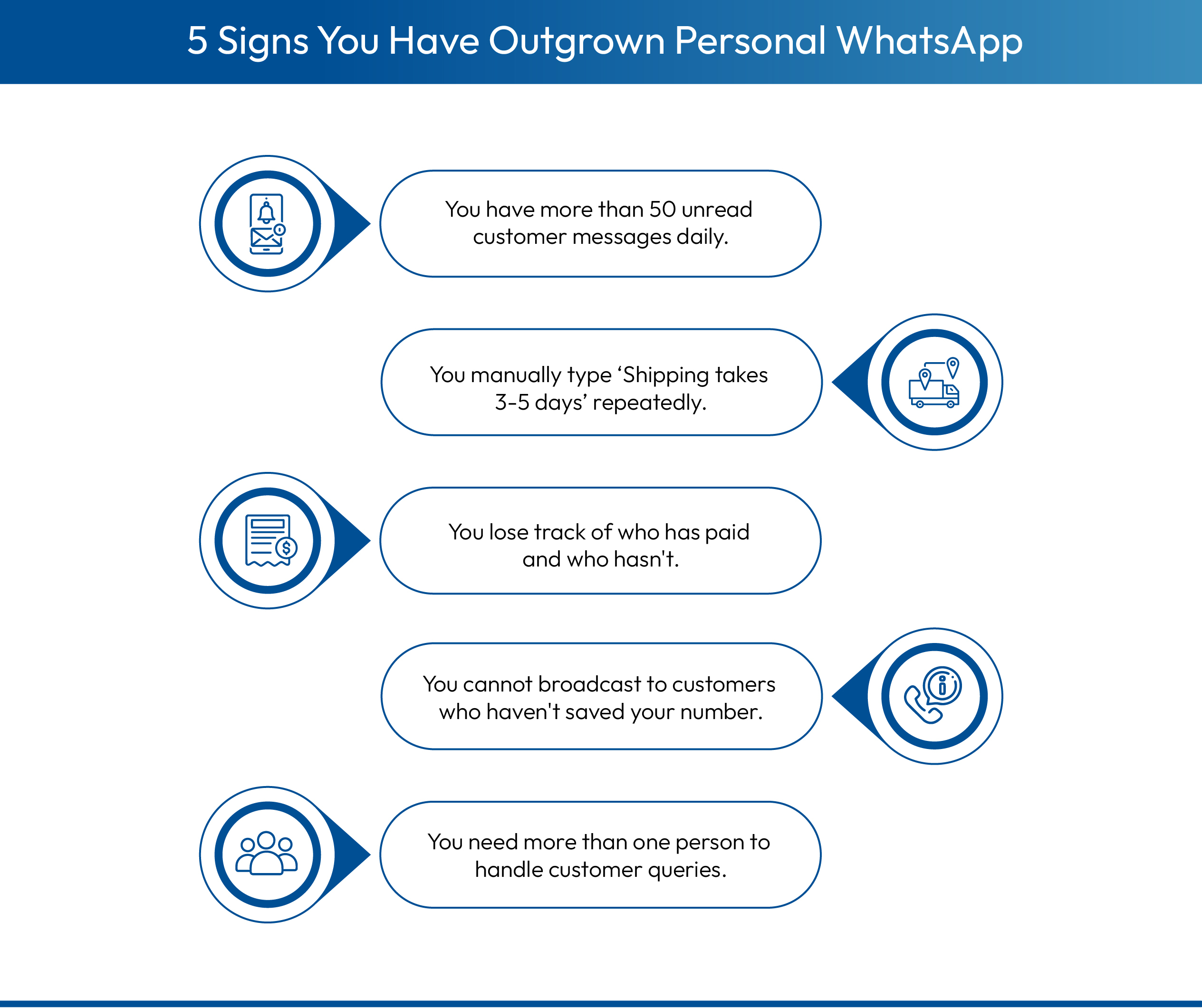
Most brands start with the free WhatsApp Business App, but once you scale, the app becomes a bottleneck. You should consider moving to the WhatsApp Business API via platforms like Kwik Engage when:
This transition marks the realization of how WhatsApp Business is different at an enterprise level. It stops being a chat app and starts being a revenue channel.
For a step-by-step breakdown of how to get WhatsApp blue tick, check out this GoKwik blog on WhatsApp blue tick verification.
- You need multi-agent support: You have a team of 5+ support agents who need to access one inbox simultaneously.
- You want the ‘Blue Tick’: You want to establish absolute brand authority with the Official Business Account status.
- You want to automate revenue: You want to send bulk broadcasts to thousands of opted-in users without the 256-contact limit of the standard app.
The Strategic Advantage: Integrating GoKwik Apps with WhatsApp
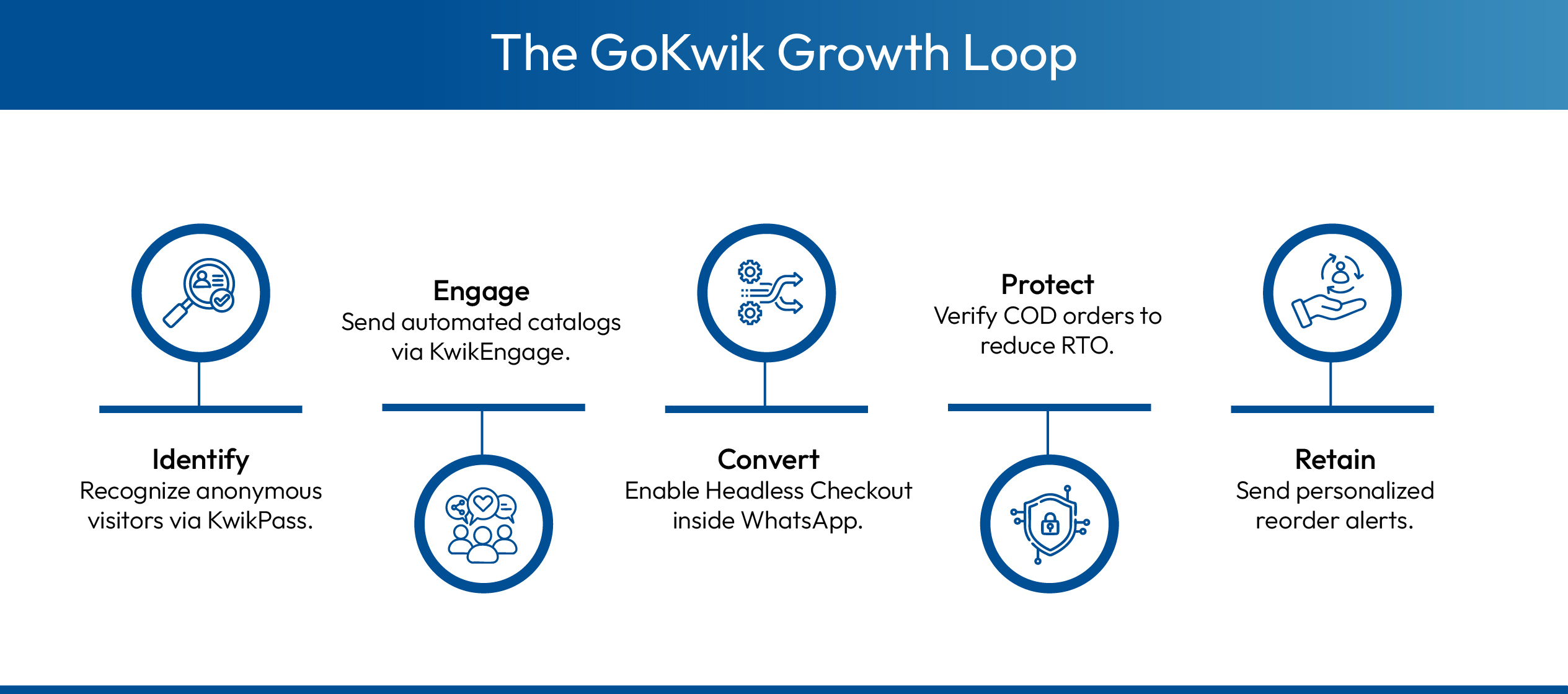
For growing D2C brands, the difference between WhatsApp and WhatsApp Business is about revenue. While the Business App is an improvement, it still requires manual effort. This is where Kwik Engage transforms WhatsApp into a high-performance sales engine using the official WhatsApp business API.
While the WhatsApp Business App offers simple ‘Away’ messages, Gokwik’s WhatsApp automation platform Kwik Engage provides deep eCommerce integration.
The average e-commerce store loses a significant portion of revenue to abandoned carts. Kwik Engage integration with Shopify stores trigger automated abandoned cart recovery workflows that go far beyond what a WhatsApp Business App can do.
Cash on Delivery (COD) often leads to high Return-to-Origin (RTO) rates. GoKwik uses WhatsApp as a verification layer to ensure orders are genuine before they ship.
Final Notes: Is WhatsApp Business Better than WhatsApp?
When you analyze WhatsApp vs WhatsApp Business, the answer is a definitive yes. If you are selling products, WhatsApp Business is the minimum requirement for professional operation. However, for D2C brands that are ready to scale, the leap from the Business App to Kwik Engage is what separates a ‘chatting’ business from a ‘converting’ brand.
The difference between WhatsApp and WhatsApp Business becomes negligible compared to the difference between ‘Manual Business App’ and ‘API-based Automations.’ By integrating Kwik Engage, you aren’t just messaging customers; you are building a frictionless shopping experience that recovers lost sales and protects your bottom line.
Ready to transform your WhatsApp channel into a revenue engine?
Discover how Kwik Engage can automate your customer journey from browse to buy. Book a demo today!



![WhatsApp Catalog: How To Sell Products on WhatsApp [A Complete Guide]](https://panel.gokwik.co/storage/app/public/images/use_kwikengage_for_a_seamless_whatsapp_catalog_setup__1772512572.jpg)